
Konro and hibachi grills: what they are, which size to buy, and how to run one

1Konro, hibachi or shichirin: what's the difference?
In Japan, a hibachi is a heating brazier; the grill most people mean when they say hibachi is a konro. Shichirin is the small round charcoal grill, and konro is the long rectangular grill the skewers rest across. In Australian shops the words get used for the same thing, and our own shelves mix both. What matters when you buy is the shape and the material, not the word: every grill under any of these names on our site is a diatomite charcoal box that runs charcoal close under the food.
2Why a diatomaceous earth konro, and is it better than metal?
The material is the whole point. The grills are made by Kinka with diatomaceous earth from Japan's Noto Peninsula. That earth is fossilised plankton from an ancient seabed, now mined from the Noto Peninsula. Diatomaceous earth is porous and a great insulator, so the heat stays in the firebox. Charcoal cooks mostly by radiant heat: about 70 to 75 percent in Japanese lab studies. The insulating walls keep that heat working over the food instead of escaping, which is why a small charcoal bed stays useful for a long time.
Is it better than metal? On insulation, yes, and we can say more than the makers do, because we tested it: even with charcoal lit, the outside doesn't get that hot. I've tested it. That is the Kinka body on its legs. What we will not claim is that diatomaceous earth uses less charcoal or cooks more evenly or juicier than metal, because no controlled trial shows it. The honest trade-off: it hates water, and it can crack if you drop it.
Two shapes matter when you choose. The narrow grills (230 mm deep) are the yakitori shape: skewers rest across the walls with the handles off the fire. The wide grills (350 mm deep) give you a proper cooking area for fish, vegetables and steak.
3Which size konro do I need for how many people?
Our advice, and we give it to everyone on the floor: go small. Most of the time you are eating with other things, so you don't need a huge amount of skewers per batch, and a small grill used fully holds its heat much better than a big one half empty. For the odd crowd, two small ones beat one big one.
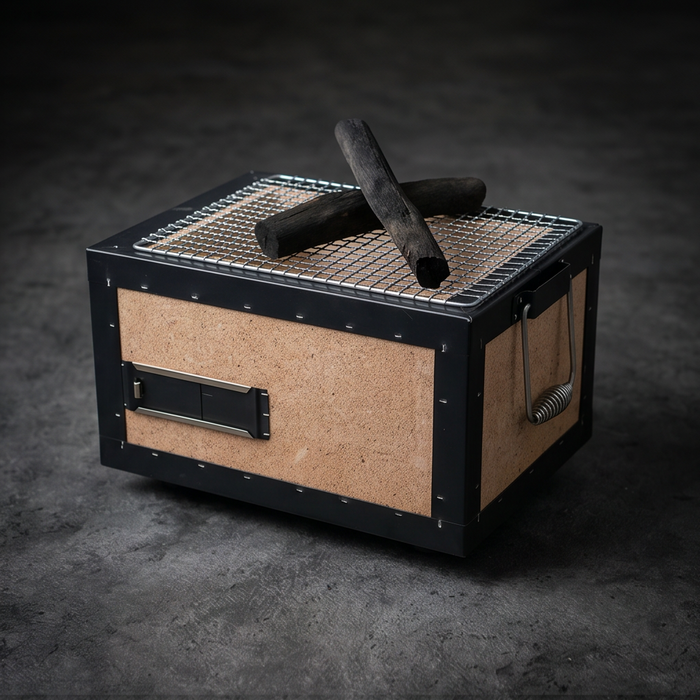
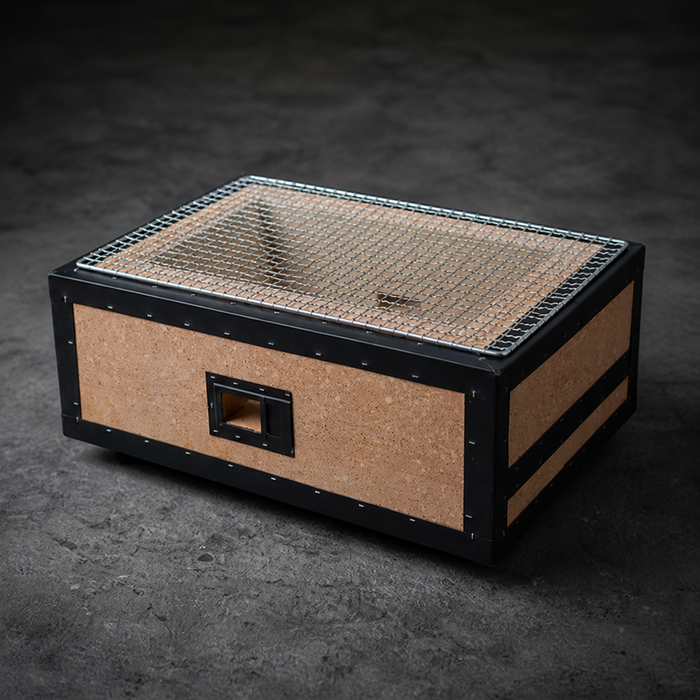
Our guide on people per size:
| Size | External dimensions | Grill weight | People | Price |
|---|---|---|---|---|
| Small | 310 x 230 x 200 mm | 6.5 kg | 2 to 4 | $334.00 |
| Medium | 540 x 230 x 200 mm | 11 kg | 4 to 8 | $486.00 |
| Medium Wide | 470 x 350 x 200 mm | 14 kg | 4 to 8 | $561.00 |
| Large | 770 x 230 x 200 mm | 15 kg | 6 to 12 | $668.00 |
| Large Wide | 690 x 350 x 200 mm | 20 kg | 6 to 12 | $687.00 |
| Extra Large Wide | 930 x 350 x 200 mm | 25 kg | 8 to 14 | $906.00 |
We also stock round tabletop shichirin grills: a small one for 1 to 2 people and a medium one for 2 to 4.
If you are buying your first one and cook for a family of four, the Small handles skewers for a weeknight, and it is the size we would point most people at.
Starter sets bundle a grill with binchotan and a steel chimney: the Small set atCurrently out of stockand the Medium set atCurrently out of stock.
Every size is 200 mm tall, so they all sit at the same working height on a table. The weights are the maker's catalogue figures for the grill itself; packed for shipping each one is a kilogram or two heavier.
4What comes with the grill, and which replacement net fits which size?
The net is a consumable and it is sized to the grill, so buy it by size code rather than by eye. The reusable steel mesh:

| Grill | Net variant | Price |
|---|---|---|
| Small | for Small Hibachi BQ8F | $17.95 |
| Medium | for Medium Hibachi BQ8WF | $29.95 |
| Medium Wide | for Medium Wide Hibachi BQ12 | $34.95 |
| Large | for Long Hibachi BQ8T, 2 pieces | $39.95 |
| Large Wide | for Large Wide Hibachi BQ17 | $79.95 |
| Extra Large Wide | not stocked; an 800 x 300 mm replacement net exists for the BQ22 in Japan | ask us |
The Large takes two pieces because the grill is 770 mm long and the mesh is not. The reusable mesh is steel: wash it with detergent and dry it, or it will rust.
Net sizes for the two wide grills: the Medium Wide net is 450 x 300 mm and the Large Wide net is 620 x 300 mm (Kinka part CP-34). The Extra Large Wide takes an 800 x 300 mm net (810 x 310 mm measured), made by Nagata Kanaami for the BQ22.
The grill is sold as the body; the net for your size is in the table above. No trivet or charcoal tray is included with any size.
5What charcoal do I use, and how much?
You don't need to burn only binchotan. Use ordinary charcoal as the fuel and add a thin layer of binchotan on top; that's enough for yakitori. Keep the bed shallow: more than a single layer gives you excessive heat and flame, which is the opposite of what this grill is for. Binchotan is expensive, our wholesale price has risen sharply in the last few years, and Japan makes very little of it, with supply getting tighter. It burns longer and hotter, and in our experience that gives yakitori a better finish. Binchotan is dense white charcoal: slow to light and long burning. In one Japanese test it ran about five hours, though that is not a guarantee for every grill or every lighting. It burns clean, but dripping fat still makes smoke. Don't waste it: put the leftover pieces out in the extinguisher, and they light again next time.

How to light it. Give yourself time: start the charcoal well before you plan to cook. Use a chimney starter: its upward airflow lights the charcoal evenly. Fill it about halfway to start, and add more once the first lot is lit. Smaller pieces catch faster; some cooks start with easier-lighting charcoal and add binchotan on top. Binchotan is dense and slow to catch. Heat it gently; rushing it makes it pop and spark, so keep your face back. Keep your charcoal dry, because damp charcoal pops and spits. It's ready when about a third to half of the charcoal is glowing red. Then tip it into the konro.
How to put it out. When you're done, put the coals in a charcoal extinguisher and close the lid: no air, no water. The leftovers can light your next fire.
6How do I look after it, and what counts as normal wear?
Never pour water on it. Diatomaceous earth absorbs water and becomes brittle, and a sudden change in temperature cracks the body. This is the one rule that ruins grills. To put the fire out, lift the coals into a charcoal extinguishing pot or let them burn down, then let the grill go cold on its own.
Cleaning is dry work. Once it is completely cold, gently remove the ash and food residue, and avoid washing the grill with water.
Don't drop it. Diatomaceous earth can crack. Cracks are not all the same thing: fine cracks in the trivet are normal with regular use, and the trivet is a consumable that gets replaced every one to two years. Fine cracks in the grill body are normal too: most diatomite konro crack in their first few fires, and the metal band holds the body together, so keep cooking. Stop using it if it wobbles, a piece comes loose, or a crack is wide enough for charcoal or ash to get out. Store it dry and indoors between cooks, because damp is what turns a hairline into a break.
The warranty covers replacement of a product that arrives defective. It does not cover mishandling, and water is the usual mishandling.
7Can I use a konro indoors or on a balcony?
We recommend using a konro outdoors. Burning charcoal gives off carbon monoxide, which you can't see or smell. Restaurants cook on these grills under commercial extraction hoods built for it. Never use one in a closed room.
Set it on a stable, heat safe surface, and put a heat resistant mat under it to protect the surface beneath.
On a Total Fire Ban day in NSW, charcoal barbecues can't be used outdoors. Check the NSW RFS total fire ban rules (https://www.rfs.nsw.gov.au/plan-and-prepare/total-fire-ban-rules) before you light up on a hot summer day. Rules differ by state, so check your own state's fire authority before cooking with charcoal.
Balconies in Australia are a strata question before they are a safety question. Charcoal barbecues are commonly banned outright on apartment balconies by strata by-laws, and published schemes exist whose by-laws state residents must not use a barbecue fired by charcoal, briquettes or wood on a balcony. Smoke drifting into a neighbour's flat can also be treated as a nuisance. Read your own scheme's by-laws and your lease before you buy, because the answer is set by the building, not by the grill.
8The konro you'll see on MasterChef Australia
The Okunoto grills we stock are the same Kinka konro you'll see on MasterChef Australia. A hibachi grill has been a MasterChef Australia regular since 2010, and it is the format the contestants cook skewers and whole fish on.
9Where can I buy one in Australia, and can I pick it up?
We have physical stores in Sydney, Melbourne and Canberra, so you can see the size in person before committing to 6.5 to 25 kg of grill, and collect rather than ship if that suits you better. If you would rather have it delivered, email us for a postage quote with the size and your postcode; these are heavy items and the quote depends on both.
Every size ships within Australia. Konro are heavy items, so they are not available for international delivery.
10Questions people ask
What is the difference between a konro and a hibachi grill?
In Japan a hibachi is a heating brazier; the grill most people mean is a konro. In Australian shops the words point at the same thing: a small charcoal box, usually of diatomaceous earth, cooking close under the food. Buy on shape and size, not on the name.
Is a diatomaceous earth konro better than a metal charcoal grill?
Diatomaceous earth insulates and metal conducts, so the heat stays in the firebox and over the food. Even with charcoal lit, the outside of the Kinka body doesn't get that hot; we have tested it. The trade-off: it hates water, and it can crack if dropped. No controlled trial shows a diatomaceous earth konro uses less charcoal or cooks more evenly than metal.
Can I use a konro grill indoors?
We recommend using a konro outdoors. Burning charcoal gives off carbon monoxide, which you can't see or smell. Restaurants cook on these grills under commercial extraction hoods built for it. Never use one in a closed room. Set it on a stable, heat safe surface.
Can I use a konro grill on a Total Fire Ban day?
No. In NSW a charcoal barbecue cannot be used outdoors on a Total Fire Ban day (NSW RFS). Rules differ by state, so check your own state's fire authority.
What charcoal goes in a konro grill, and how long does it burn?
Ordinary charcoal as the fuel, with a thin layer of binchotan on top, and keep the bed to a single layer. Binchotan is dense white charcoal, slow to light and long burning: in one Japanese test it ran about five hours. Light it in a chimney and it is ready when the pieces glow red under white ash.
Can I wash a konro grill?
No. Diatomaceous earth absorbs water and goes brittle, and a sudden temperature change cracks the body. Let it go cold, then gently brush out the ash. The steel net is washable: wash it with detergent and dry it to stop it rusting.
What size konro do I need for four people?
Our guide rates the Small (310 x 230 mm,$334.00) for 2 to 4 people, and that is the size we recommend for most people: a small grill used fully holds its heat much better than a big one half empty. If four is your regular number, the Medium (540 x 230 mm,$486.00) suits 4 to 8.
My konro has a crack. Is it still usable?
Usually, yes. A cracked trivet is normal wear and gets replaced every one to two years, and fine cracks in the body are normal too. Stop if it wobbles, a piece comes loose, or a crack could let charcoal or ash out. Cracks can't be glued.