Drag to spin · pinch or scroll to zoom

Sukenari  |  SKU: SKNR-BLUE2-DE210

Sukenari Blue 2 Deba 210mm, Ebony Spacer Handle

Sale price $611.00 Regular price $719.00

IMPORTANT: Carbon steel knives can rust or patina quickly if not cared for properly. They require regular cleaning, drying, and oiling. If you are unfamiliar with carbon steel maintenance, we recommend choosing a stainless steel option instead.

Availability

Goes well with

Detailed Specifications
Line Sukenari Blue Steel Single Bevel Migaki
Profile Deba / Japanese fish knife
Bevel Type Single Bevel
Weight 467 g | 16.5 oz
Edge Length 220 mm | 8 21/32″
Heel Height 59 mm | 2 21/64″
Width @ Heel 7.9 mm | 5/16″
Width @ Mid 6.6 mm | 17/64″
Width @ 1cm from Tip 2.8 mm | 7/64″
Steel Blue 2 / Aogami #2 | Carbon
Blade Construction Nimai - Soft Iron Clad
Maker's hardening hardness 60 HRC or more
Surface Finish Migaki
Handle
Region Toyama
Best for
  • Pro chefs
  • Enthusiasts

World-wide shipping via DHL Express, 3 to 6 days (not available in the UK).


Traditional Single-Bevel Performance with Lasting Edge Retention

Forged in Toyama, Japan, the Sukenari Blue Steel Single Bevel Migaki series combines traditional Japanese blade geometry with the dependable performance of Blue Steel carbon steel.

Blue Steel is highly regarded for its excellent balance of sharpness, edge retention and sharpening response. Its alloyed carbon steel composition allows it to take a very keen edge while maintaining that sharpness through extended use, making it particularly well suited to professional kitchens and experienced users who value consistent cutting performance.

The traditional single-bevel geometry provides precise control, clean slicing and highly accurate cuts, making the series ideal for sashimi, fish preparation and other detailed Japanese kitchen work. A smooth Migaki polished finish gives the blade a clean, understated appearance that complements its professional character.

Backed by Sukenari’s established craftsmanship, this line offers a refined balance of sharpness, durability and traditional Japanese performance.


Pros Cons
  • Excellent performance
  • Great for professionals
  • Need extra care
  • A little bit brittle
Care Instruction
  1. Don't cut hard things! Japanese knives are brittle so bone hacking is a NO NO!
  2. Wash with neutral detergent after use, and wipe dry;
  3. Please don't wash knife with dishwasher, it will damage the wood handle;
  4. Be careful not to leave the knife close to a heat source for a long time;
  5. It is a lot more dangerous to cut with a blunt knife than a sharp knife!
  6. It is best to sharpen a Japanese knife regularly on a waterstone.
  7. Oil the (carbon) knife if storing for an extended period of time to prevent rust.

Sukenari

Sukenari, professional kitchen knives from Toyama

Sukenari Co. makes, sells and repairs professional kitchen knives in Fuchu-machi, Toyama City, under the registered mark 佑成. The company was founded in 1933.

The company's own greeting page explains the mark: its first character is written with the person radical and 右, meaning right, and carries the wish that these knives can become the cook's indispensable right arm.

Read more

A 2016 profile by TONIO, Toyama's industry support body, says the founder trained at an old-established Tokyo knife maker and opened the shop in his home region in November 1945, after a wartime evacuation there. Knife regions split forging, sharpening and handle fitting between specialists; that profile says Sukenari makes its knives start to finish under one roof, as that Tokyo house did. Its own site says craftsmen still make every stage by hand, one knife at a time.

The same profile credits Sukenari with honyaki in White 1, a very hard steel that is hard to work and that, it says, only a handful of makers in Japan can handle. It also describes know-how built for ZDP189, harder than White 1, and TONIO-backed forging trials, with metallurgy and measured heat treatment, that led to its ZDP189 wa-gyuto. The profile also tells of OEM work for other professional knife makers and wholesalers since the 2008 downturn. We first visited in April 2016, when Nobuo Hanaki, then president, showed us the forging.

On our August 2026 visit, Sukenari told us the family were originally honyaki smiths for Masamoto, so in the early days they made only honyaki. New smiths there still learn honyaki first, as the foundation of the craft. As they put it, most workshops do it the other way round.

We list ZDP-189 hairline gyuto, K-tip gyuto and santoku; ZDP-247 hairline or Damascus gyuto, K-tip gyuto, santoku and sujihiki; SG2 hairline or Damascus gyuto, K-tip gyuto, gyu-hiki and santoku; HAP40 slim K-tip gyuto and mirror polished yanagiba; VG XEOS Damascus gyuto; VG10 Damascus yanagiba; YXR7 petty; Aogami Super hairline gyu-hiki; Blue 2 deba, K-tip yanagiba and Kanto usuba; White 2 K-tip kiritsuke and K-tip yanagiba. We also list an SG2 honyaki yanagiba, including a K-tip, an SG2 nimai (two-layer) sakimaru takobiki, and VG XEOS nimai yanagiba and kiritsuke yanagiba.

“A Toyama maker of professional kitchen knives since 1933.”

Est. 1933 | 昭和8年
Known for Knives made start to finish under one roof
Website sukenari.jp Instagram @sukenari_official Read more about Sukenari

Sukenari · Toyama

Knife details

Deba — knife profile
Profile

Deba

出刃

Japanese fish knife · Single or double bevel

A thick, heavy fish knife; dictionaries say it fillets and cuts fish and fowl bones.

Read more
Steel properties
  1. Hardness Very good
  2. Edge retention Very good
  3. Toughness Very good
  4. Rust resistance Low
  5. Ease of sharpening High
  6. Sharpness Very high
Our ratings, inferred from published lab tests and composition.

Our edge-retention grade is a kitchen rating. It weighs the hardness each steel is sold at, which keeps a thin edge from rolling, twice as heavily as lab wear tests, and the final grade is our judgment from selling and sharpening these knives for over a decade. Lab card-cutting tests measure abrasive wear only, so they can rank carbon steels lower. Tap ? for the lab figure.

Steel

Blue 2 / Aogami #2

青二鋼

Carbon · Hitachi Metals (now Proterial)

Proterial carbon steel, 1.05 to 1.15% carbon with chromium and tungsten; not stainless.

Read more
ShinogiCladdingClad lineHard steelHollow back
Construction

Nimai - Soft Iron Clad

二枚・軟鉄

2 layers · single bevel

Two layers, single bevel: hard steel on the back, soft iron elsewhere; it patinas.

Read more
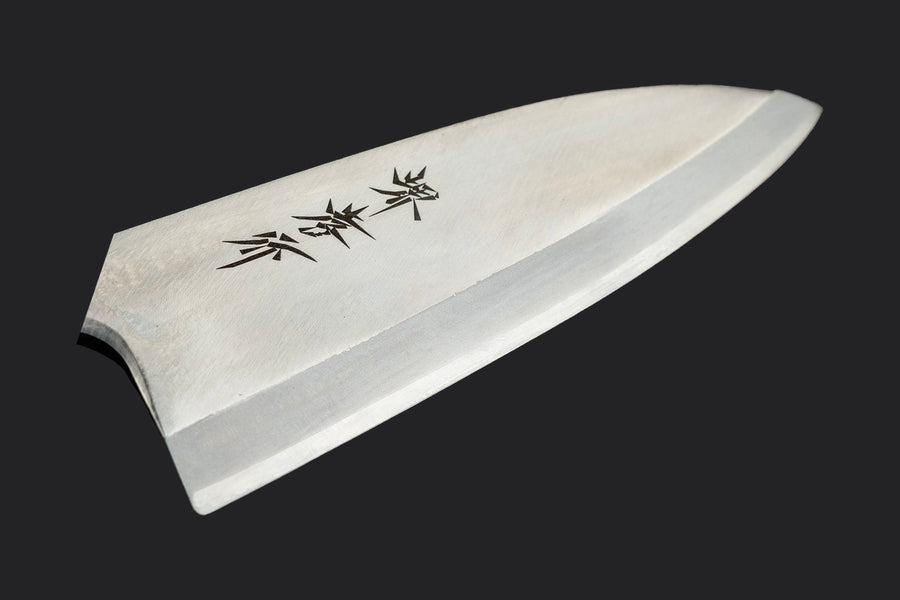
Migaki — blade surface finish
Finish

Migaki

磨き

Polished satin

Smooth polished surface, satin to soft sheen rather than mirror. Scratches show.

Read more

Frequently asked questions

Can a deba cut bone?

Yes, the bones of fish and fowl. Japanese dictionaries describe the deba (出刃包丁) as wide, thick-spined and heavy, used to fillet fish, to cut fish and fowl bone and all, and for rough chopping.

When you chop bone, use the heel of the blade (刃元), the Sakai cutlery association says. It is a fish and poultry knife, not a cleaver.

Can left-handed cooks use single bevel knives?

A standard single bevel knife is ground for right-handed use, and a left-handed one is made with the bevel reversed. Some makers offer left-handed versions.

Contact us and we will check what we can order or have in stock.

What is a mioroshi deba?

A mioroshi deba is a longer, slimmer version of the Japanese fish-butchering knife (deba), made for filleting. It keeps the deba's single bevel but is narrower, thinner at the spine and much lighter for its length.

A standard deba is thick and heavy, deep at the heel, and typically 150mm to 210mm long. Its weight and thick spine do the work when you take off a head or cut through a spine. The mioroshi deba gives up some of that weight for length: the ones we list are 210mm, 240mm and 270mm.

Our measurements show the difference. In Masamoto Sohonten's KS line, the 210mm mioroshi deba weighs 209g against 382g for the 210mm deba, and its spine above the heel is 4.8mm thick against 7.1mm.

Like the deba it is single bevel, so each knife is made for one hand. Most are right-handed, and we list left-handed ones too. Ours come from Sakai Takayuki, Masamoto Sohonten, Nakagawa and the Hatsukokoro Shirasagi line, in White 2 and Blue 1 carbon steel and in stainless.

Choose the standard deba if most of your work is heads and spines, because that work needs the weight. Choose the mioroshi deba when filleting is most of the job. Our deba guide explains the family, and both are listed with our deba and fish filleting knives.

Why is the back of a single-bevel knife hollow, and how do I sharpen it?

The shallow hollow in the back is called urasuki (裏スキ). Tojiro explains that it means the whole back never has to be ground when you sharpen, makes it easier to keep the back flat, and stops sharpening the back from affecting the edge. Only the thin flat rim around the hollow touches the stone.

Sharpen the front bevel first, laying it flat on the stone. Then lay the back completely flat and take a few light strokes, just enough to remove the burr. Never lift the spine to put an angle on the back, and keep the stone itself flat.

Which knife do I need for sushi and sashimi at home?

For occasional sushi at home, a sharp sujihiki (筋引) does the job. Tojiro describes it as a long, double-bevel slicer that can also be used for sashimi, and a double bevel works in either hand.

If sashimi is the point of the meal, choose a yanagiba (柳刃). Tojiro calls it the Kansai-style sashimi knife, now used across Japan, and it slices in one long pull from heel to tip. It is single bevel, so buy the one made for your hand.

If you start from whole fish, add a deba (出刃). Tojiro describes it as very thick and heavy, made for breaking fish down. The deba takes the fish apart and the slicer then cuts the fillets.

Will a carbon steel knife rust, and how do I look after it?

Yes, carbon steels such as Aogami (Blue) and Shirogami (White) are not stainless steels, so left wet they can spot or rust.

Care is simple once it becomes habit. Wipe the blade as you go, especially after acidic food like citrus, tomato or onion. When you finish, wash it in warm water with a little soap and dry it straight away with a towel. Do not let it air dry, leave it in the sink or the dish rack, or put it in the dishwasher. Store it dry: on a magnetic strip or in a ventilated block in a dry spot.

If the knife will sit unused for a while, wipe on a thin layer of oil before storing. In our video James shows that mineral oil can stand in for camellia (tsubaki) oil, and he picks one labelled medical grade; we list the Kitchen Knife / Cutting Board Mineral Oil Medical Grade for this. If you find light rust, lift it with a rust eraser and a little water, then dry and oil the blade; we list the CKK and Naniwa rust erasers.

What is the difference between Blue 2 and White 2 steel?

Blue 2 is White 2 with tungsten and a little chromium added. Blue 2 holds its edge longer. White 2 sharpens faster and takes a very keen edge. Both are carbon steels that will rust if left wet.

The figures come from Proterial, which makes both. Each has 1.05 to 1.15% carbon. Blue 2 (Aogami 2) adds 1.00 to 1.50% tungsten and 0.20 to 0.50% chromium. White 2 (Shirogami 2) lists neither, and Proterial describes it as a carbon steel with minimum impurities. Proterial says the tungsten and chromium improve heat treatment and wear resistance, and gives a hardening hardness over 60 HRC for both.

In use, the tungsten forms hard carbides that resist wear, so a Blue 2 edge lasts longer between sharpenings. White 2 has none, so it comes back on a whetstone very quickly. The chromium in Blue 2 is far below the 10.5% a steel needs to be stainless, so it gives no real rust protection. Wipe either steel dry after use and expect a patina.

Choose Blue 2 if you want to sharpen less often. Choose White 2 if you enjoy sharpening and want the keenest edge. We list both widely: Blue 2 from Nigara, Myojin Riki and Anryu, and White 2 from Masamoto Sohonten, Sakai Takayuki and Yoshikane.

Is it Sukenari or 佑成?

Sukenari's own site carries both names together, titled the official site of 株式会社スケナリ with 佑成 named as a registered trademark. 佑成 is the house mark that appears on the blades.

So one house answers to both names: Sukenari is the company, 株式会社スケナリ, working from Fuchu machi in Toyama City, and 佑成 is its mark on the steel.

You May Also Like