Tsunehisa  |  SKU: TNHS-GIN3-DB150

Tsunehisa Ginsan Deba 150mm

Sale price $287.00 Regular price $337.00

Pickup in Australia only

In Stock Now

Availability

Goes well with

Detailed Specifications
Line Tsunehisa Ginsan Nashiji
Profile Deba / Japanese fish knife
Bevel Type Single Bevel
Weight 250 g | 8.8 oz
Edge Length 152 mm | 5 63/64″
Heel Height 47 mm | 1 27/32″
Width @ Heel 7.3 mm | 9/32″
Width @ Mid 6.3 mm | 1/4″
Width @ 1cm from Tip 2.7 mm | 7/64″
Steel Ginsan / Silver #3 | Stainless
Blade Construction Sanmai - Stainless Clad
Maker's hardening hardness 59 HRC or more
Surface Finish Nashiji
Handle Ho Wood Octagonal
Region Fukuyama
Best for
  • First-timers
  • Students

World-wide shipping via DHL Express, 3 to 6 days (not available in the UK).


Tsunehisa Ginsan Nashiji is a series of products that have been quite popular in the entry level market, and the reason is simple, it offers pretty much everything you would want from a Japanese kitchen knife while being affordable and easy to look after, and some of the design features are very beneficial to entry level users who what get into the world of Japanese kitchen knives,

I think the look of these knives would catch the attention of many people in the first place, the very textured Nashiji finish meets the bevel in a wavy line, achieved by sandblasting the Migaki finished bevel over a mask. This is a bit more complicated design than for a budget knife, but it has that very organic look instead of the smooth and uniform finish, which creates that “forged look” that people associate with Japanese handmade knives. 

As for how it cuts, I have to admit this is not the smoothest cutting knife out there. It retains some thickness behind the edge and has a bit flat bevel, which adds some resistance to the cut. It may be a design decision made to increase the strength of the edge which can be a plus for entry level users that are afraid of chipping their knife as soon as they start using them. That being said, these knives would still easily outperform the typical European knives like Wusthof or Zwilling, they just wouldn’t stand out among their Japanese colleagues. 

The use of Ginsan steel would be the one biggest reason for me to recommend this to a beginner user who is also considering learning sharpening down the road. This is a very simple stainless steel that has only chromium addition to give it the stainlessness. As a result, it is very easy to sharpen among all common stainless steels, but the higher carbon content allows it to develop a quite clean ape very easily. Basically, it is an ideal beginner knife, low in maintenance and easy to sharpen, which works well with other features of this line.

I would highly recommend this line to people who are unsure about what to choose for themself to begin with when it comes to the first ever Japanese kitchen knives, and it can also be a good gifting option for people who are unsure of the receiver of the knife can handle the knife well.

Pros Cons
  • Workhorse grind
  • Ideal for the household
  • Easy to look after
  • Fit and finish can be improved
Care Instruction
  1. Don't cut hard things! Japanese knives are brittle so bone hacking is a NO NO!
  2. Wash with neutral detergent after use, and wipe dry;
  3. Please don't wash knife with dishwasher, it will damage the wood handle;
  4. Be careful not to leave the knife close to a heat source for a long time;
  5. It is a lot more dangerous to cut with a blunt knife than a sharp knife!
  6. It is best to sharpen a Japanese knife regularly on a waterstone.

Tsunehisa

Tsunehisa, the house brand of Shibata Knives

Tsunehisa (恒久) is the house brand of Shibata Knives, the knife company Takayuki Shibata owns and runs. It is a brand rather than a single workshop.

The name means permanence, and Shibata Knives says it chooses knives that will have a long life. Takayuki Shibata started Tsunehisa in 2015 as his third knife brand, to help manage growing orders.

Read more

Shibata Knives describes Tsunehisa as a brand that inherits traditional Japanese forging techniques while taking in the latest materials and technologies, aiming at function and design for long use. It says its experienced staff inspect each knife under strict quality control, and it offers after-sales maintenance and sharpening.

The lines we list are grouped by steel. Ginsan comes in migaki, nashiji and nawame finishes, as gyuto, santoku, nakiri and petty, with a deba in the same steel. White 1 comes stainless clad as migaki and tsuchime gyuto, Aogami Super as kurouchi tsuchime sujihiki and petty, and Blue 2 as the Samurai sakimaru sujihiki.

The Damascus lines are in VG10, AUS10 and ZA18, the AUS10 also with a tsuchime finish. The rest are AUS8 tsuchime, a VG1 gyuto and an SLD Washiji santoku. Handles come in wa and yo styles.

“The house brand of Shibata Knives; the name means permanence.”

Est. 2015 | 平成27年
Known for Knives chosen and inspected by Shibata Knives
Instagram @tsunehisa Read more about Tsunehisa

Tsunehisa · Fukuyama

Knife details

Deba — knife profile
Profile

Deba

出刃

Japanese fish knife · Single or double bevel

A thick, heavy fish knife; dictionaries say it fillets and cuts fish and fowl bones.

Read more
Steel properties
  1. Hardness Good
  2. Edge retention Good
  3. Toughness Very high
  4. Rust resistance High
  5. Ease of sharpening High
  6. Sharpness High
Our ratings, inferred from published lab tests and composition.

Our edge-retention grade is a kitchen rating. It weighs the hardness each steel is sold at, which keeps a thin edge from rolling, twice as heavily as lab wear tests, and the final grade is our judgment from selling and sharpening these knives for over a decade. Lab card-cutting tests measure abrasive wear only, so they can rank carbon steels lower. Tap ? for the lab figure.

Steel

Ginsan / Silver #3

GIN3

Stainless · Hitachi Metals (now Proterial)

Proterial's GIN 3 stainless: 0.95 to 1.10% carbon, 13.00 to 14.50% chromium, hardening hardness over 59 HRC.

Read more
CladdingCoreClad line
Construction

Sanmai - Stainless Clad

三枚

3 layers · stainless clad

Hard core between two stainless layers, bare only at the edge; the cladding resists rust.

Read more
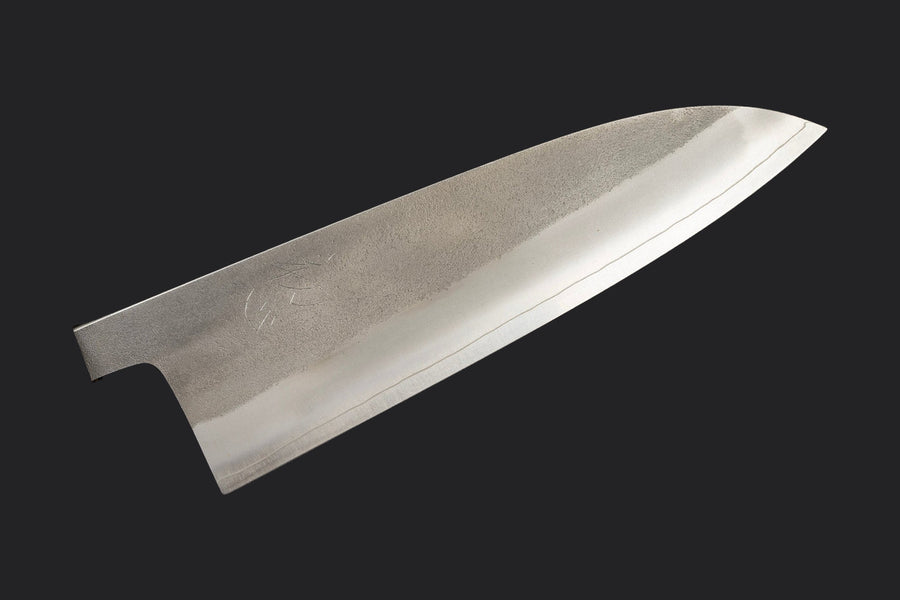
Nashiji — blade surface finish
Finish

Nashiji

梨地

Pear-skin texture

A fine matte texture like the skin of a nashi pear. It may help food release.

Read more
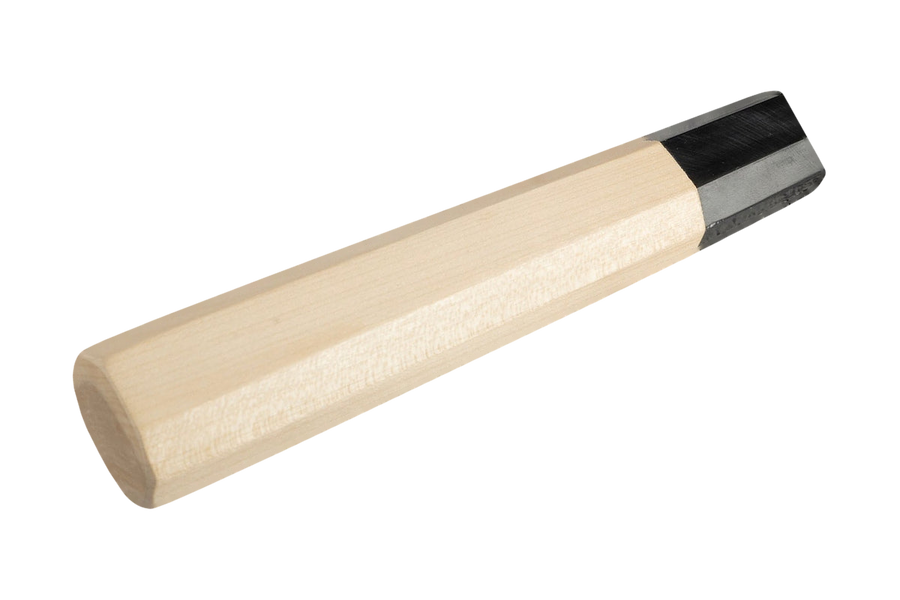
Ho Wood Octagonal handle
Handle

Ho Wood Octagonal

Octagonal WA

Light, pale ho wood (Japanese magnolia), eight-sided, with a synthetic horn ferrule.

Frequently asked questions

Can a deba cut bone?

Yes, the bones of fish and fowl. Japanese dictionaries describe the deba (出刃包丁) as wide, thick-spined and heavy, used to fillet fish, to cut fish and fowl bone and all, and for rough chopping.

When you chop bone, use the heel of the blade (刃元), the Sakai cutlery association says. It is a fish and poultry knife, not a cleaver.

Can left-handed cooks use single bevel knives?

A standard single bevel knife is ground for right-handed use, and a left-handed one is made with the bevel reversed. Some makers offer left-handed versions.

Contact us and we will check what we can order or have in stock.

What is a mioroshi deba?

A mioroshi deba is a longer, slimmer version of the Japanese fish-butchering knife (deba), made for filleting. It keeps the deba's single bevel but is narrower, thinner at the spine and much lighter for its length.

A standard deba is thick and heavy, deep at the heel, and typically 150mm to 210mm long. Its weight and thick spine do the work when you take off a head or cut through a spine. The mioroshi deba gives up some of that weight for length: the ones we list are 210mm, 240mm and 270mm.

Our measurements show the difference. In Masamoto Sohonten's KS line, the 210mm mioroshi deba weighs 209g against 382g for the 210mm deba, and its spine above the heel is 4.8mm thick against 7.1mm.

Like the deba it is single bevel, so each knife is made for one hand. Most are right-handed, and we list left-handed ones too. Ours come from Sakai Takayuki, Masamoto Sohonten, Nakagawa and the Hatsukokoro Shirasagi line, in White 2 and Blue 1 carbon steel and in stainless.

Choose the standard deba if most of your work is heads and spines, because that work needs the weight. Choose the mioroshi deba when filleting is most of the job. Our deba guide explains the family, and both are listed with our deba and fish filleting knives.

Why is the back of a single-bevel knife hollow, and how do I sharpen it?

The shallow hollow in the back is called urasuki (裏スキ). Tojiro explains that it means the whole back never has to be ground when you sharpen, makes it easier to keep the back flat, and stops sharpening the back from affecting the edge. Only the thin flat rim around the hollow touches the stone.

Sharpen the front bevel first, laying it flat on the stone. Then lay the back completely flat and take a few light strokes, just enough to remove the burr. Never lift the spine to put an angle on the back, and keep the stone itself flat.

Which knife do I need for sushi and sashimi at home?

For occasional sushi at home, a sharp sujihiki (筋引) does the job. Tojiro describes it as a long, double-bevel slicer that can also be used for sashimi, and a double bevel works in either hand.

If sashimi is the point of the meal, choose a yanagiba (柳刃). Tojiro calls it the Kansai-style sashimi knife, now used across Japan, and it slices in one long pull from heel to tip. It is single bevel, so buy the one made for your hand.

If you start from whole fish, add a deba (出刃). Tojiro describes it as very thick and heavy, made for breaking fish down. The deba takes the fish apart and the slicer then cuts the fillets.

What is Ginsan steel, and why do some Japanese knives use it?

Ginsan, also known as Silver 3, is a stainless steel from Proterial, the Yasugi Specialty Steel division. Proterial describes it as a stainless steel which has hardness and sharpness comparable to carbon steel, and lists its uses as kitchen knives and scissors.

Knife makers use it when they want the corrosion resistance of a stainless together with the hardness and sharpness that Proterial compares to carbon steel. The steel maker lists 59 HRC or over after hardening, but that is a heat treatment figure, not a finished knife figure.

Dry it after use, like any stainless knife. Its performance depends on the heat treatment and construction of the specific knife, not the steel name alone.

Is Ginsan stainless?

Yes. Proterial lists the steel as GIN 3 with 13.00 to 14.50% chromium, above the Japan Stainless Steel Association's 10.5% minimum for stainless steel.

Proterial describes it as a stainless steel with hardness and sharpness comparable to carbon steel, used in various kitchen knives and scissors, and the association notes that stainless, strictly, means it rusts less. Wash the knife and dry it after use.

What is the Tsunehisa Ginsan Nashiji knife line, and who is it for?

The Tsunehisa Ginsan Nashiji line is an entry-level series of Japanese kitchen knives featuring a textured Nashiji finish and a workhorse grind, making it best suited for first-time buyers, students, and household users who need an affordable and easy-to-maintain tool.

This series is designed for those new to Japanese cutlery, offering a balance of functionality and lower cost without the fragility of more delicate steels. The blades are on the thicker side, which provides durability but requires a bit more effort to push through dense ingredients compared to thinner, more specialized grinds. The textured Nashiji finish is a key visual and functional feature, created by sandblasting the bevel to meet the surface in a wavy line, which helps reduce food sticking.

The series is positioned as a practical workhorse for daily home cooking. It avoids the high maintenance of premium carbon steels, aligning with the "easy to look after" requirement for students or anyone just starting their knife collection.