Tsunehisa  |  SKU: TNHS_A8TS_SA16_BRN-1

Tsunehisa AUS8 Tsuchime Santoku 180 mm Western Handle

Sale price $163.00 Regular price $191.00
Handle color

Availability

Goes well with

Detailed Specifications
Line Tsunehisa AUS8 Tsuchime Western Handle
Profile Santoku / Santoku
Bevel Type Double Bevel
Weight 169 g | 6.0 oz
Edge Length 188 mm | 7 13/32″
Heel Height 46 mm | 1 13/16″
Width @ Heel 2.0 mm | 5/64″
Width @ Mid 1.8 mm | 5/64″
Width @ 1cm from Tip 1.0 mm | 3/64″
Steel AUS-8 | Stainless
Blade Construction Sanmai - Stainless Clad
Typical hardness 57 to 59 HRC
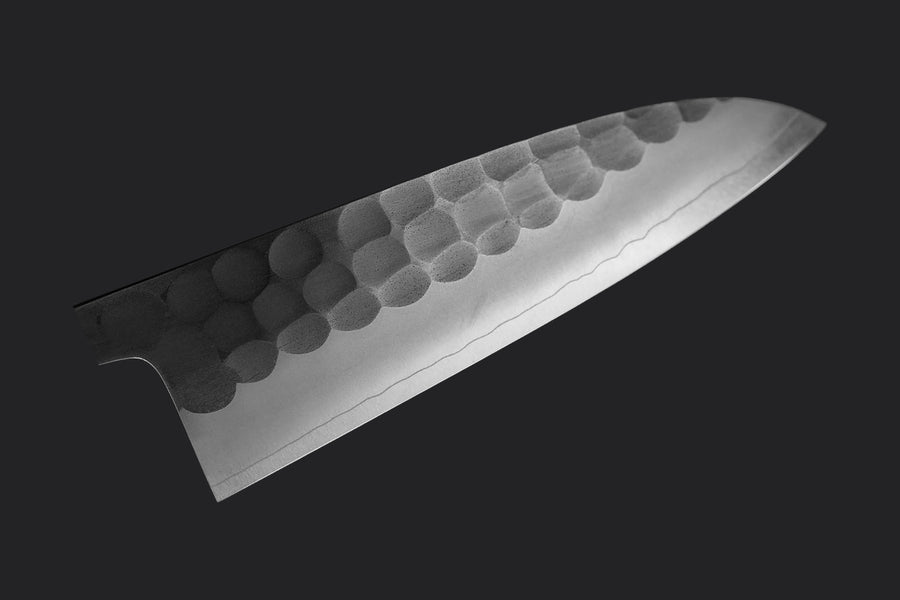
Surface Finish Tsuchime
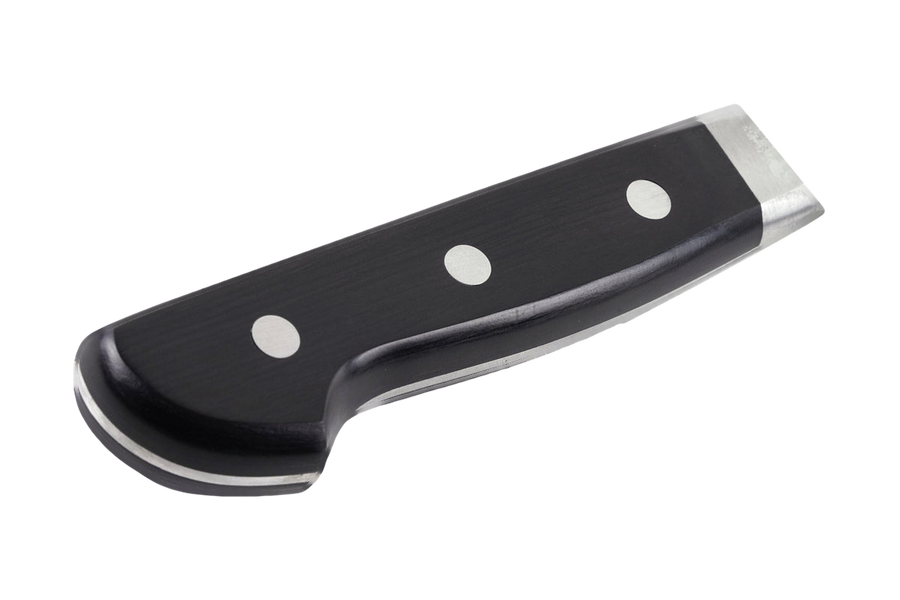
Handle Western Pakka Wood with Bolster
Region Fukuyama
Best for
  • First-timers
  • Students

World-wide shipping via DHL Express, 3 to 6 days (not available in the UK).


The blade of this Tsunehisa combines Tsuchime with a sandblasted Kasumi finish, a wave shaped mask is used at the Shinogi line to create a visually interesting pattern at the junction between the surface of the blade and the bevel. The full tang design has a metal bolster and although there are small gaps between the metal parts, the bolster, handle scale and the blade are all polished very well for a pleasing look and grip.

AUS-8 is commonly considered as a low budget steel and in many cases, it is not wrong, but it doesn’t necessarily mean it has a poor performance. The wear resistance is not as good as VG10 but in exchange, AUS-8 has noticeably better toughness. When getting a beginners oriented blade, this is something we do want to consider, many of the habits people built around European blades can result in chipping and breaking of the Japanese blade. Having a tougher steel that is more resistant to chipping can preserve the edge, avoiding the situation where the knife is immediately damaged after use. Although there is no numerical value about how much more beat this steel can take, I would feel more reassured when recommending this knife to a beginner or someone gifting to a friend.

The grind is decent too on these blades, although it doesn’t have a fancy geometry, the relative low blade thickness still makes the knives cut relatively easily, there is some thickness behind the edge but not something that affects the cut, the only downside might be the relative flat bevel, which can create some sticking cutting into some denser food.

This line would definitely be in the consideration when we recommend people a beginner knife, as the balance feature and performance is matched with a compelling price. In addition, the durable and western style full tang construction have a shape and balance that is close to a typical European knife, which makes switching into the Japanese awesomeness a bit easier for those who would like to dip their toes into this different world of cutting tools.

Pros Cons
  • Budget friendly
  • Ideal for the household
  • Easy to look after
  • Non-premium steel
Care Instruction
  1. Don't cut hard things! Japanese knives are brittle so bone hacking is a NO NO!
  2. Wash with neutral detergent after use, and wipe dry;
  3. Please don't wash knife with dishwasher, it will damage the wood handle;
  4. Be careful not to leave the knife close to a heat source for a long time;
  5. It is a lot more dangerous to cut with a blunt knife than a sharp knife!
  6. It is best to sharpen a Japanese knife regularly on a waterstone.

Tsunehisa

Tsunehisa, the house brand of Shibata Knives

Tsunehisa (恒久) is the house brand of Shibata Knives, the knife company Takayuki Shibata owns and runs. It is a brand rather than a single workshop.

The name means permanence, and Shibata Knives says it chooses knives that will have a long life. Takayuki Shibata started Tsunehisa in 2015 as his third knife brand, to help manage growing orders.

Read more

Shibata Knives describes Tsunehisa as a brand that inherits traditional Japanese forging techniques while taking in the latest materials and technologies, aiming at function and design for long use. It says its experienced staff inspect each knife under strict quality control, and it offers after-sales maintenance and sharpening.

The lines we list are grouped by steel. Ginsan comes in migaki, nashiji and nawame finishes, as gyuto, santoku, nakiri and petty, with a deba in the same steel. White 1 comes stainless clad as migaki and tsuchime gyuto, Aogami Super as kurouchi tsuchime sujihiki and petty, and Blue 2 as the Samurai sakimaru sujihiki.

The Damascus lines are in VG10, AUS10 and ZA18, the AUS10 also with a tsuchime finish. The rest are AUS8 tsuchime, a VG1 gyuto and an SLD Washiji santoku. Handles come in wa and yo styles.

“The house brand of Shibata Knives; the name means permanence.”

Est. 2015 | 平成27年
Known for Knives chosen and inspected by Shibata Knives
Instagram @tsunehisa Read more about Tsunehisa

Tsunehisa · Fukuyama

Knife details

Santoku — knife profile
Profile

Santoku

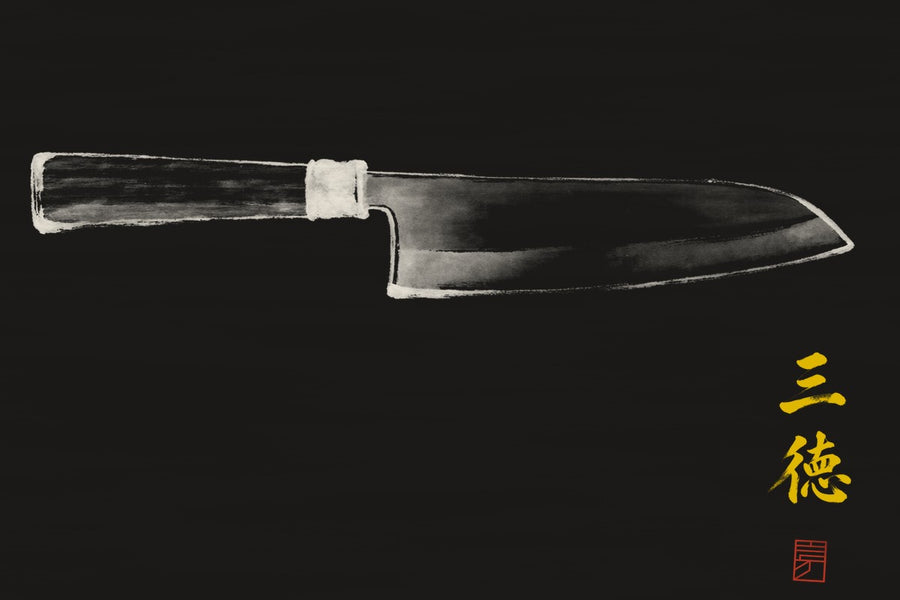
三徳

Santoku · Double bevel

An all-purpose knife for meat, fish and vegetables, with a wide blade and a rounded tip.

Read more
Steel properties
  1. Hardness Low
  2. Edge retention Low
  3. Toughness Very high
  4. Rust resistance High
  5. Ease of sharpening High
  6. Sharpness Good
Our ratings, inferred from published lab tests and composition.

Our edge-retention grade is a kitchen rating. It weighs the hardness each steel is sold at, which keeps a thin edge from rolling, twice as heavily as lab wear tests, and the final grade is our judgment from selling and sharpening these knives for over a decade. Lab card-cutting tests measure abrasive wear only, so they can rank carbon steels lower. Tap ? for the lab figure.

Steel

AUS-8

AUS-8

Stainless · Aichi

Aichi Steel's AUS series; Fukaumi lists 0.70 to 0.80% carbon, 13 to 14.5% chromium, 59 HRC reference.

Read more
CladdingCoreClad line
Construction

Sanmai - Stainless Clad

三枚

3 layers · stainless clad

Hard core between two stainless layers, bare only at the edge; the cladding resists rust.

Read more
Tsuchime — blade surface finish
Finish

Tsuchime

槌目

Hammered surface

Hammer marks across the upper blade. The dimples may help food release.

Read more
Western Pakka Wood with Bolster handle
Handle

Western Pakka Wood with Bolster

Western with bolster

Pakka wood western grip with a bolster. Resin-laminated wood resists water; entry-level.

Frequently asked questions

Gyuto or santoku: which should I choose?

The gyuto came to Japan with the beef-eating culture of the Meiji era, and that is where its name comes from. Tojiro says it is used for all kinds of cooking, which is why it is also called the chef's knife.

The santoku is a household knife that combines the good points of the nakiri and the gyuto. Tojiro describes it as all-purpose, from vegetables to meat and fish, double-bevel and built on the same construction as a Western knife.

Choose a gyuto if you want more length and reach. Choose a santoku if you want a shorter all-purpose knife. Tojiro's own size figures: gyuto 150 to 210mm for household use and up to 360mm for professional use, santoku 165 to 170mm for household use.

Rock chop or up-and-down chop: which knife shape suits me?

Match the shape to your stroke. Rock chopping keeps the tip on the board and rolls the curved belly through the food, so a gyuto or a Western chef's knife suits it, and Japanese knives rock fine as long as you rock gently.

Up-and-down chopping, the Chinese style, wants a straight run of edge, so a nakiri, usuba, santoku or bunka suits it better; a curved edge chopped straight down easily leaves pieces joined. Neither shape is better; it depends on how you cut.

What does santoku mean?

A Japanese dictionary explains the name of the santoku (三徳包丁) as coming from the three things it handles: meat, fish and vegetables. The same dictionary entry points from the santoku to the bunka (文化包丁), treating the two as one knife.

One Japanese knife maker guide distinguishes the two by the tip. It says that in the Showa era the bunka was made with its tip cut at an angle, and the santoku came after it by rounding that tip.

Who makes AUS-8?

AUS-8 is made by Aichi Steel, whose page on stainless steels for blades groups the AUS grades with its 13-chromium steels. There, AUS-6M, AUS-8 and AUS-10 are the grades that add still more carbon and add vanadium and molybdenum, which Aichi says further improves hardness, wear resistance and tempering resistance.

By the JSSA's definition, stainless means 10.5% or more chromium, and the JSSA notes that stainless, strictly, means it rusts less, so wash the knife after use and dry it.

What does the name Tsunehisa mean?

Tsunehisa (恒久) means permanence. Shibata Knives describes Tsunehisa as its original brand, and says it selects knives that will have a long life, inspecting each one before delivery. Its own words are that it delivers knives worthy of a permanent position in your home.

The brand is built on traditional Japanese forging techniques with modern materials, and Shibata Knives offers after-sales maintenance and sharpening for the line.

Is Tsunehisa a brand or a blacksmith?

Tsunehisa is a brand, not a single smith or a workshop. Shibata Knives describes it as an original brand of the company, run by Takayuki Shibata, and Shibata Knives does not name the workshop that makes each line. The company inherits traditional Japanese forging techniques with modern materials, and experienced staff inspect each knife before it is delivered.

What stands behind each Tsunehisa knife is that selection and inspection, and the company offers after-sales maintenance and sharpening for the line.

Are Tsunehisa knives worth it?

We think so, for a first Japanese knife in particular. Tsunehisa is the third brand of Takayuki Shibata, the Fukuyama sharpener behind Masakage and Koutetsu. His site says he started it in 2015 to keep up with orders.

Most of the Tsunehisa we stock is Ginsan (Silver #3), a stainless steel, so it needs less care than carbon steel. We list it in three finishes: Migaki, Nawame and Nashiji. We also list the SLD Washiji nakiri.

Stock changes, so check each listing. The Takayuki Shibata craftsman page has more on him.

How can I tell sanmai, warikomi, damascus and honyaki apart?

Start with the line on the blade. On a clad knife, sanmai or warikomi, a hard steel core is joined to a softer cladding, and the join shows on the bevel. Tojiro says this is where the name kasumi (霞, haze) comes from: the hard steel takes a shine while the soft metal looks hazy.

A honyaki (本焼) is made of one steel. Before hardening the smith coats the parts that should stay softer with clay, so only the edge hardens fully, and the boundary can show as a hamon (刃文).

Damascus is a pattern made by forging many layers of different metals together and then bringing the pattern out with the finish. If it matters how a knife is built, ask before you buy. Our sanmai, warikomi and honyaki pages show each construction.

You May Also Like