Hatsukokoro  |  SKU: YAUJ_G3DA_NA170

Hatsukokoro Ginsan Damascus Tsuchime Nakiri 170 mm with Teak wood Handle, by Yoshihiro Yauji

Sale price $454.00 Regular price $534.00

Pickup in Australia only

In Stock Now

Availability

Goes well with

Detailed Specifications
Line Hatsukokoro by Yoshihiro Yauji Ginsan Damascus Tsuchime
Profile Nakiri / Japanese vegetable knife
Steel Ginsan / Silver #3 | Stainless
Blade Construction Sanmai - Stainless Damascus Clad
Maker's hardening hardness 59 HRC or more
Surface Finish Tsuchime
Handle
Region Takefu
Best for
  • Pro chefs
  • Household

World-wide shipping via DHL Express, 3 to 6 days (not available in the UK).


This Hatsukokoro line is by Yoshihiro Yauji and carries a Tsuchime hammer texture across a full kitchen: Santoku, Gyuto in two sizes, Nakiri and a Petty, all with a K&S teak wood handle.

Inside is a Ginsan stainless core with stainless Damascus cladding, hardened to 60 to 62 HRC. Because the blade is stainless, care stays simple: wash it, dry it, and put it away rather than leaving it wet.

The gyuto runs from 210 to 240 mm at 190 and 240 g, the santoku is a compact everyday blade at 172 g, and the nakiri brings a 52 mm tall blade to leafy greens. These are unfussy knives for daily vegetable and meat work, and optional handle upgrades are available if you want to dress one up.

Pros Cons
  • Excellent performance
  • Ideal for the household
Care Instruction
  1. Don't cut hard things! Japanese knives are brittle so bone hacking is a NO NO!
  2. Wash with neutral detergent after use, and wipe dry;
  3. Please don't wash knife with dishwasher, it will damage the wood handle;
  4. Be careful not to leave the knife close to a heat source for a long time;
  5. It is a lot more dangerous to cut with a blunt knife than a sharp knife!
  6. It is best to sharpen a Japanese knife regularly on a waterstone.

Yoshihiro Yauji

Yoshihiro Yauji (弥氏 良寛), Kutsurogi (寬), Echizen

Yauji Yoshihiro(弥氏 良寛), born in Echizen, Fukui Prefecture in 1983. At age of 20 in 2003, he entered Kitaoka Knives to apprentice under Kitaoka Hideo(北岡 英雄), the third generation bladesmith of Kitaoka Knives. In fiscal 2018, he was certified as a traditional craftsman.

In April of 2021, Yoshihiro Yauji left Kitaoka Knives and set up his own independent knife workshop Kutsurogi(寬), which shares a same Kanji with part of his name. Kutsurogi along with Yoshihiro Yauji is now a part of the Takefu Knife Village, which is an association that consists 14 knife companies and more than 40 bladesmiths, all located in Echizen area. Takefu Knife Village is home to makers such as Yu Kurosaki, Shiro Kamo and Yoshimi Kato.

Yoshihiro Yauji's knives are often found in damascus, with a color that is usually brighter than what you find on other makers. These blades seems to be grinded with a convex bevel, which helps prevent food sticking greatly, especially when paired with a more"sticky" finish like a mirror polish.

“Traditional craftsman certified in fiscal 2018, listed with Kutsurogi (寬) at Takefu Knife Village.”

Est. 2021 | 令和3年
Known for Traditional craftsman certification, Kutsurogi (寬)
Website takefu-knifevillage.jp Instagram @yoshihiro_yaichi Read more about Yoshihiro Yauji

Yoshihiro Yauji · Takefu

Knife details

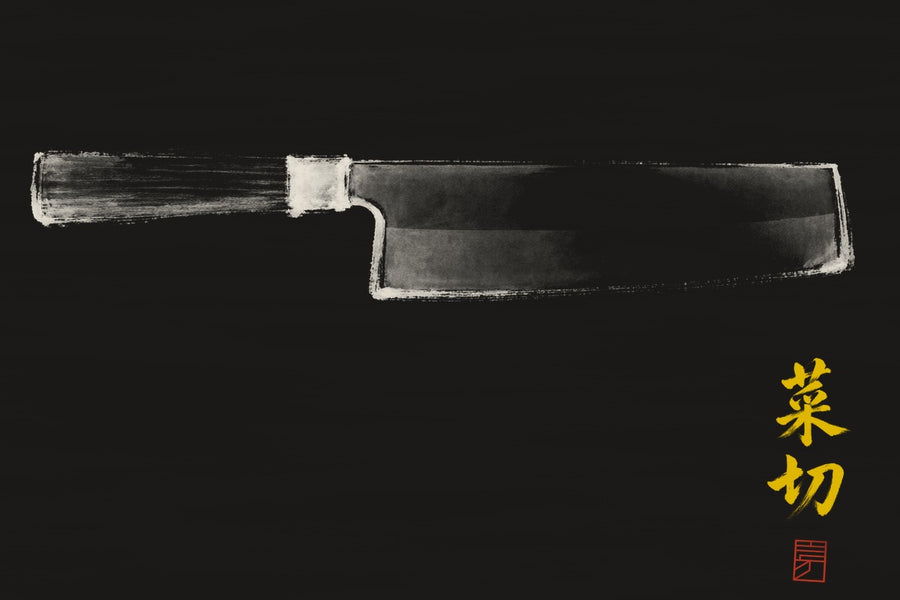
Nakiri — knife profile
Profile

Nakiri

菜切

Japanese vegetable knife · Double bevel

Thin, wide vegetable knife with no point; Tojiro says its straight edge sits flat on the board.

Read more
Steel properties
  1. Hardness Good
  2. Edge retention Good
  3. Toughness Very high
  4. Rust resistance High
  5. Ease of sharpening High
  6. Sharpness High
Our ratings, inferred from published lab tests and composition.

Our edge-retention grade is a kitchen rating. It weighs the hardness each steel is sold at, which keeps a thin edge from rolling, twice as heavily as lab wear tests, and the final grade is our judgment from selling and sharpening these knives for over a decade. Lab card-cutting tests measure abrasive wear only, so they can rank carbon steels lower. Tap ? for the lab figure.

Steel

Ginsan / Silver #3

GIN3

Stainless · Hitachi Metals (now Proterial)

Proterial's GIN 3 stainless: 0.95 to 1.10% carbon, 13.00 to 14.50% chromium, hardening hardness over 59 HRC.

Read more
CladdingCoreClad line
Construction

Sanmai - Stainless Damascus Clad

三枚ダマスカス

3 layers · damascus clad

Hard core between stainless damascus layers, bare at the edge. Thinning wears the pattern.

Read more
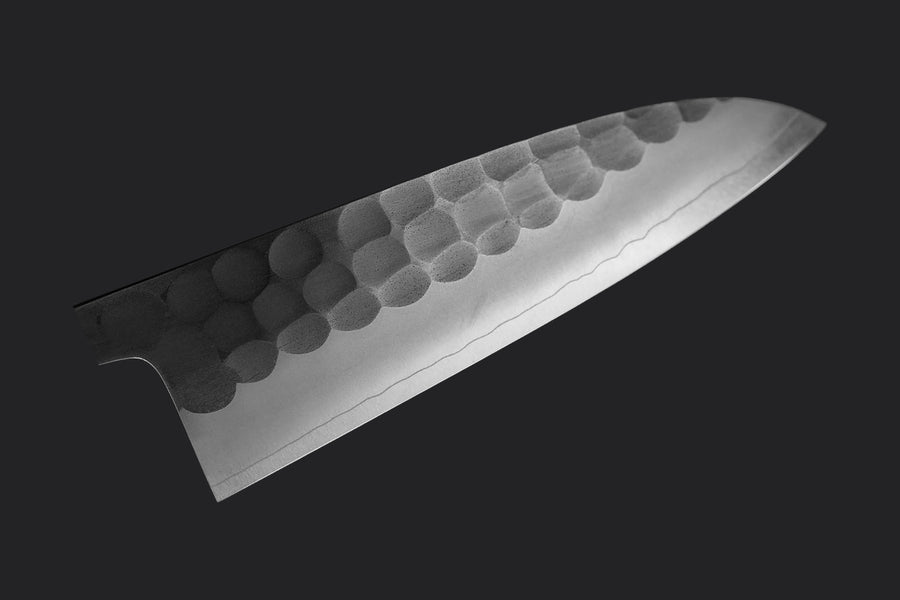
Tsuchime — blade surface finish
Finish

Tsuchime

槌目

Hammered surface

Hammer marks across the upper blade. The dimples may help food release.

Read more

Frequently asked questions

Why won't my knife cut all the way through? The slices stay joined at the bottom.

Part of the edge never reaches the board, so the cut never finishes. At our counter we put it simply: there is not enough flat at the heel. A knife with a long curve is built for rock chopping, not for the Chinese or Eastern up-and-down chop.

A straight edge, like a nakiri's, meets the board along its whole length and finishes the cut. On any knife, a dip worn near the heel or a dull section can cause the same thing.

Nakiri or usuba: what is the difference?

The bevel. A Japanese dictionary describes the nakiri (菜切包丁) as shaped like an usuba but double-bevel and relatively easy to handle; the Sakai cutlery association describes the usuba (薄刃包丁) as an acute, wide knife for vegetables, in a square Kanto type and a kamagata Kansai type.

The names overlap, since another dictionary records the usuba as also called nakiri, so check the bevel rather than the name.

Bunka, nakiri or usuba: which knife is best for vegetables?

For everyday vegetable prep, a nakiri (菜切) is the simple choice. Tojiro describes it as Japan's own vegetable knife: a square, double-bevel blade, so it cuts the same way in either hand.

A bunka (文化) is a home knife that Tojiro describes as combining the good points of the nakiri and the gyuto. Choose it if you want one knife for vegetables plus meat and fish, with an angled tip.

An usuba (薄刃) is a knife made for vegetable preparation in Japanese cooking. It is single bevel, so it is made for one hand, and Tojiro lists its jobs as peeling and hollowing at the heel, and katsuramuki, fine garnish cuts and rounding off cut edges along the middle of the edge. Choose it if you want to learn those techniques.

What is Ginsan steel, and why do some Japanese knives use it?

Ginsan, also known as Silver 3, is a stainless steel from Proterial, the Yasugi Specialty Steel division. Proterial describes it as a stainless steel which has hardness and sharpness comparable to carbon steel, and lists its uses as kitchen knives and scissors.

Knife makers use it when they want the corrosion resistance of a stainless together with the hardness and sharpness that Proterial compares to carbon steel. The steel maker lists 59 HRC or over after hardening, but that is a heat treatment figure, not a finished knife figure.

Dry it after use, like any stainless knife. Its performance depends on the heat treatment and construction of the specific knife, not the steel name alone.

Is Ginsan stainless?

Yes. Proterial lists the steel as GIN 3 with 13.00 to 14.50% chromium, above the Japan Stainless Steel Association's 10.5% minimum for stainless steel.

Proterial describes it as a stainless steel with hardness and sharpness comparable to carbon steel, used in various kitchen knives and scissors, and the association notes that stainless, strictly, means it rusts less. Wash the knife and dry it after use.

Is Yoshihiro Yauji a certified traditional craftsman?

Yes. The Echizen Uchihamono association's roster of certified craftsmen lists Yoshihiro Yauji as certified as a traditional craftsman in fiscal 2018.

The roster says he wants to pass on traditional techniques and develop them into new things. It also says he formed a team that has begun making products while sharing the history and culture of traditional tatara iron making.

Are Yoshihiro Yauji knives worth it?

We think so. Yoshihiro Yauji is a blacksmith in Echizen, Fukui. The national register lists him as a certified traditional craftsperson (dentō kōgeishi) for Echizen forged cutlery from 25 February 2019. He joined Kitaoka Cutlery in 2003, trained under Hideo Kitaoka, and set up his own workshop, Kutsurogi, in 2021.

He forges and polishes his own blades. In a 2023 profile he said that doing both jobs means the polisher's feedback reaches the smith directly. Single-bevel knives are his speciality.

We list Hatsukokoro knives he forges, including the Ginga ATS-34 Damascus line. Stock changes, so check each listing. The Yoshihiro Yauji maker page has more on him.

Are Damascus knives worth it, or is it just looks?

On nearly every Japanese kitchen knife sold as Damascus, the pattern is there for looks. It sits in the soft cladding on the sides of the blade, and the plain core steel at the edge does the cutting. Pay more for Damascus if you enjoy how it looks, and for no other reason.

Most are built in three layers (sanmai): a hard core with a softer layer forge-welded to each side. On a Damascus knife that outer layer is itself made of many thin layers, etched or blasted so the pattern shows. The cladding is made separately from the core, so a maker can change the look without changing how the blade cuts. Two knives with the same core steel and the same grind perform the same, patterned or plain.

The cladding does real work, but plain cladding does it too. It supports the hard, brittle core, and when it is stainless it shields a carbon steel core from rust except at the edge. Our Damascus construction page shows the layers.

The pattern also changes with use. The contrast fades where you sharpen, and once the knife is thinned the cladding near the edge will not look as it did out of the box. If the budget is tight, spend it on the core steel and grind, or on a whetstone. If you like the pattern, buy it; wanting a good-looking knife is a fair reason to choose one.