Drag to spin · pinch or scroll to zoom

Hatsukokoro  |  SKU: HATS-HYG3-BU180

Hatsukokoro Hayabusa Ginsan Bunka 180mm

Sale price $220.00 Regular price $259.00

Availability

Goes well with

Detailed Specifications
Line Hatsukokoro Hayabusa Ginsan Migaki
Profile Bunka / K-tip santoku
Bevel Type Double Bevel
Weight 122 g | 4.3 oz
Edge Length 172 mm | 6 49/64″
Heel Height 47 mm | 1 27/32″
Width @ Heel 1.7 mm | 1/16″
Width @ Mid 231.6 mm | 9 1/8″
Width @ 1cm from Tip 0.9 mm | 1/32″
Steel Ginsan / Silver #3 | Stainless
Blade Construction Sanmai - Stainless Clad
Maker's hardening hardness 59 HRC or more
Surface Finish Migaki
Handle Octagonal Black Chacate
Region Hyogo
Best for
  • First-timers
  • Students
  • Pro chefs

World-wide shipping via DHL Express, 3 to 6 days (not available in the UK).


At this point we might be more than familiar with the Hayabusa(隼, Peregrine Falcon) family that Hatsukokoro have been producing, as their budget friendly collection, the Hayabusa knives offers many blades with varieties of steel in a simple Migaki finish and a fairly affordable price tag.

However, the geometry produced by a grinding machine have lead to a rather average performance: the more flat bevel causes sticking and a higher thickness behind edge leads to resistance when cutting into food.

What struck me the most at first glance with this new Ginsan Hayabusa was its geometry, it have taken a completely different approach which may be due to tweaking with grinding equipment. The blades are now extremely thin behind the edge and stays thin until it transitions into a convex geometry halfway towards the spine. This has drastically changed the performance of the blade and made it much smoother to cut as the resistance when cutting into the food is greatly reduced, and the slight convex helps minimise sticking.

It's exciting to see makers putting more effort in optimising the performance of their machine manufactured blades, and I can see this Hayabusa can gradually replace the Ginso as the budget friendly Ginsan knife. When this performance and low price is paired with the low maintenance, easy to sharpen steel, I can easily recommend this knife to anyone getting into Japanese kitchen knife who also want try sharpening themselves.

Pros Cons
  • Budget friendly
  • Thin behind the edge
  • Easy to look after
  • A little bit brittle
Care Instruction
  1. Don't cut hard things! Japanese knives are brittle so bone hacking is a NO NO!
  2. Wash with neutral detergent after use, and wipe dry;
  3. Please don't wash knife with dishwasher, it will damage the wood handle;
  4. Be careful not to leave the knife close to a heat source for a long time;
  5. It is a lot more dangerous to cut with a blunt knife than a sharp knife!
  6. It is best to sharpen a Japanese knife regularly on a waterstone.

Hatsukokoro

Hatsukokoro, a knife brand from Amagasaki

Hatsukokoro (初心) is a knife brand from Amagasaki, Hyogo, launched in 2019. It is a brand rather than a forge: it works with knife makers instead of forging itself.

The name comes from the proverb 初心忘るべからず, roughly never forget your beginner's mind. For the same characters the brand chose the gentler reading hatsukokoro over shoshin.

The brand's own catalogue names the place behind some of its lines, and the maker behind a few: Shinkiro comes from Fukushima, and Hayabusa HAP40, Saihyo and Sunaarashi from Seki City, while for others the maker or the place stays private. Some of our listing titles also carry the maker alongside the brand, such as Hatsukokoro x Yoshikane and the Hatsukokoro x Yoshihiro Yauji collaboration.

The Hatsukokoro lines we list include both carbon and stainless steels. Our listings include Hayabusa in SG2 and Aogami Super, Saihyo in SG2 and Ginrei in Ginsan. Carbon steel kurouchi lines include Aosagi, Aokitae, Kurokaze and Kurogane.

“A knife brand from Amagasaki that works with knife makers rather than forging.”

Est. 2019 | 令和元年
Known for Lines made with partner makers, from Seki City to Fukushima
Website handk.co Instagram @handk_official Read more about Hatsukokoro

Hatsukokoro · Hyogo

Knife details

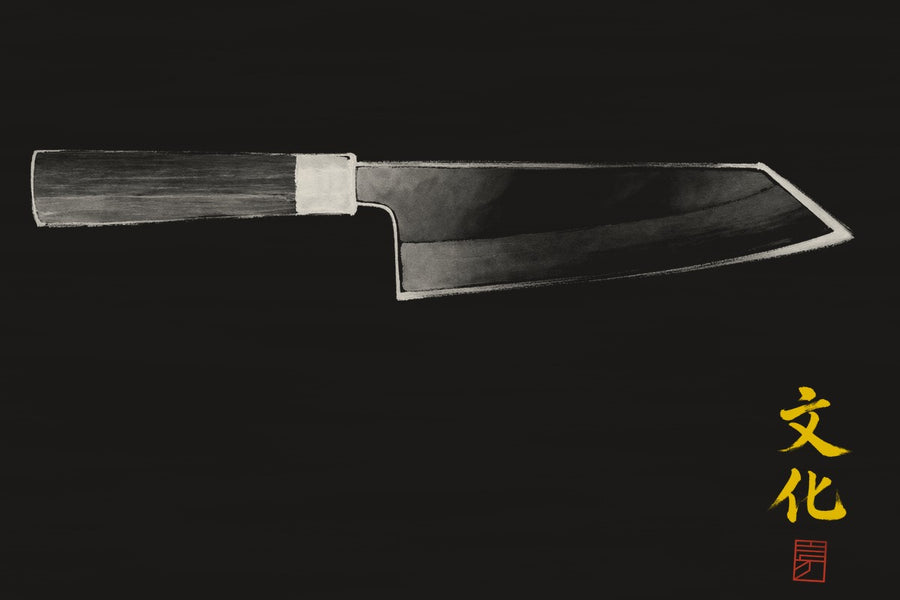
Bunka — knife profile
Profile

Bunka

文化

K-tip santoku · Double bevel

A compact all-rounder like a santoku; a Sakai maker says its angled K-tip suits fine work.

Read more
Steel properties
  1. Hardness Good
  2. Edge retention Good
  3. Toughness Very high
  4. Rust resistance High
  5. Ease of sharpening High
  6. Sharpness High
Our ratings, inferred from published lab tests and composition.

Our edge-retention grade is a kitchen rating. It weighs the hardness each steel is sold at, which keeps a thin edge from rolling, twice as heavily as lab wear tests, and the final grade is our judgment from selling and sharpening these knives for over a decade. Lab card-cutting tests measure abrasive wear only, so they can rank carbon steels lower. Tap ? for the lab figure.

Steel

Ginsan / Silver #3

GIN3

Stainless · Hitachi Metals (now Proterial)

Proterial's GIN 3 stainless: 0.95 to 1.10% carbon, 13.00 to 14.50% chromium, hardening hardness over 59 HRC.

Read more
CladdingCoreClad line
Construction

Sanmai - Stainless Clad

三枚

3 layers · stainless clad

Hard core between two stainless layers, bare only at the edge; the cladding resists rust.

Read more
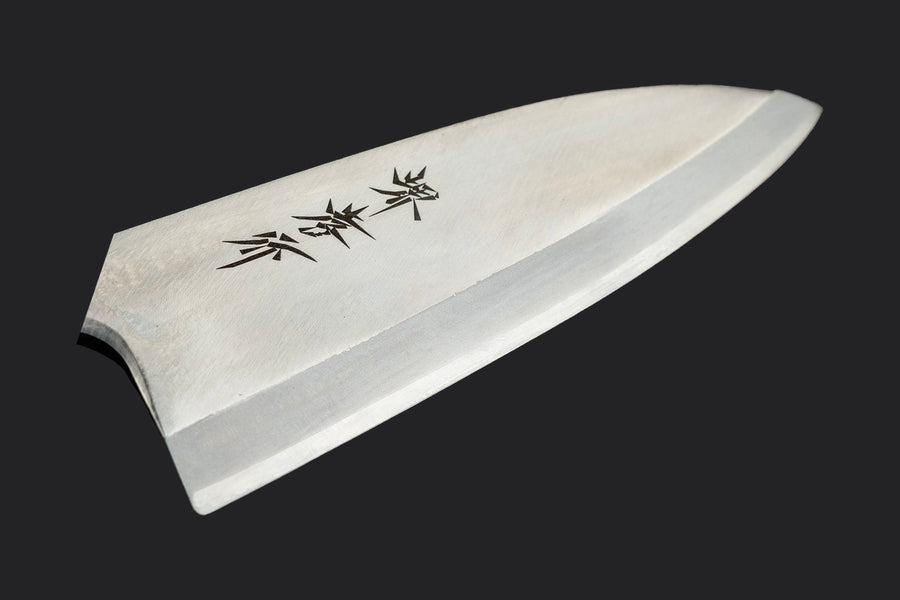
Migaki — blade surface finish
Finish

Migaki

磨き

Polished satin

Smooth polished surface, satin to soft sheen rather than mirror. Scratches show.

Read more
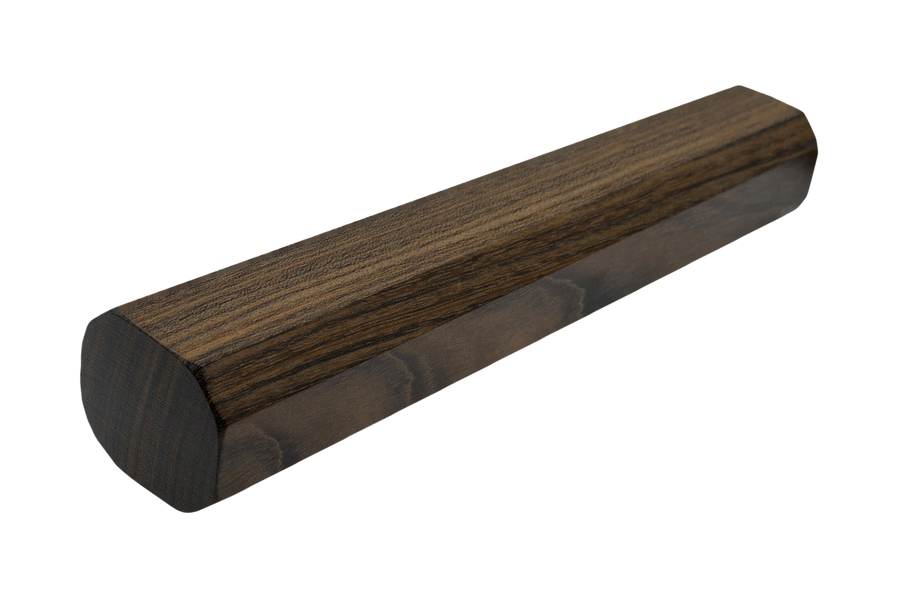
Octagonal Black Chacate handle
Handle

Octagonal Black Chacate

Octagonal WA

Black chacate, a dense dark African wood near ebony, eight-sided; may show pale sapwood.

Frequently asked questions

Why is it called a bunka knife?

The bunka knife (文化包丁) takes its name from bunka, culture. A Sakai knife maker ties the name to Japan's modernisation, when Western culture and Japanese tradition merged, and says it stands for that new era and for the knife's wide range of uses.

The same maker says that as diets broadened to meat, fish and vegetables, an all-purpose knife was wanted, and the bunka took features from both Japanese and Western knives.

What is the difference between a bunka and a santoku?

The tip. One Japanese knife maker describes the bunka (文化包丁, kengata) as combining the good points of the gyuto and the nakiri with the tip cut at an angle, and the santoku as coming after it, by rounding that tip.

Both are all-purpose knives for the home; santoku (三徳) means three virtues, for the three foods it cuts: meat, fish and vegetables.

Bunka, nakiri or usuba: which knife is best for vegetables?

For everyday vegetable prep, a nakiri (菜切) is the simple choice. Tojiro describes it as Japan's own vegetable knife: a square, double-bevel blade, so it cuts the same way in either hand.

A bunka (文化) is a home knife that Tojiro describes as combining the good points of the nakiri and the gyuto. Choose it if you want one knife for vegetables plus meat and fish, with an angled tip.

An usuba (薄刃) is a knife made for vegetable preparation in Japanese cooking. It is single bevel, so it is made for one hand, and Tojiro lists its jobs as peeling and hollowing at the heel, and katsuramuki, fine garnish cuts and rounding off cut edges along the middle of the edge. Choose it if you want to learn those techniques.

What is Ginsan steel, and why do some Japanese knives use it?

Ginsan, also known as Silver 3, is a stainless steel from Proterial, the Yasugi Specialty Steel division. Proterial describes it as a stainless steel which has hardness and sharpness comparable to carbon steel, and lists its uses as kitchen knives and scissors.

Knife makers use it when they want the corrosion resistance of a stainless together with the hardness and sharpness that Proterial compares to carbon steel. The steel maker lists 59 HRC or over after hardening, but that is a heat treatment figure, not a finished knife figure.

Dry it after use, like any stainless knife. Its performance depends on the heat treatment and construction of the specific knife, not the steel name alone.

Is Ginsan stainless?

Yes. Proterial lists the steel as GIN 3 with 13.00 to 14.50% chromium, above the Japan Stainless Steel Association's 10.5% minimum for stainless steel.

Proterial describes it as a stainless steel with hardness and sharpness comparable to carbon steel, used in various kitchen knives and scissors, and the association notes that stainless, strictly, means it rusts less. Wash the knife and dry it after use.

Is Hatsukokoro a maker or a brand, and who makes the knives?

Hatsukokoro (初心) is a brand, not a forge. H&K, a company founded in 2013 and based in Amagasaki, Hyogo, created it in 2019.

H&K names the producer for some lines, for example Shinkiro by Takahiro Nihei in Fukushima, Ginyou by Yoshihiro Yauji in Echizen and Kurosagi by Motokyuichi Hamono in Nagasaki, and keeps others confidential. Some knives we stock carry the maker in the title, such as Hatsukokoro x Yoshikane SKD Nashiji.

What does the name Hatsukokoro mean?

Hatsukokoro is written 初心, the characters for first and heart: the frame of mind you start out with. H&K, the company behind the brand, says the name comes from the Japanese proverb 初心忘るべからず, which it translates as don't forget your original intention. The saying is usually traced back to the Noh master Zeami.

Those two characters are normally read shoshin. H&K says it chose the softer reading hatsukokoro instead.

H&K was set up in 2013 in Amagasaki, Hyogo, and launched Hatsukokoro as its knife brand in 2019. It is a brand rather than a single forge: the knives are made for it by workshops across Japan, which is why some of our listings carry both names, such as Hatsukokoro x Yoshikane.

Which Hatsukokoro line should I pick, carbon or stainless?

Pick by how much care you want to give. The carbon lines, Blue 1, Blue 2 and AS kurouchi, need drying and a little oil after use. The SG2, HAP40, Ginsan and VG10 lines are low maintenance, so they suit a busy kitchen or someone who just wants to cook.

Neither is better; it depends on your routine. If you will dry and oil the blade after each use, a carbon line can suit you, and if you want the least fuss, a stainless line is the easier choice.

You May Also Like