Drag to spin · pinch or scroll to zoom

Hatsukokoro  |  SKU: HST-KAJNB2-KGY24-OTMPSS

Hatsukokoro Kaijin Blue 2 K-tip Gyuto 240mm Migaki Curly Maple

Sale price $257.00 Regular price $302.00

IMPORTANT: Carbon steel knives can rust or patina quickly if not cared for properly. They require regular cleaning, drying, and oiling. If you are unfamiliar with carbon steel maintenance, we recommend choosing a stainless steel option instead.

Availability

Goes well with

Detailed Specifications
Line Hatsukokoro Kaijin Blue 2
Profile K-tip Gyuto / K-tip chef's knife
Bevel Type Double Bevel
Weight 177 g | 6.2 oz
Edge Length 243 mm | 9 9/16″
Heel Height 51 mm | 2 1/64″
Width @ Heel 2.4 mm | 3/32″
Width @ Mid 2.1 mm | 5/64″
Width @ 1cm from Tip 0.7 mm | 1/32″
Steel Blue 2 / Aogami #2 | Carbon
Blade Construction Sanmai - Stainless Clad
Maker's hardening hardness 60 HRC or more
Surface Finish Migaki
Handle Curly Maple with S/S Ferrule- Blue
Region Hyogo
Best for
  • Pro chefs
  • Enthusiasts

World-wide shipping via DHL Express, 3 to 6 days (not available in the UK).


Hatsukokoro Kaijin(海神, Sea God), is a rather budget friendly line for its name, it has a pretty plain look with polished edge and sandblasted bevel, and zero additional design feature. But I have to say, if your next knife purchase is all about performance, this can deliver it at a price that is very hard to beat.

The key in a good cutting knife is the combination of an edge that cuts aggressively and a bevel geometry that penetrates and releases off food smoothly, and Kaijin does both fairly well. The steel choice is Blue No.2, a carbon steel produced by Proterial that excels at producing a really “bitey” edge. This type of edge can slice open soft items like proteins and tough surfaces like skins, and it’s an experience that stainless steel just couldn’t deliver. 

The magic of simple carbon steel is, they can be heat treated to a higher hardness and still retain a more decent toughness than most of the conventional stainless steel, this means they can perform when the edge gets pretty thin. In this case, it is exactly what Kaijin did. The bevel of Kaijin gets sharpened to a very low thickness near the edge, and this thickness gradually increases, transitions into two parallel surfaces. This type of convex grind and an extremely low thickness behind the edge is the key in delivering a smooth food penetration and food release, and it’s not an exception in the case of Kaijin. Although in some cases the very thin slice of food would stick to the flat zone of the blade, this still outperformed most of the knives we’ve tested on potatoes outside of the ones with more complicated hand grinded bevel.

Completing the package is the latest dyed and stabilized blue curly maple handle, paired with an elegant stainless steel ferrule. This modern handle not only looks striking but also improves durability and balance, it is our interpretation of "the ocean", adding significant value and complete the blade into one refined package.

Despite the carbon steel core used on the Kaijin, I still consider it as a rather practical line as the cladding is stainless. So the downside of the line really is the small amount of care needed to keep the exposed core steel dry and clean and a rather delicate edge that can’t handle much of a beating. I recommend this knife to anyone who already has some experience on an entry level VG10 or other stainless steel, and looking to upgrade into a carbon steel. This Kaijin line would deliver the desired smooth cut while keeping the maintenance and cost very manageable.

Pros Cons
  • Great for professionals
  • Great artistic
  • Budget friendly
  • Relatively hard to sharpen
  • Prone to rust
Care Instruction
  1. Don't cut hard things! Japanese knives are brittle so bone hacking is a NO NO!
  2. Wash with neutral detergent after use, and wipe dry;
  3. Please don't wash knife with dishwasher, it will damage the wood handle;
  4. Be careful not to leave the knife close to a heat source for a long time;
  5. It is a lot more dangerous to cut with a blunt knife than a sharp knife!
  6. It is best to sharpen a Japanese knife regularly on a waterstone.
  7. Oil the (carbon) knife if storing for an extended period of time to prevent rust.

Hatsukokoro

Hatsukokoro, a knife brand from Amagasaki

Hatsukokoro (初心) is a knife brand from Amagasaki, Hyogo, launched in 2019. It is a brand rather than a forge: it works with knife makers instead of forging itself.

The name comes from the proverb 初心忘るべからず, roughly never forget your beginner's mind. For the same characters the brand chose the gentler reading hatsukokoro over shoshin.

The brand's own catalogue names the place behind some of its lines, and the maker behind a few: Shinkiro comes from Fukushima, and Hayabusa HAP40, Saihyo and Sunaarashi from Seki City, while for others the maker or the place stays private. Some of our listing titles also carry the maker alongside the brand, such as Hatsukokoro x Yoshikane and the Hatsukokoro x Yoshihiro Yauji collaboration.

The Hatsukokoro lines we list include both carbon and stainless steels. Our listings include Hayabusa in SG2 and Aogami Super, Saihyo in SG2 and Ginrei in Ginsan. Carbon steel kurouchi lines include Aosagi, Aokitae, Kurokaze and Kurogane.

“A knife brand from Amagasaki that works with knife makers rather than forging.”

Est. 2019 | 令和元年
Known for Lines made with partner makers, from Seki City to Fukushima
Website handk.co Instagram @handk_official Read more about Hatsukokoro

Hatsukokoro · Hyogo

Knife details

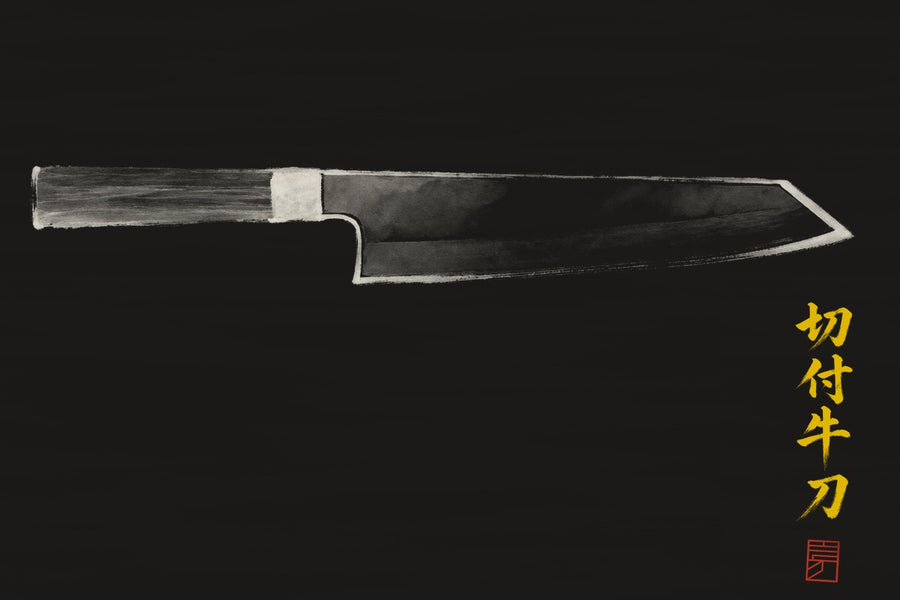
K-tip Gyuto — knife profile
Profile

K-tip Gyuto

切付牛刀

K-tip chef's knife · Double bevel

Double-bevel chef's knife with an angled tip and flatter edge for push cuts and scoring.

Read more
Steel properties
  1. Hardness Very good
  2. Edge retention Very good
  3. Toughness Very good
  4. Rust resistance Low
  5. Ease of sharpening High
  6. Sharpness Very high
Our ratings, inferred from published lab tests and composition.

Our edge-retention grade is a kitchen rating. It weighs the hardness each steel is sold at, which keeps a thin edge from rolling, twice as heavily as lab wear tests, and the final grade is our judgment from selling and sharpening these knives for over a decade. Lab card-cutting tests measure abrasive wear only, so they can rank carbon steels lower. Tap ? for the lab figure.

Steel

Blue 2 / Aogami #2

青二鋼

Carbon · Hitachi Metals (now Proterial)

Proterial carbon steel, 1.05 to 1.15% carbon with chromium and tungsten; not stainless.

Read more
CladdingCoreClad line
Construction

Sanmai - Stainless Clad

三枚

3 layers · stainless clad

Hard core between two stainless layers, bare only at the edge; the cladding resists rust.

Read more
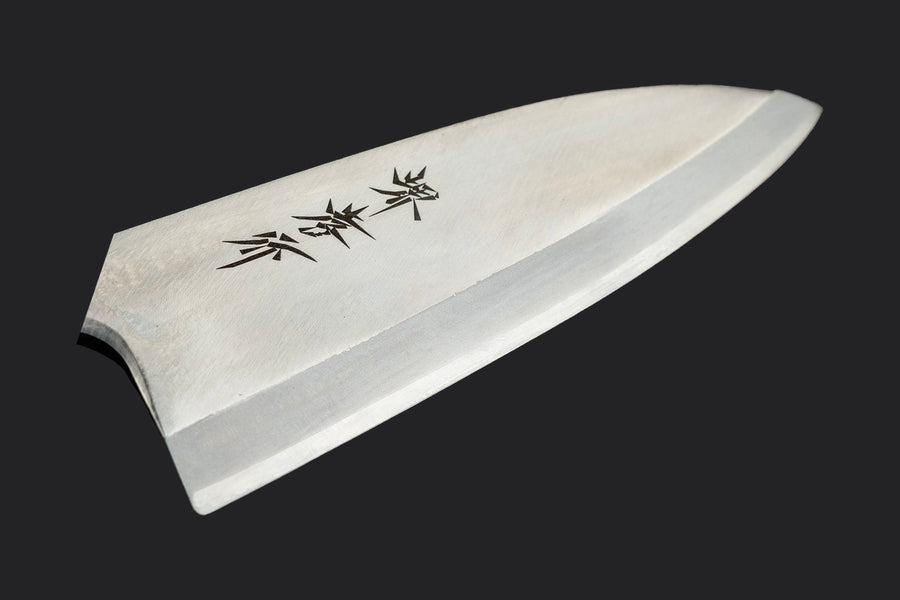
Migaki — blade surface finish
Finish

Migaki

磨き

Polished satin

Smooth polished surface, satin to soft sheen rather than mirror. Scratches show.

Read more
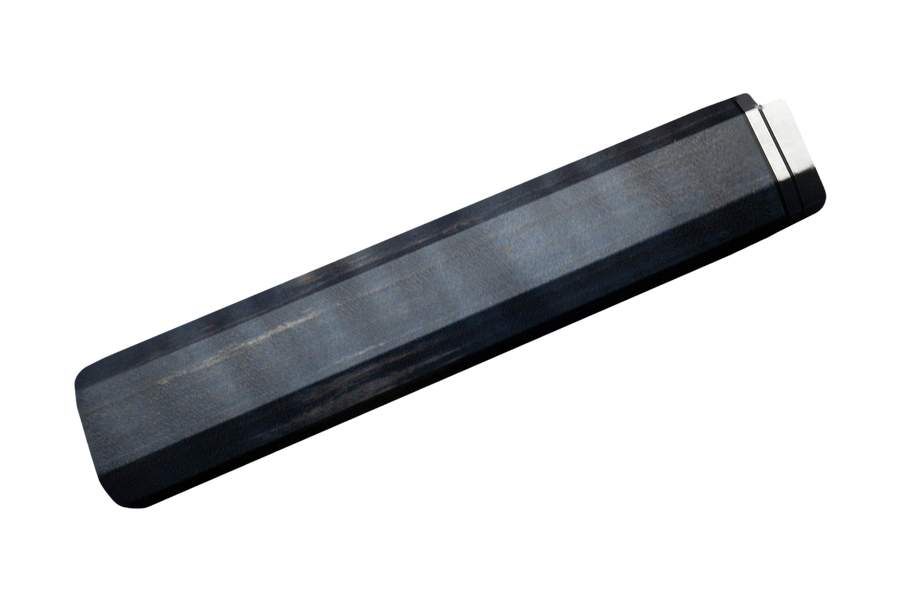
Curly Maple with S/S Ferrule- Blue handle
Handle

Curly Maple with S/S Ferrule- Blue

Octagonal WA

Blue-dyed, stabilised curly maple, eight-sided, stainless steel ferrule. Resists water.

Frequently asked questions

Is a K-tip Gyuto the same as a traditional Kiritsuke?

Not quite - and it is the single most common point of confusion when people shop for a kiritsuke. The two knives share the same striking angled, reverse-tanto tip, but underneath that tip they are very different tools.

A K-tip gyuto is normally a double-bevel knife: it is ground on both sides like any Western-style chef's knife, so it is forgiving to use, and sharpened exactly the way you would sharpen a normal gyuto. You get the dramatic kiritsuke look with the everyday usability of an all-purpose chef's knife.

A traditional kiritsuke, including the kiritsuke-yanagiba (slicer), is a single-bevel knife, ground on one side only. It is historically a master chef's knife: it takes real practice to use well, is set up for right-handed users by default, and needs single-bevel sharpening technique to maintain.

So if you want the kiritsuke silhouette with no learning curve, choose a K-tip gyuto. If you specifically want the traditional single-bevel discipline - and the precision it allows on fish and vegetables - choose a true kiritsuke. At Knives and Stones we stock both, and each product page tells you which construction you are looking at.

Will a carbon steel knife rust, and how do I look after it?

Yes, carbon steels such as Aogami (Blue) and Shirogami (White) are not stainless steels, so left wet they can spot or rust.

Care is simple once it becomes habit. Wipe the blade as you go, especially after acidic food like citrus, tomato or onion. When you finish, wash it in warm water with a little soap and dry it straight away with a towel. Do not let it air dry, leave it in the sink or the dish rack, or put it in the dishwasher. Store it dry: on a magnetic strip or in a ventilated block in a dry spot.

If the knife will sit unused for a while, wipe on a thin layer of oil before storing. In our video James shows that mineral oil can stand in for camellia (tsubaki) oil, and he picks one labelled medical grade; we list the Kitchen Knife / Cutting Board Mineral Oil Medical Grade for this. If you find light rust, lift it with a rust eraser and a little water, then dry and oil the blade; we list the CKK and Naniwa rust erasers.

What is the difference between Blue 2 and White 2 steel?

Blue 2 is White 2 with tungsten and a little chromium added. Blue 2 holds its edge longer. White 2 sharpens faster and takes a very keen edge. Both are carbon steels that will rust if left wet.

The figures come from Proterial, which makes both. Each has 1.05 to 1.15% carbon. Blue 2 (Aogami 2) adds 1.00 to 1.50% tungsten and 0.20 to 0.50% chromium. White 2 (Shirogami 2) lists neither, and Proterial describes it as a carbon steel with minimum impurities. Proterial says the tungsten and chromium improve heat treatment and wear resistance, and gives a hardening hardness over 60 HRC for both.

In use, the tungsten forms hard carbides that resist wear, so a Blue 2 edge lasts longer between sharpenings. White 2 has none, so it comes back on a whetstone very quickly. The chromium in Blue 2 is far below the 10.5% a steel needs to be stainless, so it gives no real rust protection. Wipe either steel dry after use and expect a patina.

Choose Blue 2 if you want to sharpen less often. Choose White 2 if you enjoy sharpening and want the keenest edge. We list both widely: Blue 2 from Nigara, Myojin Riki and Anryu, and White 2 from Masamoto Sohonten, Sakai Takayuki and Yoshikane.

What does the name Hatsukokoro mean?

Hatsukokoro is written 初心, the characters for first and heart: the frame of mind you start out with. H&K, the company behind the brand, says the name comes from the Japanese proverb 初心忘るべからず, which it translates as don't forget your original intention. The saying is usually traced back to the Noh master Zeami.

Those two characters are normally read shoshin. H&K says it chose the softer reading hatsukokoro instead.

H&K was set up in 2013 in Amagasaki, Hyogo, and launched Hatsukokoro as its knife brand in 2019. It is a brand rather than a single forge: the knives are made for it by workshops across Japan, which is why some of our listings carry both names, such as Hatsukokoro x Yoshikane.

Is Hatsukokoro a maker or a brand, and who makes the knives?

Hatsukokoro (初心) is a brand, not a forge. H&K, a company founded in 2013 and based in Amagasaki, Hyogo, created it in 2019.

H&K names the producer for some lines, for example Shinkiro by Takahiro Nihei in Fukushima, Ginyou by Yoshihiro Yauji in Echizen and Kurosagi by Motokyuichi Hamono in Nagasaki, and keeps others confidential. Some knives we stock carry the maker in the title, such as Hatsukokoro x Yoshikane SKD Nashiji.

Which Hatsukokoro line should I pick, carbon or stainless?

Pick by how much care you want to give. The carbon lines, Blue 1, Blue 2 and AS kurouchi, need drying and a little oil after use. The SG2, HAP40, Ginsan and VG10 lines are low maintenance, so they suit a busy kitchen or someone who just wants to cook.

Neither is better; it depends on your routine. If you will dry and oil the blade after each use, a carbon line can suit you, and if you want the least fuss, a stainless line is the easier choice.

How can I tell sanmai, warikomi, damascus and honyaki apart?

Start with the line on the blade. On a clad knife, sanmai or warikomi, a hard steel core is joined to a softer cladding, and the join shows on the bevel. Tojiro says this is where the name kasumi (霞, haze) comes from: the hard steel takes a shine while the soft metal looks hazy.

A honyaki (本焼) is made of one steel. Before hardening the smith coats the parts that should stay softer with clay, so only the edge hardens fully, and the boundary can show as a hamon (刃文).

Damascus is a pattern made by forging many layers of different metals together and then bringing the pattern out with the finish. If it matters how a knife is built, ask before you buy. Our sanmai, warikomi and honyaki pages show each construction.

You May Also Like