Makoto Kurosaki  |  SKU: MKT-SMDRZK-SS-PT135

Makoto Kurosaki Samidorizuki SGStrix Petty 135mm

Sale price $325.00 Regular price $383.00

Pickup in Australia only

In Stock Now

Availability

Goes well with

Detailed Specifications
Line Makoto Kurosaki Samidorizuki SGStrix
Profile Petty / Utility knife
Bevel Type Double Bevel
Weight 81 g | 2.9 oz
Edge Length 135 mm | 5 5/16″
Heel Height 30 mm | 1 3/16″
Width @ Heel 2.0 mm | 5/64″
Width @ Mid 1.9 mm | 5/64″
Width @ 1cm from Tip 1.4 mm | 1/16″
Steel SPG STRIX | Powdered | Stainless
Blade Construction Sanmai - Stainless Clad
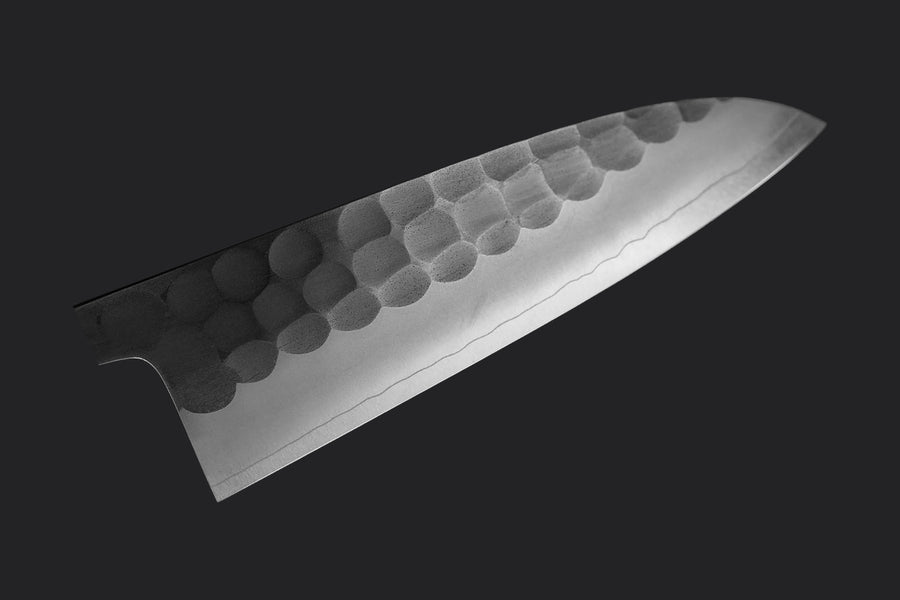
Surface Finish Tsuchime
Handle Special Handle
Region Takefu
Best for
  • Enthusiasts
  • Pro chefs
  • Household

World-wide shipping via DHL Express, 3 to 6 days (not available in the UK).


The Samidorizuki line carries SPG STRIX, a powdered stainless steel from Takefu Special Steel hardened to 63 to 65 HRC. It is built on a strengthened metallic base, so despite the high hardness it sharpens with feedback closer to a carbon steel than a typical powder stainless.

Each blade is a double bevel sanmai build, on an octagonal stabilised birch handle. The gyuto weighs 170 g with a 215 mm edge and a spine that tapers from 2.1 mm at the heel to 1.3 mm near the tip; the compact 170 mm santoku is 148 g, and the 135 mm petty handles the peeling and detail work at 81 g.

At 63 to 65 HRC the edge holds up well, and the steel is designed so it sharpens with the feedback of a carbon steel on your usual stones. For cooks who want high hardness without the fuss of carbon steel, this series threads that needle well.

Video Review

Pros Cons
  • Excellent performance
  • Ideal for the household
  • Great for professionals
Care Instruction
  1. Don't cut hard things! Japanese knives are brittle so bone hacking is a NO NO!
  2. Wash with neutral detergent after use, and wipe dry;
  3. Please don't wash knife with dishwasher, it will damage the wood handle;
  4. Be careful not to leave the knife close to a heat source for a long time;
  5. It is a lot more dangerous to cut with a blunt knife than a sharp knife!
  6. It is best to sharpen a Japanese knife regularly on a waterstone.

Makoto Kurosaki

Makoto Kurosaki (黒崎真) is a professional sharpener based at Takefu Knife Village in Echizen, Fukui, where he runs his own sharpening workshop, Style K, opened in 2018. He is the older brother of blacksmith Yu Kurosaki, and his work shows a family eye for clean, crisp knife design, but his own role is the one behind the edge: taking forged blades and grinding and sharpening them into knives that actually cut. His Kaen line, with its hexagonal tsuchime patterns and VG10/VG2 coreless damascus, pairs that clean look with thin, light geometry.

In 2020 he was certified a Dento Kogeishi (traditional craftsman), and his recent lines use modern steels such as Takefu's SPG Strix powdered stainless, hardened to 63-65 HRC while keeping a carbon-like sharpening feel. The workshop is now organised as Echizen Kurosaki K.K. (越前くろさき). He is a sharpener (togishi), not a blacksmith, so his craft is the finishing that turns a forged blank into a working knife.

“The sharpener's craft: clean, crisp lines and near-laser grinds from Echizen.”

Est. 2018 | 平成30年
Known for Clean, crisp knife lines and thin, high-performance grinds; work in SPG Strix powder stainless and coreless VG10/VG2 damascus.
Website takefu-knifevillage.jp Read more about Makoto Kurosaki

Makoto Kurosaki · Takefu

Knife details

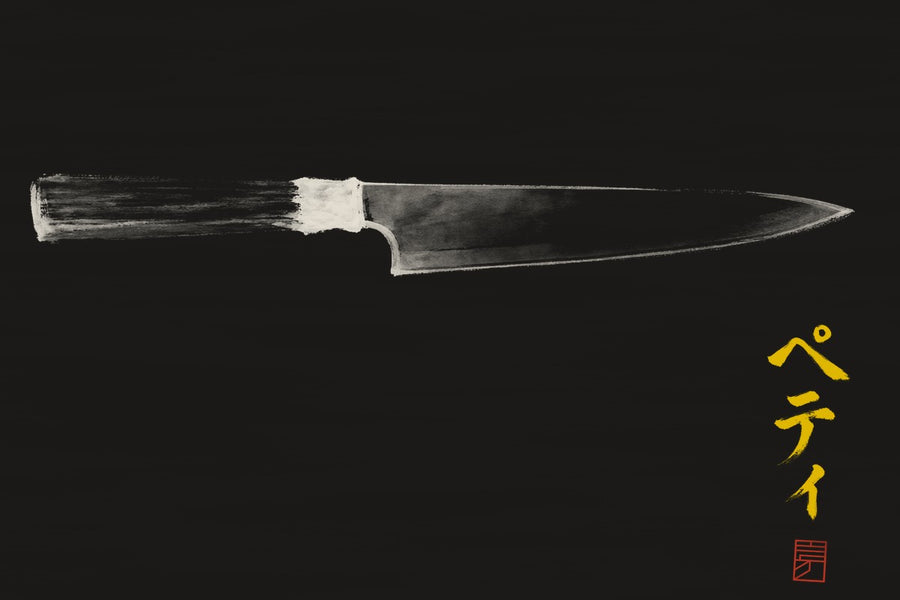
Petty — knife profile
Profile

Petty

ペティ

Utility knife · Double bevel

Small, slim double-bevel utility knife for peeling, trimming and small board jobs.

Read more
Steel properties
  1. Toughness Good
  2. Rust resistance High
  3. Ease of sharpening Fair
  4. Sharpness High

Our ratings, inferred from published lab tests and composition.

Steel

SPG STRIX

Stainless · Takefu Special Steel

Takefu stainless powder steel; Takefu says it sharpens like carbon steel.

Read more
CladdingCoreClad line
Construction

Sanmai - Stainless Clad

三枚

3 layers · stainless clad

Hard core between two stainless layers, bare only at the edge; the cladding resists rust.

Read more
Tsuchime — blade surface finish
Finish

Tsuchime

槌目

Hammered surface

Hammer marks across the upper blade. The dimples may help food release.

Read more
Handle

Special Handle

Octagonal WA

The maker's own handle; material not disclosed. See the product photos for its look.

Frequently asked questions

What is a petty knife and when do I need one?

A petty is a small utility knife, from the French petit. It is commonly shaped like a small gyuto and runs from 120 to 150 mm, up to 180 mm. Its clearest role is detailed work where a larger knife feels cumbersome: fruit peeling, garnish work, condiments, and small board work beside a gyuto or santoku.

A knife maker, Tojiro, frames the petty as a useful second knife, not an automatic necessity, and recommends santoku plus petty or gyuto plus petty combinations. It is not a replacement for a full size chef's knife; it lacks the blade length and belly for efficient chopping, rocking, or breaking down larger proteins. Treat it as a precision tool, not an all-rounder.

How long is a petty knife?

Petty knife lengths vary by maker: KAI's guide defines a petty (ペティナイフ) as a small knife with a narrow blade measuring 150 mm or under. Its table gives 90 to 150 mm, and it describes the shape as a smaller gyuto with a pointed tip.

We list petty knives from 70 mm to 165 mm, including lengths above the limit used in KAI's guide.

What is a good second Japanese knife after a gyuto?

For most cooks the second knife after a gyuto is a small utility knife (petty) of about 150mm. If most of your cooking is vegetables, make it a vegetable knife (nakiri) instead; if you carve or slice a lot of meat or fish, a slicing knife (sujihiki).

A gyuto covers the main board work, so the gap it leaves is small work. A petty does the jobs where a full-size blade is clumsy: peeling, trimming and coring in the hand, and small board jobs such as shallots, fruit and herbs. Our petty knife FAQ covers the shape in detail.

A nakiri earns the second slot if you prep vegetables every day. Its flat edge meets the board along its whole length, so slices separate cleanly. It has no pointed tip, so the gyuto still does the tip work.

A sujihiki is the choice for carving roasts and portioning large pieces of meat or fish. The long, narrow blade has less surface touching the food than a gyuto, so slices come away cleaner. 240mm and 270mm are the popular lengths.

A santoku or a bunka is a weak second knife: both are all-purpose shapes that repeat what the gyuto does. If your gyuto already handles the small jobs comfortably, the second knife can wait, and a whetstone to keep the first one sharp is the better spend.

Why is SPG STRIX easy to sharpen for such a hard steel?

Takefu, which makes SPG STRIX, designed it that way. It says a blade steel's hardness comes from its metal base and its carbides, and it made this stainless powder steel by strengthening the base, which it says gives ease of sharpening like carbon steel at about HRC 65.

Takefu calls it a powder steel developed for blades and does not disclose its composition. We recommend drying the knife after washing.

How can I tell sanmai, warikomi, damascus and honyaki apart?

Start with the line on the blade. On a clad knife, sanmai or warikomi, a hard steel core is joined to a softer cladding, and the join shows on the bevel. Tojiro says this is where the name kasumi (霞, haze) comes from: the hard steel takes a shine while the soft metal looks hazy.

A honyaki (本焼) is made of one steel. Before hardening the smith coats the parts that should stay softer with clay, so only the edge hardens fully, and the boundary can show as a hamon (刃文).

Damascus is a pattern made by forging many layers of different metals together and then bringing the pattern out with the finish. If it matters how a knife is built, ask before you buy. Our sanmai, warikomi and honyaki pages show each construction.