Iron Clad  |  SKU: MASA_YKW2_BU170

Masakage Yuki White2 Bunka 170mm Stainless Clad

Sale price $354.00 Regular price $416.00

IMPORTANT: Carbon steel knives can rust or patina quickly if not cared for properly. They require regular cleaning, drying, and oiling. If you are unfamiliar with carbon steel maintenance, we recommend choosing a stainless steel option instead.

Pickup in Australia only

In Stock Now

Availability

Goes well with

Detailed Specifications
Line Masakage Yuki White 2 Nashiji
Profile Bunka / K-tip santoku
Bevel Type Double Bevel
Weight 159 g | 5.6 oz
Edge Length 174 mm | 6 27/32″
Heel Height 47 mm | 1 27/32″
Width @ Heel 3.3 mm | 1/8″
Width @ Mid 1.9 mm | 5/64″
Width @ 1cm from Tip 1.1 mm | 3/64″
Steel White 2 / Shirogami #2 | Carbon
Blade Construction Sanmai - Stainless Clad
Maker's hardening hardness 60 HRC or more
Surface Finish Nashiji
Handle Octagonal Ebony with Black Horn Ferrule
Region Fukuyama
Best for
  • Pro chefs
  • Enthusiasts
  • First-timers

World-wide shipping via DHL Express, 3 to 6 days (not available in the UK).


Yuki(雪, Snow) is a simple and elegant line offered by Masakage, Nashiji surface, Migaki bevel with soft kasumi polish on the soft cladding, it's a minimalistic design that that aims to display nothing but the organic trace produced by the craft of the blacksmith and the sharpener. This simple silver look almost feels like a gentle snow that takes away colour, leaving just texture and geometry of the blade for you to experience in hand.

The choice of steel seems to complement the name too. With Hitachi White #2, you can obtain an extremely sharpen edge on these blades. Although bring prone to rust, the stainless cladding on the outside covers up most of the core steel with Kato san's masterful forging, making it relatively easier to maintain compare to knives with iron cladding.

The spine of these knives are lightly tapered, enough to let you know it is a hand forged knife, the thickness if the blade ensure a good rigidity and gives weight to the blade, make Yuki a line with very solid feel in hand. That thickness doesn't reduce the cutting performance thanks to the sharpening done by Shibata san. In the spine shot we can clearly see the thick blade gets thinned down to a edge with a beautiful concave grind. Combining with the aggressive edge you can get with carbon steel, Yuki is excellent in food penetration. As the food reach the Shinogi line, they would also release off cleanly.

Fo people look to get an authentically crafted knife, Yuki would be a great option. The hand forging and sharpening feature are strong on these blades while the simple design kept the price relatively affordable. If you are curious about why these knives are beloved by knife enthusiasts and professionals, consider this line as you first step into the world of artisan knives.

Pros Cons
  • Excellent performance
  • Great OOTB
  • Thin behind the edge
  • Prone to rust
  • A little bit brittle
Care Instruction
  1. Don't cut hard things! Japanese knives are brittle so bone hacking is a NO NO!
  2. Wash with neutral detergent after use, and wipe dry;
  3. Please don't wash knife with dishwasher, it will damage the wood handle;
  4. Be careful not to leave the knife close to a heat source for a long time;
  5. It is a lot more dangerous to cut with a blunt knife than a sharp knife!
  6. It is best to sharpen a Japanese knife regularly on a waterstone.
  7. Oil the (carbon) knife if storing for an extended period of time to prevent rust.

Masakage

Masakage (昌景), Takayuki Shibata's brand

Masakage is the first original brand created by Takayuki Shibata, aimed at all-round knives with good performance, fit and finish, and the handcrafted look of village smiths. 

The name of the Masakage Brand originated from a Warring States Samurai General Masakage Yamagata, and this name carries the hope of Shibata san of creating a versatile brand that excels in all aspects, just like how Masakage Yamagata excels in battle, strategy, diplomacy, public order, and domestic affairs. 

The Masakage brand began as collaborations between Shibata-san and smiths of the Takefu Knife Village. Over the years, well-known Echizen makers such as Yu Kurosaki, Yoshimi Kato and Takeshi Saji have forged for it. These blades are then hand sharpened at Shibata’s workshop, where they achieve sharp edges and beautiful finish.

The way that Masakage knives are done are pretty much as handcrafted as you can get while being reasonably affordable, and they do display characteristics that are unique for handcrafted knives. Commonly seen on these blades are the forge-tapered spine, elegant, organic surface finish and complex bevel geometry that offer the smoothest cut. And I have to say I really like the names that Shibata san came up with, Kiri(fog), Yuki(snow), Shimo(frost), Mizu(water), Kumo(cloud)... Each lineup gets a poetic name that triggers your imagery about nature, where that image is reflected on the appearance of the knife through a carefully designed fabrication process. As far as product design goes, Masakage is careful.

So Masakage is indeed doing what Shibata san want the brand to do: providing knives that are truly excellent in all aspects. They got great balance and handling, excellent sharpness and edge retention, great look and on top of that, a beautiful name to complete them as integral packages.

Read more

Masakage is an original brand of Shibata Knives, the company of Takayuki Shibata in Fukuyama. On his site, Shibata writes that the Japanese blacksmithing scene was grim, with smiths retiring and dying and no one replacing them, and that he felt he had to make his own brand.

The brand takes its name from Masakage Yamagata, a samurai general of the Warring States period whom the site describes as excelling in battle, strategy, diplomacy, public order and domestic affairs. Masakage's earlier site said its knives were made by blacksmiths and hand sharpened by Shibata before sale.

We stock two Masakage lines: Koishi, in Aogami Super with a kurouchi tsuchime finish, and Yuki, in White 2 clad in stainless steel.

“Takayuki Shibata's own knife brand, named after the samurai general Masakage Yamagata.”

Est. 2008 | 平成20年
Known for Knives the brand says are made by blacksmiths and sharpened by Takayuki Shibata
Instagram @masakage Read more about Masakage

Masakage · Fukuyama

Knife details

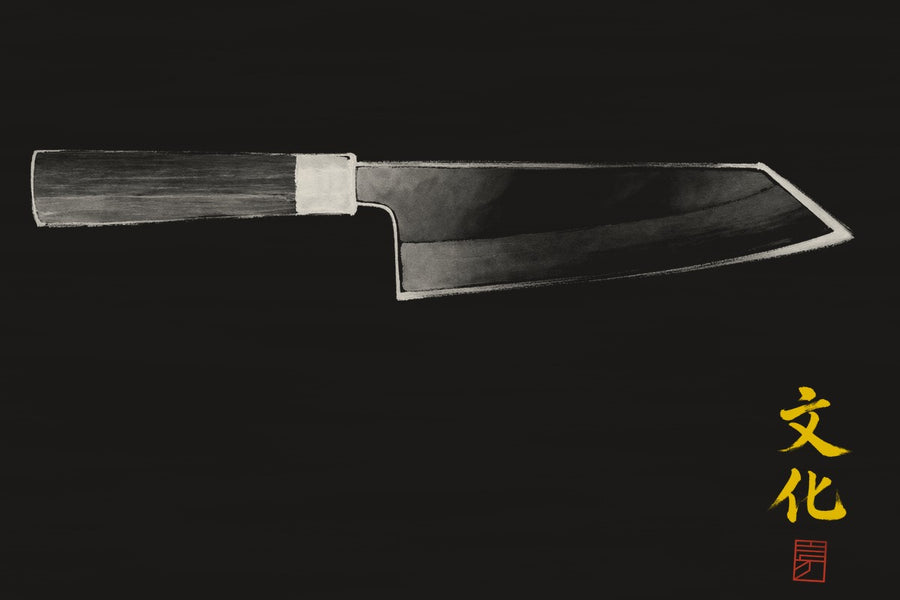
Bunka — knife profile
Profile

Bunka

文化

K-tip santoku · Double bevel

A compact all-rounder like a santoku; a Sakai maker says its angled K-tip suits fine work.

Read more
Steel properties
  1. Hardness Very good
  2. Edge retention Good
  3. Toughness Good
  4. Rust resistance Low
  5. Ease of sharpening High
  6. Sharpness Very high
Our ratings, inferred from published lab tests and composition.

Our edge-retention grade is a kitchen rating. It weighs the hardness each steel is sold at, which keeps a thin edge from rolling, twice as heavily as lab wear tests, and the final grade is our judgment from selling and sharpening these knives for over a decade. Lab card-cutting tests measure abrasive wear only, so they can rank carbon steels lower. Tap ? for the lab figure.

Steel

White 2 / Shirogami #2

白二鋼

Carbon · Hitachi Metals (now Proterial)

Proterial carbon steel, 1.05 to 1.15% carbon, no chromium or tungsten; not stainless.

Read more
CladdingCoreClad line
Construction

Sanmai - Stainless Clad

三枚

3 layers · stainless clad

Hard core between two stainless layers, bare only at the edge; the cladding resists rust.

Read more
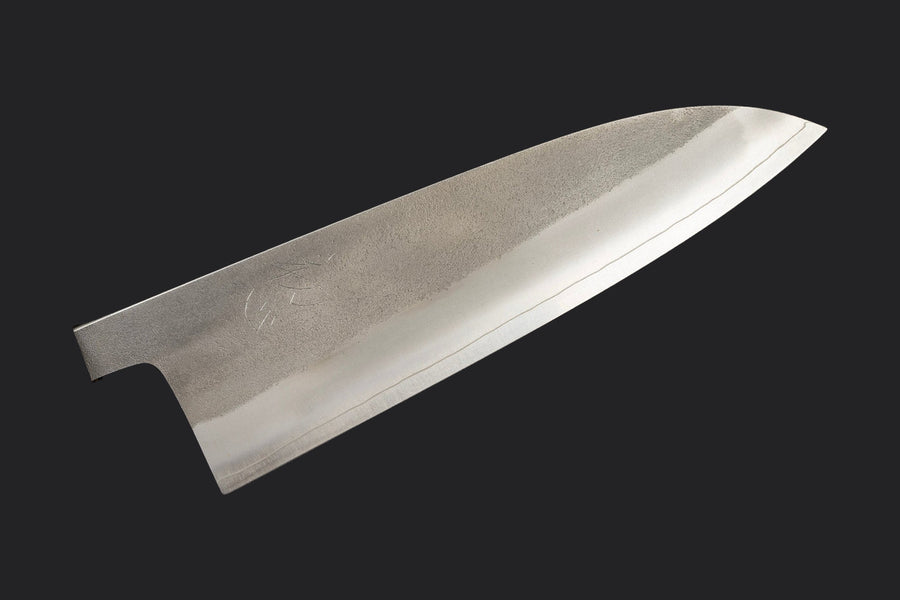
Nashiji — blade surface finish
Finish

Nashiji

梨地

Pear-skin texture

A fine matte texture like the skin of a nashi pear. It may help food release.

Read more
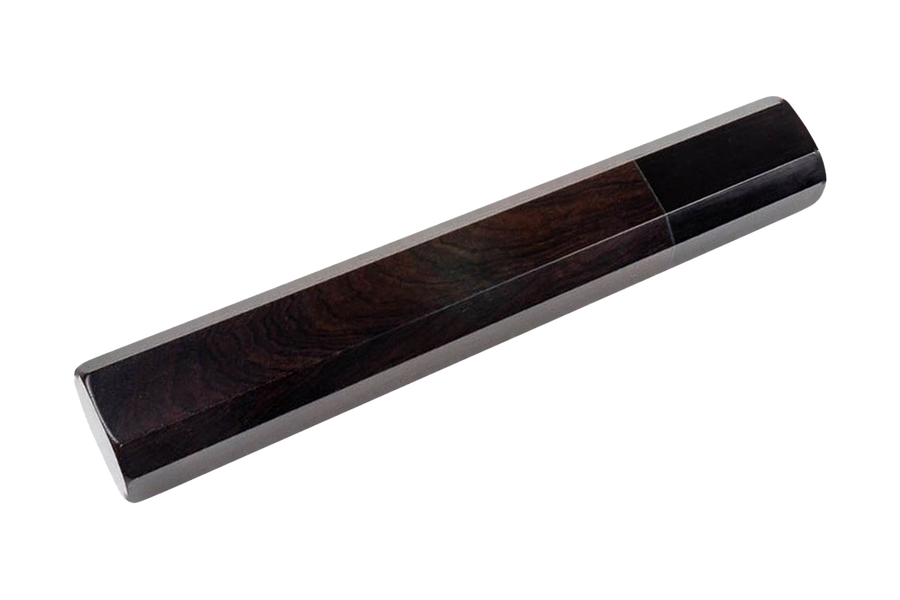
Octagonal Ebony with Black Horn Ferrule handle
Handle

Octagonal Ebony with Black Horn Ferrule

Octagonal WA

Ebony, eight-sided, with a black buffalo horn ferrule: the standard all-black wa handle.

Frequently asked questions

Why is it called a bunka knife?

The bunka knife (文化包丁) takes its name from bunka, culture. A Sakai knife maker ties the name to Japan's modernisation, when Western culture and Japanese tradition merged, and says it stands for that new era and for the knife's wide range of uses.

The same maker says that as diets broadened to meat, fish and vegetables, an all-purpose knife was wanted, and the bunka took features from both Japanese and Western knives.

What is the difference between a bunka and a santoku?

The tip. One Japanese knife maker describes the bunka (文化包丁, kengata) as combining the good points of the gyuto and the nakiri with the tip cut at an angle, and the santoku as coming after it, by rounding that tip.

Both are all-purpose knives for the home; santoku (三徳) means three virtues, for the three foods it cuts: meat, fish and vegetables.

Bunka, nakiri or usuba: which knife is best for vegetables?

For everyday vegetable prep, a nakiri (菜切) is the simple choice. Tojiro describes it as Japan's own vegetable knife: a square, double-bevel blade, so it cuts the same way in either hand.

A bunka (文化) is a home knife that Tojiro describes as combining the good points of the nakiri and the gyuto. Choose it if you want one knife for vegetables plus meat and fish, with an angled tip.

An usuba (薄刃) is a knife made for vegetable preparation in Japanese cooking. It is single bevel, so it is made for one hand, and Tojiro lists its jobs as peeling and hollowing at the heel, and katsuramuki, fine garnish cuts and rounding off cut edges along the middle of the edge. Choose it if you want to learn those techniques.

Shirogami 1 vs Shirogami 2: what is the difference?

Shirogami 1 (White 1) has more carbon than Shirogami 2 (White 2): Proterial lists 1.25 to 1.35% carbon for Shirogami 1 and 1.05 to 1.15% for Shirogami 2, with the same silicon (0.10 to 0.20%) and manganese (0.20 to 0.30%) ranges for both.

Proterial describes both as carbon steel with minimum impurities, Shirogami 1 with the highest hardness and Shirogami 2 with high hardness, and gives a hardening hardness of over 60 HRC for both. It lists Shirogami 1 for the highest quality tipped tools, planes, chisels and razors, and Shirogami 2 for high quality tipped tools, chisels, razors, sickles, axes and gravers.

What is the difference between White 1, White 2 and White 3?

White 1, White 2 and White 3 are Proterial's Shirogami 1, Shirogami 2 and Shirogami 3. Proterial lists carbon at 1.25 to 1.35% for Shirogami 1, 1.05 to 1.15% for Shirogami 2 and 0.80 to 0.90% for Shirogami 3, with the same silicon and manganese ranges for all three and no chromium listed.

Proterial describes all three as carbon steel with minimum impurities, at highest, high and middle hardness in that order, and gives a hardening hardness of over 60 HRC for each.

What is the difference between Blue 2 and White 2 steel?

Blue 2 is White 2 with tungsten and a little chromium added. Blue 2 holds its edge longer. White 2 sharpens faster and takes a very keen edge. Both are carbon steels that will rust if left wet.

The figures come from Proterial, which makes both. Each has 1.05 to 1.15% carbon. Blue 2 (Aogami 2) adds 1.00 to 1.50% tungsten and 0.20 to 0.50% chromium. White 2 (Shirogami 2) lists neither, and Proterial describes it as a carbon steel with minimum impurities. Proterial says the tungsten and chromium improve heat treatment and wear resistance, and gives a hardening hardness over 60 HRC for both.

In use, the tungsten forms hard carbides that resist wear, so a Blue 2 edge lasts longer between sharpenings. White 2 has none, so it comes back on a whetstone very quickly. The chromium in Blue 2 is far below the 10.5% a steel needs to be stainless, so it gives no real rust protection. Wipe either steel dry after use and expect a patina.

Choose Blue 2 if you want to sharpen less often. Choose White 2 if you enjoy sharpening and want the keenest edge. We list both widely: Blue 2 from Nigara, Myojin Riki and Anryu, and White 2 from Masamoto Sohonten, Sakai Takayuki and Yoshikane.

Is Masakage a blacksmith or a brand?

Masakage is a brand, not a single forge. Takayuki Shibata (柴田 崇行) dates it on his own site to 2008, as his first brand, and gives his reason: "Smiths were retiring and dying, and no one was replacing them. I felt that I had to make my own brand."

The same site says he took up sharpening in 2007, taught by a local cutler, and put bigger orders in to his blacksmiths as sales grew. Shibata's company is Iron Clad, in Fukuyama, Hiroshima.

Are Masakage knives worth it?

We think so. Masakage was the first brand of Takayuki Shibata, a sharpener and knife designer in Fukuyama, Hiroshima. He launched it in 2008. His company, IRONCLAD Ltd., also holds Koutetsu and Tsunehisa, and his site says it sells in more than twenty countries.

Several smiths have forged for Masakage over the years, so it is worth judging each line on its steel and finish rather than on one maker's name.

We list Masakage Koishi (Aogami Super, kurouchi tsuchime) and Masakage Yuki (White #2, stainless clad). Stock changes, so check each listing. The Takayuki Shibata craftsman page has more on him.