


Nakagawa Blue 1 Damascus K-tip Gyuto 255mm Birch Handle
Nakagawa Blue 1 Damascus K-tip Gyuto 255mm Birch Handle is backordered and will ship as soon as it is back in stock.
Pickup in Australia only
Sold out right now
Leave your email and we’ll send one message the moment it’s back in stock.
One email, no marketing. Privacy policy.
In Stock Now
-
Nakagawa Ginsan Wide Bevel Kasumi K-tip Gyuto 210mm Ebony HandleSale price $516.00 Regular price $607.00Unit price
-
Nakagawa Ginsan Yanagiba 270 / 300 / 330 mm Mirror Polished Finish, Left-HandedSale priceFrom $715.00 Regular price $841.00Unit price
-
Naoto Blue 1 Damascus Kurouchi Bunka 180mmSale price $335.00 Regular price $393.00Unit price
-
Naoto Blue 1 Damascus Kurouchi Santoku 180mmSale price $335.00 Regular price $393.00Unit price
-
Hatsukokoro Blue 1 Kasumi Gyuto 210mmSale price $333.00 Regular price $416.00Unit price
-
K&S Yuepo SLD Nashiji K-tip Gyuto 210mm, Ebony HandleSale price $190.00 Regular price $223.00Unit price
-
Hatsukokoro Ryuhyo SG2 Black Damascus K-tip Gyuto 210mm EbonySale price $387.00 Regular price $455.00Unit price
-
Hatsukokoro Kaijin Blue 2 K-tip Gyuto 210mm Migaki Curly MapleSale price $190.00 Regular price $223.00Unit price
Availability
Delivery unavailable for this item. Available for in-store pickup only.
-
St Peters, NSW —2 Bishop St, Unit 2, St Peters NSW 2044
Goes well with
Detailed Specifications
| Line | Nakagawa Blue 1 Damascus Traditional Double Bevel |
| Profile | K-tip Gyuto / K-tip chef's knife |
| Bevel Type | Double Bevel |
| Weight | 246 g | 8.7 oz |
| Edge Length | 240 mm | 9 29/64″ |
| Heel Height | 49 mm | 1 59/64″ |
| Width @ Heel | 3.0 mm | 1/8″ |
| Width @ Mid | 2.2 mm | 3/32″ |
| Width @ 1cm from Tip | 1.0 mm | 3/64″ |
| Steel | Blue 1 / Aogami #1 | Carbon |
| Blade Construction | Sanmai - Soft Iron Damascus Clad |
| Maker's hardening hardness | 60 HRC or more |
| Surface Finish | Migaki |
| Handle | Octagonal Birch Burl with Spacer |
| Region | Sakai |
| Best for |
|

| Pros | Cons |
|
|
- Don't cut hard things! Japanese knives are brittle so bone hacking is a NO NO!
- Wash with neutral detergent after use, and wipe dry;
- Please don't wash knife with dishwasher, it will damage the wood handle;
- Be careful not to leave the knife close to a heat source for a long time;
- It is a lot more dangerous to cut with a blunt knife than a sharp knife!
- It is best to sharpen a Japanese knife regularly on a waterstone.
- Oil the (carbon) knife if storing for an extended period of time to prevent rust.
Knife details
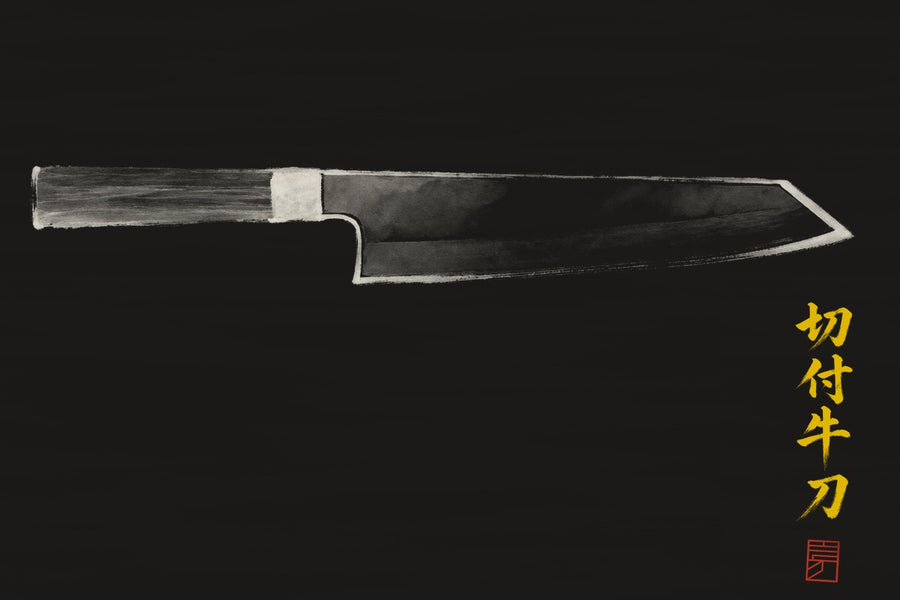
K-tip Gyuto
切付牛刀
K-tip chef's knife · Double bevel
Double-bevel chef's knife with an angled tip and flatter edge for push cuts and scoring.
Read more-
Hardness
Very high
How hard the steel is after heat treatment, measured in HRC. Harder steel can take a thinner, sharper edge but is more likely to chip. Maker's hardening hardness: 60 HRC or more
-
Edge retention
Very good
How long the edge stays sharp in kitchen use before it needs sharpening. Not lab-tested; estimated from V-Toku2 (314 mm of test card cut at 63.6 HRC, Knife Steel Nerds CATRA test, 2020). Hardness used: 63 HRC, the usual hardness makers sell it at. Carbon steels score lower on this abrasive test, which is why our grade also counts hardness.
-
Toughness
Very good
How well the steel resists chipping and cracking from bones, hard boards or twisting.
-
Rust resistance
Low
How slowly the steel rusts or stains when left wet.
-
Ease of sharpening
High
How quickly the steel comes back to sharp on a whetstone.
-
Sharpness
Very high
How fine an edge the steel can take and hold. Judged from the hard carbides inside it: smaller and fewer carbides allow a keener edge.
Our ratings, inferred from published lab tests and composition.
Our edge-retention grade is a kitchen rating. It weighs the hardness each steel is sold at, which keeps a thin edge from rolling, twice as heavily as lab wear tests, and the final grade is our judgment from selling and sharpening these knives for over a decade. Lab card-cutting tests measure abrasive wear only, so they can rank carbon steels lower. Tap ? for the lab figure.
Blue 1 / Aogami #1
青一鋼
Carbon · Hitachi Metals (now Proterial)
Proterial carbon steel, 1.25 to 1.35% carbon with chromium and tungsten; not stainless.
Read moreSanmai - Soft Iron Damascus Clad
三枚・軟鉄ダマスカス
3 layers · iron damascus clad
Hard core between two soft iron damascus layers. The iron patinas and rusts; keep it dry.
Read more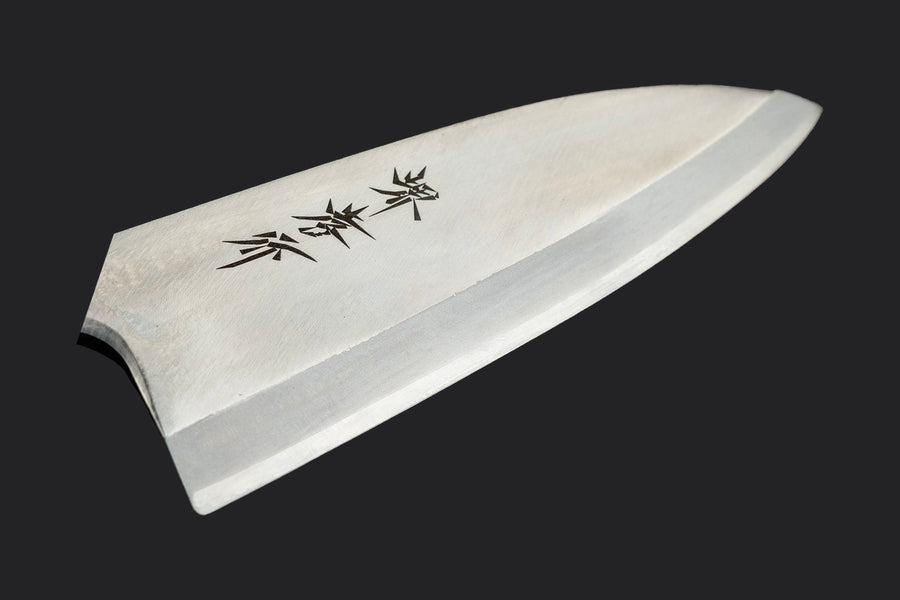
Migaki
磨き
Polished satin
Smooth polished surface, satin to soft sheen rather than mirror. Scratches show.
Read more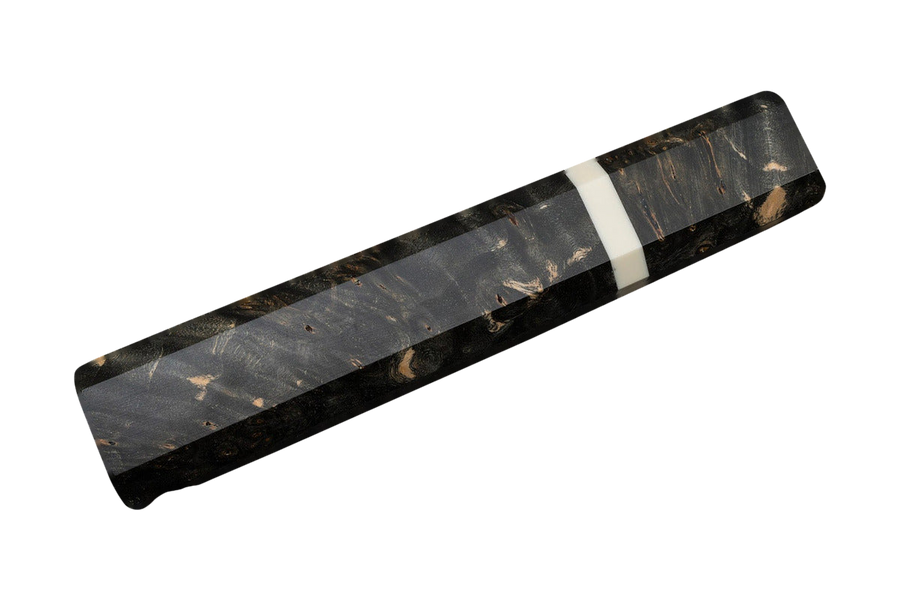
Octagonal Birch Burl with Spacer
Octagonal WA
Stabilised birch burl, eight-sided, with a spacer. Resin-stabilised wood resists water.
