Nakagawa Hamono  |  SKU: NAKA_G3KA_BK170

Nakagawa Ginsan Bunka 165mm with K&S Ebony Handle

Sale price $469.00 Regular price $551.00

Pickup in Australia only

In Stock Now

Availability

Detailed Specifications
Line Hatsukokoro by Nakagawa Ginsan Wide Bevel Kasumi
Profile Bunka / K-tip santoku
Steel Ginsan / Silver #3 | Stainless
Blade Construction Sanmai - Stainless Clad
Maker's hardening hardness 59 HRC or more
Surface Finish Kasumi
Handle
Region Sakai
Best for
  • Pro chefs
  • Students
  • First-timers

World-wide shipping via DHL Express, 3 to 6 days (not available in the UK).


The Nakagawa Ginsan Wide Bevel is a line commissioned by Hatsukokoro that offers a series of very solid blades that are good for both professional works and home use. This line combines moderate thickness, decent profile and good detail finish in a completely stainless package, making these knives good all-rounders in most situations, wether at home or in a more professional setting.

The wide bevel in the name refers to the grind that these blades takes on. Usually Japanese double bevel knives will have a flat grind, where the secondary bevel starts all the way at the spine, in cases where the secondary bevels start halfway, they tend to blends into the flat zone slightly. This line however, have a very distinct boundary at the beginning of its secondary bevel,creating a very sharp and geometrycall look, especially on the Kiritsuke Gyuto, which distinct the entire line from other plain Migaki finish knives.

Performance of the knife on the chopping board is great, as the bevel takes a concave grind, it is of a good sharpness even the thickness of the spine is not as thin as some "laser" knives, though there is a slight tendency for the food to stick due to this grind. This combination allows the edge to be thin, while having more material behind the bevel to provide toughness in a professional setting.

The Ginsan steel used in this line is what makes these knives truly all-rounders in my opinion. Comparing with VG10, two steels have similar hardness and edge retention, but the higher alloy content in VG10(Mo,V and Co) makes the sharpening harder than a more "pure" composition like Ginsan's. Thus, in a commercial kitchen where the wearing and sharpening of knives happens more often, the Ginsan will often save time and efforts.

A drawback comes with Ginsan is that knives made with it tend to have a higher price, which is true on this line. Also, even the rounding and polishing on the spine and choil are all pretty good, the Migaki finish is not the aesthetically pleasing one in this price range. If these minor concerns don't bother you, this Ginsan wide bevel line will offer s me very good user's knives.

Pros Cons
  • Easy to look after
  • Ideal for the household
  • Great for professionals
  • High budget
Care Instruction
  1. Don't cut hard things! Japanese knives are brittle so bone hacking is a NO NO!
  2. Wash with neutral detergent after use, and wipe dry;
  3. Please don't wash knife with dishwasher, it will damage the wood handle;
  4. Be careful not to leave the knife close to a heat source for a long time;
  5. It is a lot more dangerous to cut with a blunt knife than a sharp knife!
  6. It is best to sharpen a Japanese knife regularly on a waterstone.

Satoshi Nakagawa

Satoshi Nakagawa's workshop in Sakai, since 2021

Nakagawa Hamono is Satoshi Nakagawa's (中川悟志) workshop in Sakai, registered as Nakagawa Uchihamono Co., Ltd. (株式会社中川打刃物), with its office and forge in Sakai Nishi-ku. The company says he carries on Sakai's forged knife industry.

He worked 16 years under Kenichi Shiraki (白木健一) as his only disciple and successor. In 2021 he took over his master's workshop and equipment and put up the Nakagawa Uchihamono sign.

Read more

The workshop's own profile says it works with White 3 to White 1, Blue 2 to Blue 1, stainless Ginsan and VG10, as well as honyaki. Sakai City's register lists Satoshi Nakagawa as a certified traditional craftsman in the forging division.

He has forged for Sakai Takayuki, and he forges the Hatsukokoro lines that carry his name, titled Hatsukokoro by Nakagawa and Hatsukokoro x Nakagawa.

The lines we list under his own name are Nakagawa Honyaki, the Nakagawa Blue 1 Damascus (double bevel, etched black, wide bevel) and the Nakagawa VG10 single bevel. The Hatsukokoro lines run across Ginsan, Blue 1 and Blue 2, in kasumi, wide bevel, single bevel, mirror polish and Damascus versions.

“A new-generation blacksmith in Sakai. ”

Est. 2021 | 令和3年
Known for Single bevel knives in Ginsan, Blue and VG10 steels.
Website nakagawa-knives.com Instagram @nakagawa_kajiya Read more about Satoshi Nakagawa

Satoshi Nakagawa · Sakai

Knife details

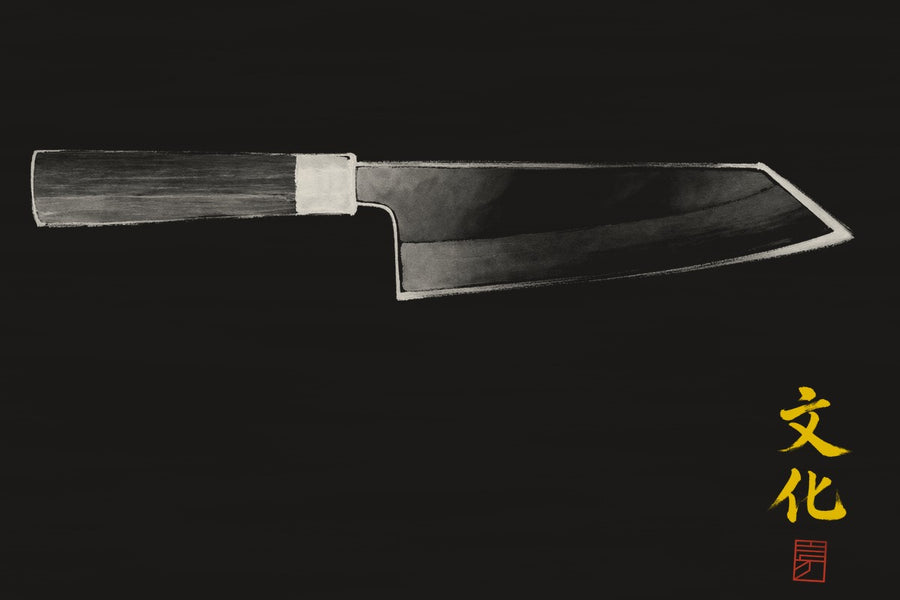
Bunka — knife profile
Profile

Bunka

文化

K-tip santoku · Double bevel

A compact all-rounder like a santoku; a Sakai maker says its angled K-tip suits fine work.

Read more
Steel properties
  1. Hardness Good
  2. Edge retention Good
  3. Toughness Very high
  4. Rust resistance High
  5. Ease of sharpening High
  6. Sharpness High
Our ratings, inferred from published lab tests and composition.

Our edge-retention grade is a kitchen rating. It weighs the hardness each steel is sold at, which keeps a thin edge from rolling, twice as heavily as lab wear tests, and the final grade is our judgment from selling and sharpening these knives for over a decade. Lab card-cutting tests measure abrasive wear only, so they can rank carbon steels lower. Tap ? for the lab figure.

Steel

Ginsan / Silver #3

GIN3

Stainless · Hitachi Metals (now Proterial)

Proterial's GIN 3 stainless: 0.95 to 1.10% carbon, 13.00 to 14.50% chromium, hardening hardness over 59 HRC.

Read more
CladdingCoreClad line
Construction

Sanmai - Stainless Clad

三枚

3 layers · stainless clad

Hard core between two stainless layers, bare only at the edge; the cladding resists rust.

Read more
Kasumi — blade surface finish
Finish

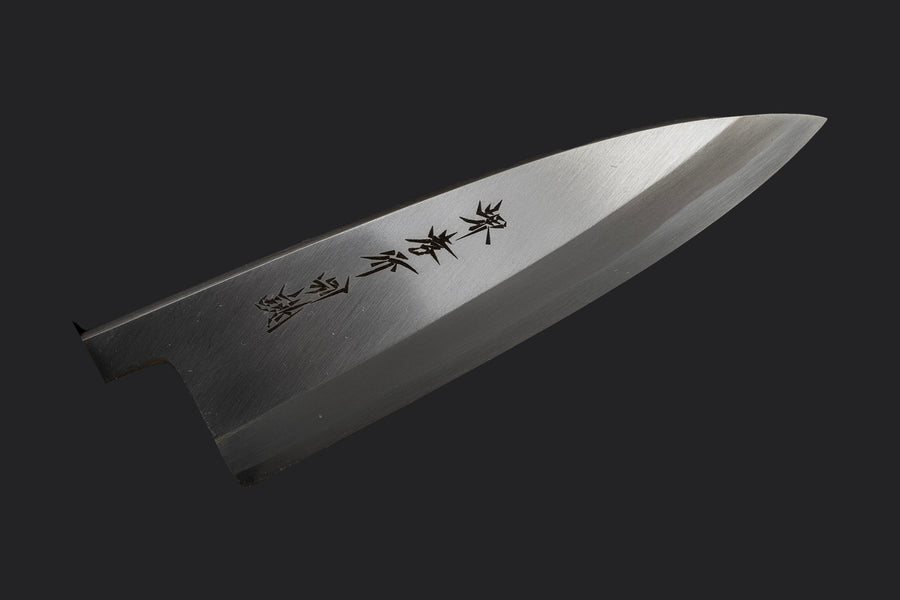
Kasumi

霞

Misty polish

Hazy, matte bevel where soft iron meets hard core steel. The iron patinas and rusts.

Read more

Frequently asked questions

Why is it called a bunka knife?

The bunka knife (文化包丁) takes its name from bunka, culture. A Sakai knife maker ties the name to Japan's modernisation, when Western culture and Japanese tradition merged, and says it stands for that new era and for the knife's wide range of uses.

The same maker says that as diets broadened to meat, fish and vegetables, an all-purpose knife was wanted, and the bunka took features from both Japanese and Western knives.

What is the difference between a bunka and a santoku?

The tip. One Japanese knife maker describes the bunka (文化包丁, kengata) as combining the good points of the gyuto and the nakiri with the tip cut at an angle, and the santoku as coming after it, by rounding that tip.

Both are all-purpose knives for the home; santoku (三徳) means three virtues, for the three foods it cuts: meat, fish and vegetables.

Bunka, nakiri or usuba: which knife is best for vegetables?

For everyday vegetable prep, a nakiri (菜切) is the simple choice. Tojiro describes it as Japan's own vegetable knife: a square, double-bevel blade, so it cuts the same way in either hand.

A bunka (文化) is a home knife that Tojiro describes as combining the good points of the nakiri and the gyuto. Choose it if you want one knife for vegetables plus meat and fish, with an angled tip.

An usuba (薄刃) is a knife made for vegetable preparation in Japanese cooking. It is single bevel, so it is made for one hand, and Tojiro lists its jobs as peeling and hollowing at the heel, and katsuramuki, fine garnish cuts and rounding off cut edges along the middle of the edge. Choose it if you want to learn those techniques.

What is Ginsan steel, and why do some Japanese knives use it?

Ginsan, also known as Silver 3, is a stainless steel from Proterial, the Yasugi Specialty Steel division. Proterial describes it as a stainless steel which has hardness and sharpness comparable to carbon steel, and lists its uses as kitchen knives and scissors.

Knife makers use it when they want the corrosion resistance of a stainless together with the hardness and sharpness that Proterial compares to carbon steel. The steel maker lists 59 HRC or over after hardening, but that is a heat treatment figure, not a finished knife figure.

Dry it after use, like any stainless knife. Its performance depends on the heat treatment and construction of the specific knife, not the steel name alone.

Is Ginsan stainless?

Yes. Proterial lists the steel as GIN 3 with 13.00 to 14.50% chromium, above the Japan Stainless Steel Association's 10.5% minimum for stainless steel.

Proterial describes it as a stainless steel with hardness and sharpness comparable to carbon steel, used in various kitchen knives and scissors, and the association notes that stainless, strictly, means it rusts less. Wash the knife and dry it after use.

What is the Hatsukokoro by Nakagawa Ginsan Wide Bevel Kasumi knife line, and who is it for?

The Hatsukokoro by Nakagawa Ginsan Wide Bevel Kasumi is a commissioned line of stainless steel knives featuring a specific wide-bevel grind, designed as all-rounders for both professional chefs and home cooks.

This collection is built for users who need a durable, low-maintenance tool without the fuss of carbon steel, making it suitable for first-timers, students, and working pros alike. While the performance is solid for daily tasks, the trade-off is the cost, with current in-stock options like the 210mm Gyuto with an Ebony handle and the 170mm Santoku, both at a higher price point.

Are Hatsukokoro x Nakagawa knives forged by Satoshi Nakagawa?

Yes. We know from our own dealings with him that Satoshi Nakagawa forges commissioned lines for the Hatsukokoro brand, and our product titles name them Hatsukokoro by Nakagawa and Hatsukokoro x Nakagawa. He works from his own company in Sakai, Nakagawa Uchihamono.

He trained for sixteen years under Kenichi Shiraki as his only disciple and successor. His company says he works in White 3 to White 1, Blue 2 to Blue 1, stainless Ginsan, VG10 and honyaki.

Ginsan, Blue 1 or Blue 2: which Nakagawa steel should I pick?

Pick by how much care you want to give. Ginsan is stainless, while Blue 1 and Blue 2 are not: Proterial lists their chromium at 0.50% or less, well under the 10.5% the Japan Stainless Steel Association sets for stainless.

If you will dry and oil the blade after each use, a Blue 1 or Blue 2 line can suit you; if you want less upkeep, we suggest Ginsan.