Nakagawa Hamono  |  SKU: NAKA_G3KA_GY240EB

Hatsukokoro x Nakagawa Ginsan Wide-bevel Gyuto 240mm

Sale price $573.00 Regular price $674.00

Pickup in Australia only

In Stock Now

Availability

Goes well with

Detailed Specifications
Line Hatsukokoro by Nakagawa Ginsan Wide Bevel Kasumi
Profile Gyuto / Chef's knife
Bevel Type Double Bevel
Weight 210 g | 7.4 oz
Edge Length 234 mm | 9 7/32″
Heel Height 50 mm | 1 31/32″
Width @ Heel 3.0 mm | 1/8″
Width @ Mid 2.4 mm | 3/32″
Width @ 1cm from Tip 1.2 mm | 3/64″
Steel Ginsan / Silver #3 | Stainless
Blade Construction Sanmai - Stainless Clad
Maker's hardening hardness 59 HRC or more
Surface Finish Kasumi
Handle Octagonal Ebony
Region Sakai
Best for
  • Pro chefs
  • Students
  • First-timers

World-wide shipping via DHL Express, 3 to 6 days (not available in the UK).


The Nakagawa Ginsan Wide Bevel is a line commissioned by Hatsukokoro that offers a series of very solid blades that are good for both professional works and home use. This line combines moderate thickness, decent profile and good detail finish in a completely stainless package, making these knives good all-rounders in most situations, wether at home or in a more professional setting.

The wide bevel in the name refers to the grind that these blades takes on. Usually Japanese double bevel knives will have a flat grind, where the secondary bevel starts all the way at the spine, in cases where the secondary bevels start halfway, they tend to blends into the flat zone slightly. This line however, have a very distinct boundary at the beginning of its secondary bevel,creating a very sharp and geometrycall look, especially on the Kiritsuke Gyuto, which distinct the entire line from other plain Migaki finish knives.

Performance of the knife on the chopping board is great, as the bevel takes a concave grind, it is of a good sharpness even the thickness of the spine is not as thin as some "laser" knives, though there is a slight tendency for the food to stick due to this grind. This combination allows the edge to be thin, while having more material behind the bevel to provide toughness in a professional setting.

The Ginsan steel used in this line is what makes these knives truly all-rounders in my opinion. Comparing with VG10, two steels have similar hardness and edge retention, but the higher alloy content in VG10(Mo,V and Co) makes the sharpening harder than a more "pure" composition like Ginsan's. Thus, in a commercial kitchen where the wearing and sharpening of knives happens more often, the Ginsan will often save time and efforts.

A drawback comes with Ginsan is that knives made with it tend to have a higher price, which is true on this line. Also, even the rounding and polishing on the spine and choil are all pretty good, the Migaki finish is not the aesthetically pleasing one in this price range. If these minor concerns don't bother you, this Ginsan wide bevel line will offer s me very good user's knives.

Pros Cons
  • Easy to look after
  • Ideal for the household
  • Great for professionals
  • High budget
Care Instruction
  1. Don't cut hard things! Japanese knives are brittle so bone hacking is a NO NO!
  2. Wash with neutral detergent after use, and wipe dry;
  3. Please don't wash knife with dishwasher, it will damage the wood handle;
  4. Be careful not to leave the knife close to a heat source for a long time;
  5. It is a lot more dangerous to cut with a blunt knife than a sharp knife!
  6. It is best to sharpen a Japanese knife regularly on a waterstone.

Satoshi Nakagawa

Satoshi Nakagawa's workshop in Sakai, since 2021

Nakagawa Hamono is Satoshi Nakagawa's (中川悟志) workshop in Sakai, registered as Nakagawa Uchihamono Co., Ltd. (株式会社中川打刃物), with its office and forge in Sakai Nishi-ku. The company says he carries on Sakai's forged knife industry.

He worked 16 years under Kenichi Shiraki (白木健一) as his only disciple and successor. In 2021 he took over his master's workshop and equipment and put up the Nakagawa Uchihamono sign.

Read more

The workshop's own profile says it works with White 3 to White 1, Blue 2 to Blue 1, stainless Ginsan and VG10, as well as honyaki. Sakai City's register lists Satoshi Nakagawa as a certified traditional craftsman in the forging division.

He has forged for Sakai Takayuki, and he forges the Hatsukokoro lines that carry his name, titled Hatsukokoro by Nakagawa and Hatsukokoro x Nakagawa.

The lines we list under his own name are Nakagawa Honyaki, the Nakagawa Blue 1 Damascus (double bevel, etched black, wide bevel) and the Nakagawa VG10 single bevel. The Hatsukokoro lines run across Ginsan, Blue 1 and Blue 2, in kasumi, wide bevel, single bevel, mirror polish and Damascus versions.

“A new-generation blacksmith in Sakai. ”

Est. 2021 | 令和3年
Known for Single bevel knives in Ginsan, Blue and VG10 steels.
Website nakagawa-knives.com Instagram @nakagawa_kajiya Read more about Satoshi Nakagawa

Satoshi Nakagawa · Sakai

Knife details

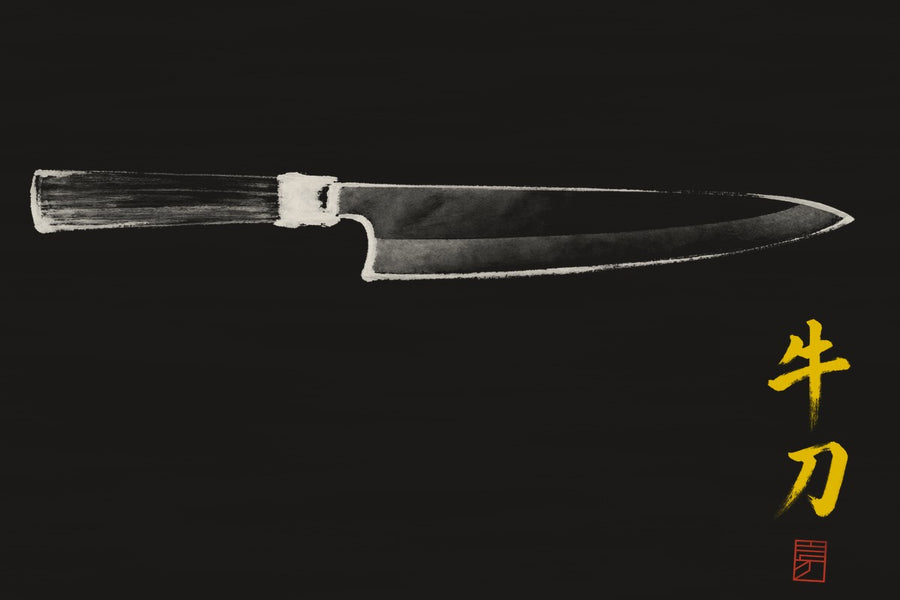
Gyuto — knife profile
Profile

Gyuto

牛刀

Chef's knife · Double bevel

Double-bevel all-purpose chef's knife with a pointed tip; thinner than a Western one.

Read more
Steel properties
  1. Hardness Good
  2. Edge retention Good
  3. Toughness Very high
  4. Rust resistance High
  5. Ease of sharpening High
  6. Sharpness High
Our ratings, inferred from published lab tests and composition.

Our edge-retention grade is a kitchen rating. It weighs the hardness each steel is sold at, which keeps a thin edge from rolling, twice as heavily as lab wear tests, and the final grade is our judgment from selling and sharpening these knives for over a decade. Lab card-cutting tests measure abrasive wear only, so they can rank carbon steels lower. Tap ? for the lab figure.

Steel

Ginsan / Silver #3

GIN3

Stainless · Hitachi Metals (now Proterial)

Proterial's GIN 3 stainless: 0.95 to 1.10% carbon, 13.00 to 14.50% chromium, hardening hardness over 59 HRC.

Read more
CladdingCoreClad line
Construction

Sanmai - Stainless Clad

三枚

3 layers · stainless clad

Hard core between two stainless layers, bare only at the edge; the cladding resists rust.

Read more
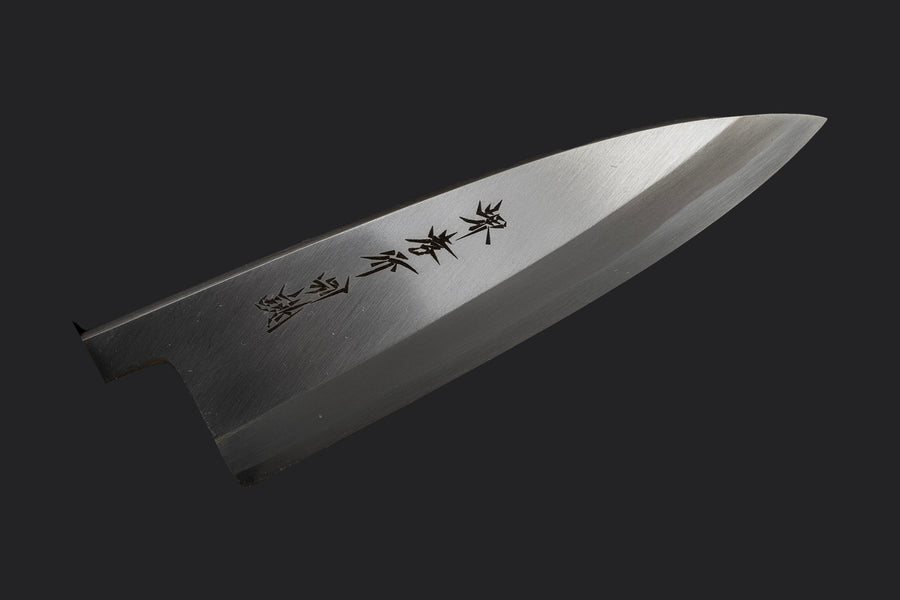
Kasumi — blade surface finish
Finish

Kasumi

霞

Misty polish

Hazy, matte bevel where soft iron meets hard core steel. The iron patinas and rusts.

Read more
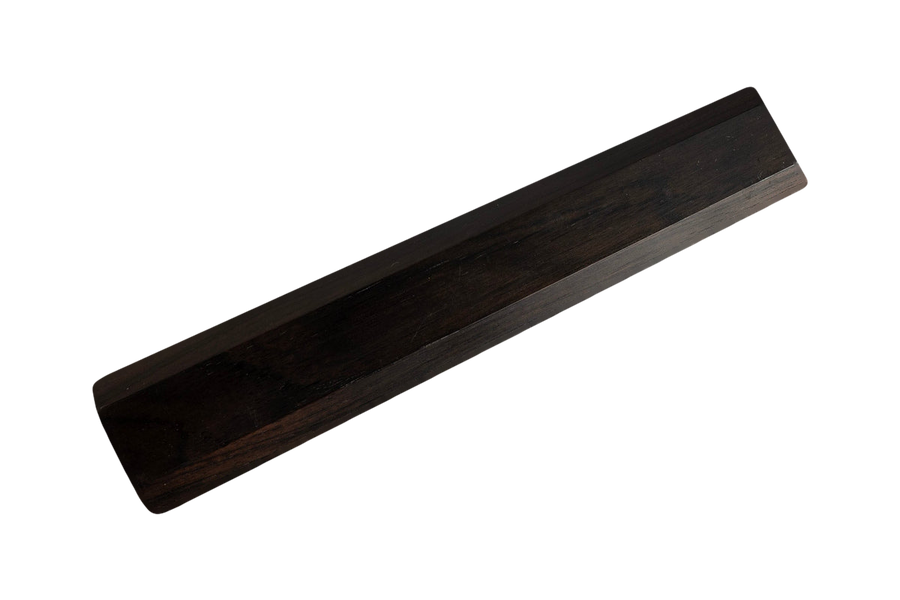
Octagonal Ebony handle
Handle

Octagonal Ebony

Octagonal WA

Dense, dark ebony in the eight-sided wa shape. The flats give a sure grip for either hand.

Frequently asked questions

Gyuto or santoku: which should I choose?

The gyuto came to Japan with the beef-eating culture of the Meiji era, and that is where its name comes from. Tojiro says it is used for all kinds of cooking, which is why it is also called the chef's knife.

The santoku is a household knife that combines the good points of the nakiri and the gyuto. Tojiro describes it as all-purpose, from vegetables to meat and fish, double-bevel and built on the same construction as a Western knife.

Choose a gyuto if you want more length and reach. Choose a santoku if you want a shorter all-purpose knife. Tojiro's own size figures: gyuto 150 to 210mm for household use and up to 360mm for professional use, santoku 165 to 170mm for household use.

What is a gyuto knife used for?

The gyuto (牛刀) is a chef's knife for all kinds of cooking, and it is basically double-bevel. A knife maker's guide says it came to Japan in the Meiji era with the culture of eating beef, which gave it its name, but it does not cut only meat.

A Japanese dictionary describes the gyuto as slimmer than a santoku, with a pointed tip, used widely for meat, fish and vegetables.

What gyuto length should I choose?

A knife maker's guide lists 150 to 210 mm, double-bevel, for home use, and 180 to 360 mm, single- or double-bevel, for professional kitchens.

We suggest starting with a 210 mm gyuto for a home kitchen, and stepping up to 240 mm if you regularly cut large pieces and have the board for it.

240mm vs 210mm gyuto: which size should I choose?

Get the 210mm. We only point people to a 240mm when they have about 45cm of usable board, cook in volume, and regularly break down big roasts or whole fish.

On the gyutos we've measured for our product pages, the extra length is real. As of October 2026, the 210mm gyutos we list have a median edge of 213mm from heel to tip, across the 111 we have measured; the 240mm ones have a median of 240mm, across 100. The 240s are also heavier, 212g against 175g at the median, and a touch taller at the heel, 50mm against 48mm, across the same 100 and 111 knives.

Weight overlaps between the two sizes. As of October 2026, 11 of the 100 measured 240s weigh less than the median 210 at 175g. The 240s we measured weigh 146 to 323g, and the 111 measured 210s 121 to 255g. The number in the name does not decide how heavy a knife is, so check the measured weight on the product page.

Japanese or German kitchen knives: which should I buy?

Buy Japanese if you want a thinner, harder knife and will treat it with some care. Buy German if the knife has to put up with rough use, rock chopping and a honing steel. We sell Japanese knives only, so you know where we stand, but the differences are real.

Hardness is the main one. German makers publish about 56 to 58 HRC for their chef's knives. Japanese steels sit higher: Takefu Special Steel rates VG10 at 60 HRC or more, and Proterial gives Blue 2 (Aogami 2) over 60 HRC after hardening. Harder steel holds a fine edge longer and lets the maker grind the blade thinner, so it moves through food with less effort. Softer steel dulls sooner, but its edge tends to roll where a harder one would chip, so it forgives more.

Shape follows. A German chef's knife has a deep curved belly made for rocking. A Japanese gyuto is flatter towards the heel, which suits push and pull cuts. German makers now publish edge angles of about 14 to 15 degrees per side, and Japanese double bevel knives are usually sharpened at about 12 to 16, so the real gap is thickness and hardness rather than the angle.

Care differs too. A honing steel suits the softer German edge. A Japanese knife is sharpened on a whetstone and should stay away from bones, frozen food and very hard squash. Both want a wooden or plastic board.

If you are moving across from German knives, a stainless gyuto of about 210 mm is the easiest step. The Sakai Takayuki VG10 33 Layer Hammered Damascus gyuto has a Western handle and will feel familiar in the hand.

What is the flat spot on a knife, and is it the same as the "sweet spot"?

The flat spot is the straight run of edge from the heel towards the middle, the part that meets the board along its length. It is commonly known as the sweet spot; some people also use "sweet spot" for the balance point, so ask which one someone means.

Past the flat, the edge curves up towards the tip (the belly), which suits a swinging or pulling stroke. Sharpeners also say "flat spot" for a worn patch of edge, so when you mean the shape, "the flat part of the edge" is clearer.

Gyuto or chef's knife: what is the difference?

A gyuto is a chef's knife, and its shape is largely modelled on the French chef's knife: a fairly flat run of edge near the heel, then a curve up to the tip. A German-style chef's knife has a bigger belly and curves along much more of its edge.

The flat run suits push and pull cuts, and the belly is made for rocking. That flat run is commonly known as the sweet spot.

Is a Japanese knife set worth buying, or should I buy knives one at a time?

Buy one at a time. Start with a chef's knife (gyuto) or a santoku and add a knife only when you notice you are missing one. A boxed set makes you pay for knives you will rarely pick up to get the one you use daily, and we sell very few of them.

If you want knives that match, build a small set yourself.

  • The main knife is a 210mm gyuto, or a 165 to 180mm santoku if your board is small. It does most of the work.
  • Add a small utility knife (petty) of about 150mm for peeling, trimming and other close work.
  • Add a third only if your cooking calls for it: a vegetable knife (nakiri) for daily vegetable prep, or a slicing knife (sujihiki) for carving roasts and portioning meat or fish.

Our Knife Bundles collection groups knives by line, such as the Hatsukokoro Hayabusa VG10 and our own K&S AUS-10 Monosteel, so handles and finish match.

A set bought in one go only makes sense when you know you will use every knife in it. If you already own a chef's knife you are happy with, skip a second all-purpose knife and put the money into a whetstone. Our first Japanese knife guide covers choosing the first one.