Nigara  |  SKU: NIGA_SGAM_KSU255_BR

Nigara Anmon SG2 Raindrop Damascus K-tip Sujihiki 255mm Birch

Sale price $650.00 Regular price $765.00

Pickup in Australia only

In Stock Now

Availability

Goes well with

Detailed Specifications
Line Nigara Anmon SG2
Profile Sujihiki / Slicing knife
Bevel Type Double Bevel
Weight 175 g | 6.2 oz
Edge Length 243 mm | 9 9/16″
Heel Height 39 mm | 1 17/32″
Width @ Heel 2.5 mm | 3/32″
Width @ Mid 2.0 mm | 5/64″
Width @ 1cm from Tip 1.0 mm | 3/64″
Steel SG2 / R2 | Powdered | Stainless
Blade Construction Sanmai - Stainless Damascus Clad
Typical working hardness 61 to 65 HRC
Surface Finish Etched
Handle Octagonal Birch Burl with Spacer
Region Aomori
Best for
  • Enthusiasts
  • Pro chefs
  • Collectors

World-wide shipping via DHL Express, 3 to 6 days (not available in the UK).


The Anmon SG2 series consist knives of various construction and sizes, all clad in 25 layers of forged damascus on each side of the blade. The ripple markings on the finely polished steel, distinctive of Tsugaru forging, is an original technique of the Nigara Forging.

The “Anmon” design was inspired by the rippling water of the Anmon Waterfalls, cascading from the foot of the World Heritage Shirakami Mountains adjacent to the city of Hirosaki. Old growth beech and pine encompass the Anmon falls where the cool mountain stream cascades down from the precipitous rocks above. The sight of the rippling waterfall has enchanted its visitors with its mystical power.

However, a interview with the Toshiju Yoshizawa reveals the personal inspiration for him, he said it was Andy Warhol's painting of John Lennon, specifically the fascinating distortion in his glasses that lead him to this design.

Combining this pattern with a matte etched surface, the Anmon line gets a truly breathtaking, high contrast look. This dazzling appearance combines the great edge retentionof the SG2 powder stainless steel, result a series of knives excels in all aspects. There is a reason that these knives are sold very quickly despite the high price of them.

Pros Cons
  • Great artistic
  • Great for professionals
  • Highly collectable
  • High budget
  • Relatively hard to sharpen
Care Instruction
  1. Don't cut hard things! Japanese knives are brittle so bone hacking is a NO NO!
  2. Wash with neutral detergent after use, and wipe dry;
  3. Please don't wash knife with dishwasher, it will damage the wood handle;
  4. Be careful not to leave the knife close to a heat source for a long time;
  5. It is a lot more dangerous to cut with a blunt knife than a sharp knife!
  6. It is best to sharpen a Japanese knife regularly on a waterstone.

Nigara

Hirosaki sword and knife artisan

Nigara (二唐刃物鍛造所) is a forge in Hirosaki, Aomori. Go Yoshizawa (吉澤剛) is its president and signs as the eighth generation; his father, Toshiju Yoshizawa (吉澤俊寿), the seventh generation, is chairman.

Nigara dates its line to 1803, when the family began as gunsmiths in the service of the Tsugaru domain, and it made Japanese swords for generations. In the Edo period the domain took it on as its weapons works, and it made even cannon and warships. After the Second World War the forge turned from military swords to farm tools and kitchen knives; in those years it made knives in winter and sold them in summer.

In the early Showa era a Nigara smith whose sword name was Kunitoshi (国俊) studied under Dr Kotaro Honda, director of Tohoku University's metals research institute. Nigara's company history says he excelled at sword making. He was recognised as a holder of an intangible cultural property of Aomori Prefecture and passed his skill on to the seventh generation. The sixth generation had no son, so Toshiju, a grandson through a daughter's line, joined as heir. The present company dates from 1949, and besides knives it does welding and steel construction work, with a welding department since 1963. Nigara showed at Maison et Objet in Paris in 2011 and at Ambiente in Frankfurt in 2013.

We have visited Nigara several times, once for a few days of hands-on training at the forge.

The Anmon Damascus knives we list come in SG2 as gyuto, kiritsuke gyuto, bunka, santoku, nakiri, petty and sujihiki, and as single-bevel yanagiba and takobiki in Blue 2 and Ginsan. SG2 tsuchime knives, kurouchi or matt migaki, cover gyuto, petty, santoku, nakiri, bunka and sujihiki, plus a double-bevel honesuki and a butcher. We also list VG10 Damascus tsuchime, Ginsan Kurozome Damascus and Aogami Super tsuchime knives, and an SPG STRIX tsuchime Damascus nakiri. The honyaki are Blue 2 with shaped hamon, as yanagiba, kiritsuke yanagiba and sakimaru, and a White 1 kiritsuke yanagiba.

“An Aomori knife company whose family made Japanese swords for generations, with an Anmon line of Damascus knives.”

Est. 1949 | 昭和24年
Known for Glamorous and innovative knife design, inherited forging skills.
Website nigaraknives.com Read more about Nigara

Nigara · Aomori

Knife details

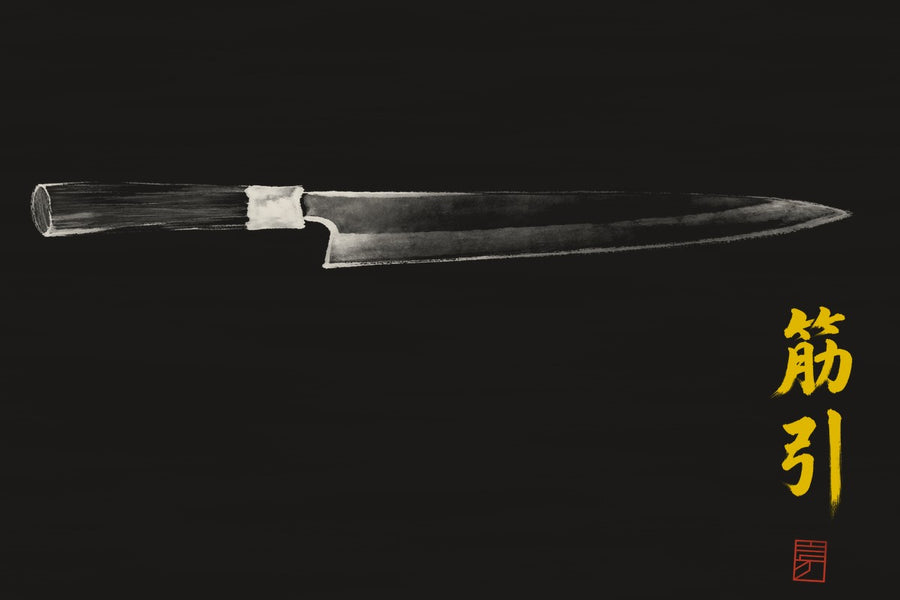
Sujihiki — knife profile
Profile

Sujihiki

筋引

Slicing knife · Double bevel

A long, narrow slicer for dividing large meat; Tojiro says it cuts sashimi too.

Read more
Steel properties
  1. Hardness Very high
  2. Edge retention Very good
  3. Toughness Good
  4. Rust resistance High
  5. Ease of sharpening Fair
  6. Sharpness High
Our ratings, inferred from published lab tests and composition.

Our edge-retention grade is a kitchen rating. It weighs the hardness each steel is sold at, which keeps a thin edge from rolling, twice as heavily as lab wear tests, and the final grade is our judgment from selling and sharpening these knives for over a decade. Lab card-cutting tests measure abrasive wear only, so they can rank carbon steels lower. Tap ? for the lab figure.

Steel

SG2 / R2

スーパーゴールド2

Stainless · Takefu Special Steel

Takefu powder stainless, 62 HRC or more (Takefu's figure). Long edge; resists rust.

Read more
CladdingCoreClad line
Construction

Sanmai - Stainless Damascus Clad

三枚ダマスカス

3 layers · damascus clad

Hard core between stainless damascus layers, bare at the edge. Thinning wears the pattern.

Read more
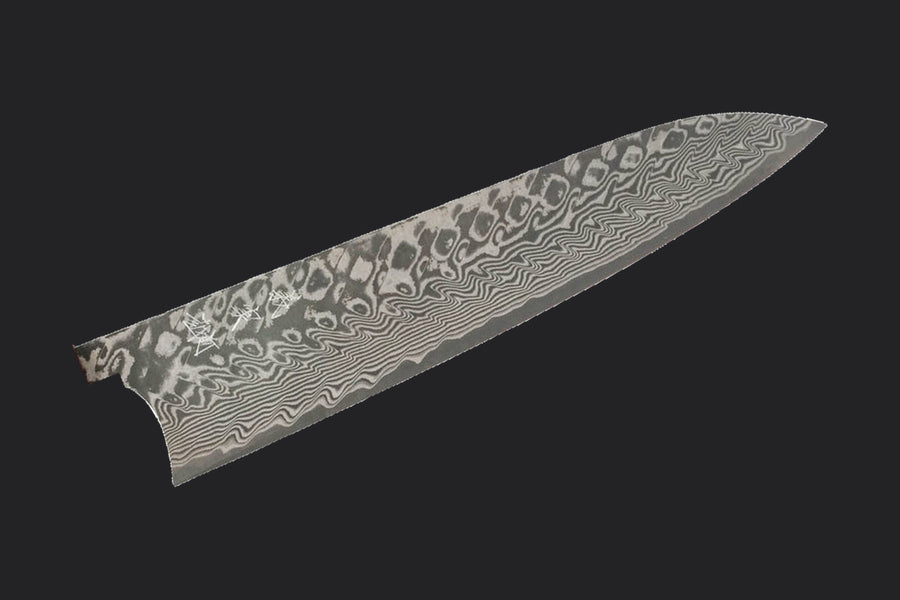
Etched — blade surface finish
Finish

Etched

エッチング

Acid-etched pattern

Acid darkens the layers at different rates to show the damascus. Heavy thinning fades it.

Read more
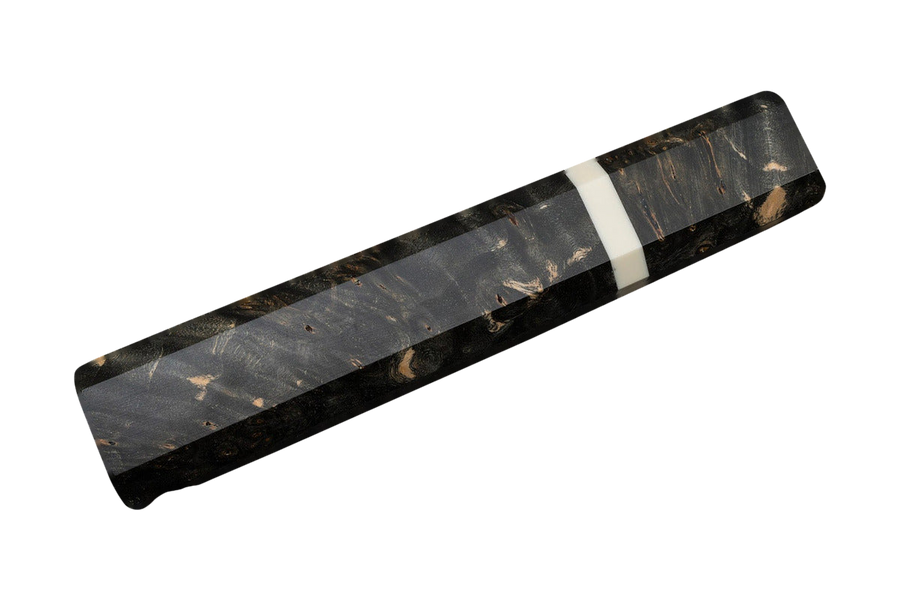
Octagonal Birch Burl with Spacer handle
Handle

Octagonal Birch Burl with Spacer

Octagonal WA

Stabilised birch burl, eight-sided, with a spacer. Resin-stabilised wood resists water.

Frequently asked questions

What size sujihiki should I buy?

Between 210 and 270 mm, depending on where it will work. One Japanese maker lists 210 to 240 mm, double-bevel, for home use and 240 to 270 mm, single- or double-bevel, for professional kitchens.

Another, in Sakai, recommends 240 mm at home, with the size of your board in mind, and 270 mm for professional use.

Sujihiki or yanagiba: which do I need?

Most home cooks need the sujihiki. Choose the yanagiba when slicing raw fish for sashimi and sushi is the main job and you are prepared to learn single bevel sharpening.

A sujihiki is a long, narrow, double bevel slicer. Tojiro describes it as the knife for dividing large pieces of meat, known abroad as a slicer or carving knife, and says its length lets it cut sashimi as well. It carves roasts, trims sinew and portions fish, works in either hand and sharpens like any double bevel knife. Sujihiki run from about 210 to 300 mm, and 240 mm suits most home boards.

A yanagiba is the single bevel sashimi knife. It is ground on one side with a hollow back, and each slice is one long pull from heel to tip, so raw fish is cut cleanly rather than sawn. The edge is too fine for bones or anything hard. It is made for one hand and most are right handed, so check the listing if you are left handed. Sharpening means working the whole bevel and keeping the back flat. Yanagiba run from about 240 to 330 mm, with 270 and 300 mm the common sizes.

So for roasts, portioning meat and the occasional side of fish, buy a sujihiki. For regular sashimi and sushi work, buy a yanagiba and keep it for fish.

Which knife do I need for sushi and sashimi at home?

For occasional sushi at home, a sharp sujihiki (筋引) does the job. Tojiro describes it as a long, double-bevel slicer that can also be used for sashimi, and a double bevel works in either hand.

If sashimi is the point of the meal, choose a yanagiba (柳刃). Tojiro calls it the Kansai-style sashimi knife, now used across Japan, and it slices in one long pull from heel to tip. It is single bevel, so buy the one made for your hand.

If you start from whole fish, add a deba (出刃). Tojiro describes it as very thick and heavy, made for breaking fish down. The deba takes the fish apart and the slicer then cuts the fillets.

SG2 steel knives at Knives and Stones

SG2 (Super Gold 2, which Takefu writes as SPG2) is Takefu Special Steel's own blade steel, made by powder metallurgy. Takefu says it meets all four of what it calls the major requirements for a blade: high hardness, high toughness, good wear resistance and excellent corrosion resistance.

SG2 runs 61 to 65 HRC depending on the maker, and Takefu does not publish its composition. As of 18 October 2026, 291 of the knives we list have SG2 in their title.

SG2 vs AS steel for kitchen knives: which is better?

Neither is objectively better, it just depends on whether you value stainless convenience or a laser-sharp carbon edge. Go with SG2 if you want a stainless knife that holds its edge for a long time and needs little rust care. Choose AS if you are chasing the thinnest possible edge and don't mind wiping the blade down after every use.

SG2 is a powdered stainless steel from Takefu, 61 to 65 HRC depending on the maker. It is tough and resists corrosion, which is why I reach for it when working with acidic foods. Aogami Super is high carbon, and Proterial gives it a hardening hardness of over 60 HRC. It takes a very keen edge, but it will rust if you neglect it.

R2 steel vs SG2: are they the same?

We can't confirm that from a steelmaker. SG2 (Super Gold 2, which Takefu writes as SPG2) is Takefu Special Steel's own blade steel, made by powder metallurgy. Takefu does not publish its composition; SG2 runs 61 to 65 HRC depending on the maker.

As of 18 October 2026, we found no steelmaker page for a steel called R2. Some knives on our shelf are listed as SG2/R2: six as of 18 October 2026, from Kurosaki, Shiro Kamo and Yoshimi Kato.

What is the difference between VG10 and SG2?

Both are Takefu blade steels, and they differ in class and in what Takefu publishes about each. Takefu lists VG10 as a stainless steel with 1.00% carbon, 15.00% chromium, 1.00% molybdenum, 0.25% vanadium and 1.55% cobalt, at a hardening hardness of HRC 60 or more.

Takefu describes SG2, its Super Gold 2, as a blade steel created by powder metallurgy, lists its composition as not disclosed, and SG2 runs 61 to 65 HRC depending on the maker. Takefu also calls SG2 a powdered stainless high-speed steel.