Nigara  |  SKU: NG-B2WIDM-SKM300

Nigara Blue 2 "Rentetsu" Wrought Iron Sakimaru Takobiki 300mm

Sale price $2,866.00 Regular price $3,372.00

IMPORTANT: Carbon steel knives can rust or patina quickly if not cared for properly. They require regular cleaning, drying, and oiling. If you are unfamiliar with carbon steel maintenance, we recommend choosing a stainless steel option instead.

Pickup in Australia only

In Stock Now

Availability

Goes well with

Detailed Specifications
Line Nigara Specials
Profile Sakimaru Takohiki / Round-tip sashimi knife
Bevel Type Single Bevel
Weight 233 g | 8.2 oz
Edge Length 292 mm | 11 1/2″
Heel Height 38 mm | 1 1/2″
Width @ Heel 3.8 mm | 5/32″
Width @ Mid 3.0 mm | 1/8″
Width @ 1cm from Tip 1.0 mm | 3/64″
Steel Blue 2 / Aogami #2 | Carbon
Blade Construction Sanmai - Soft Iron Damascus Clad
Maker's hardening hardness 60 HRC or more
Surface Finish Etched
Handle Amboyna Octagonal Horn
Region Aomori
Best for
  • Collectors
  • Enthusiasts

World-wide shipping via DHL Express, 3 to 6 days (not available in the UK).


Nigara, with their more than 350 years of katana forging history, ocassinally produce some extreme-skill-showing knives that displays their unique Japanese artistics.

For example the "Onikoroshi (Troll Killer)" requires multiple times of forging, twisting. The forging process is done by master Tsuyoshi Yoshizawa (吉澤 剛) himself who also often forges samurai swords. The wrought iron cladded knives gives out the highly attractive clouds on the cladding. The "Kagetora (Tiger Shadow)" series comines Blue 2 and White 2 steel, demonstrating unrivalled forging skills.

These knives are very hard to come by and highly collectible.

Pros Cons
  • Highly collectable
  • Great artistic
  • High budget
Care Instruction
  1. Don't cut hard things! Japanese knives are brittle so bone hacking is a NO NO!
  2. Wash with neutral detergent after use, and wipe dry;
  3. Please don't wash knife with dishwasher, it will damage the wood handle;
  4. Be careful not to leave the knife close to a heat source for a long time;
  5. It is a lot more dangerous to cut with a blunt knife than a sharp knife!
  6. It is best to sharpen a Japanese knife regularly on a waterstone.
  7. Oil the (carbon) knife if storing for an extended period of time to prevent rust.

Nigara

Hirosaki sword and knife artisan

Nigara (二唐刃物鍛造所) is a forge in Hirosaki, Aomori. Go Yoshizawa (吉澤剛) is its president and signs as the eighth generation; his father, Toshiju Yoshizawa (吉澤俊寿), the seventh generation, is chairman.

Nigara dates its line to 1803, when the family began as gunsmiths in the service of the Tsugaru domain, and it made Japanese swords for generations. In the Edo period the domain took it on as its weapons works, and it made even cannon and warships. After the Second World War the forge turned from military swords to farm tools and kitchen knives; in those years it made knives in winter and sold them in summer.

In the early Showa era a Nigara smith whose sword name was Kunitoshi (国俊) studied under Dr Kotaro Honda, director of Tohoku University's metals research institute. Nigara's company history says he excelled at sword making. He was recognised as a holder of an intangible cultural property of Aomori Prefecture and passed his skill on to the seventh generation. The sixth generation had no son, so Toshiju, a grandson through a daughter's line, joined as heir. The present company dates from 1949, and besides knives it does welding and steel construction work, with a welding department since 1963. Nigara showed at Maison et Objet in Paris in 2011 and at Ambiente in Frankfurt in 2013.

We have visited Nigara several times, once for a few days of hands-on training at the forge.

The Anmon Damascus knives we list come in SG2 as gyuto, kiritsuke gyuto, bunka, santoku, nakiri, petty and sujihiki, and as single-bevel yanagiba and takobiki in Blue 2 and Ginsan. SG2 tsuchime knives, kurouchi or matt migaki, cover gyuto, petty, santoku, nakiri, bunka and sujihiki, plus a double-bevel honesuki and a butcher. We also list VG10 Damascus tsuchime, Ginsan Kurozome Damascus and Aogami Super tsuchime knives, and an SPG STRIX tsuchime Damascus nakiri. The honyaki are Blue 2 with shaped hamon, as yanagiba, kiritsuke yanagiba and sakimaru, and a White 1 kiritsuke yanagiba.

“An Aomori knife company whose family made Japanese swords for generations, with an Anmon line of Damascus knives.”

Est. 1949 | 昭和24年
Known for Glamorous and innovative knife design, inherited forging skills.
Website nigaraknives.com Read more about Nigara

Nigara · Aomori

Knife details

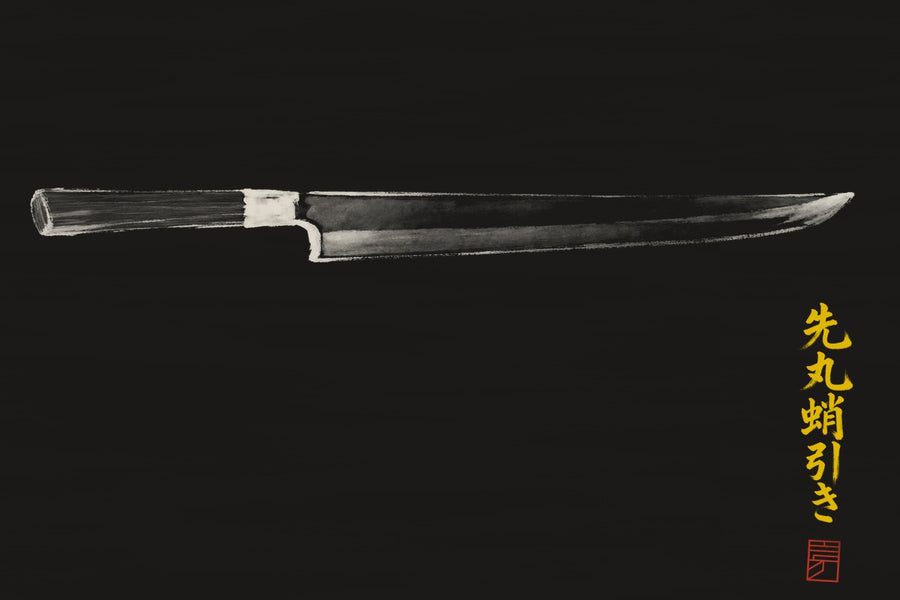
Sakimaru Takohiki — knife profile
Profile

Sakimaru Takohiki

先丸蛸引き

Round-tip sashimi knife · Single bevel

A takohiki with a sword-shaped tip, says a Sakai maker; pulls sashimi along the whole blade.

Read more
Steel properties
  1. Hardness Very good
  2. Edge retention Very good
  3. Toughness Very good
  4. Rust resistance Low
  5. Ease of sharpening High
  6. Sharpness Very high
Our ratings, inferred from published lab tests and composition.

Our edge-retention grade is a kitchen rating. It weighs the hardness each steel is sold at, which keeps a thin edge from rolling, twice as heavily as lab wear tests, and the final grade is our judgment from selling and sharpening these knives for over a decade. Lab card-cutting tests measure abrasive wear only, so they can rank carbon steels lower. Tap ? for the lab figure.

Steel

Blue 2 / Aogami #2

青二鋼

Carbon · Hitachi Metals (now Proterial)

Proterial carbon steel, 1.05 to 1.15% carbon with chromium and tungsten; not stainless.

Read more
ShinogiCladdingClad lineHard steelHollow back
Construction

Sanmai - Soft Iron Damascus Clad

三枚・軟鉄ダマスカス

3 layers · iron damascus clad

Hard core between two soft iron damascus layers. The iron patinas and rusts; keep it dry.

Read more
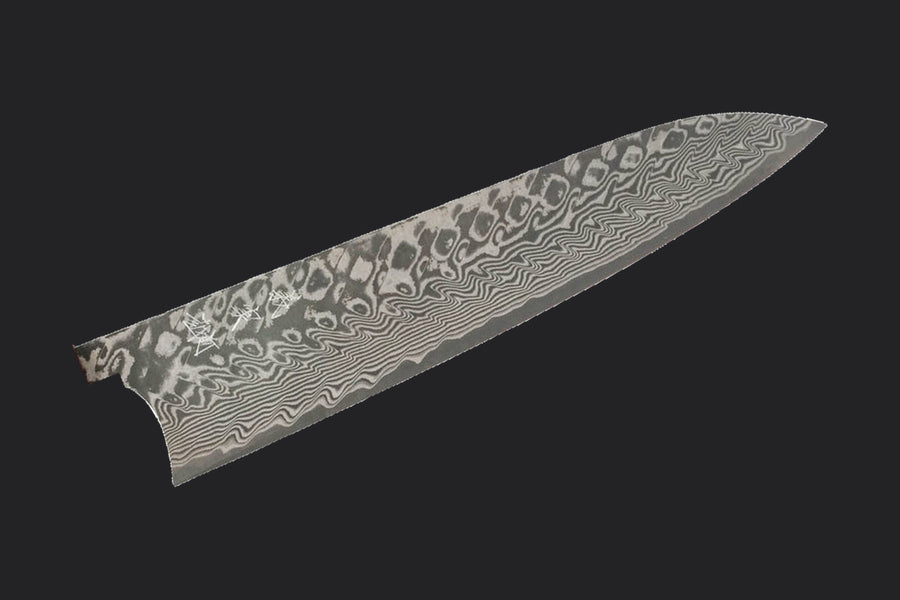
Etched — blade surface finish
Finish

Etched

エッチング

Acid-etched pattern

Acid darkens the layers at different rates to show the damascus. Heavy thinning fades it.

Read more
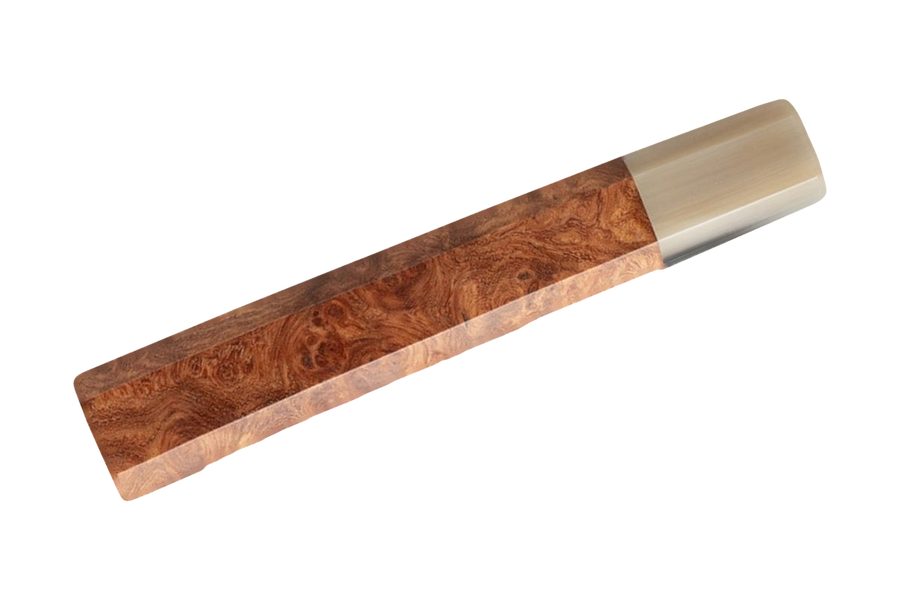
Octagonal Amboyna Blonde Horn handle
Handle

Octagonal Amboyna Blonde Horn

Standard Octagonal

Amboyna burl, eight-sided, gently tapered, blonde or marbled horn ferrule. Grain varies.

Read more

Frequently asked questions

Takohiki or yanagiba: what is the difference?

An encyclopedia describes sashimi knives as thin and narrow, calling the pointed ones yanagiba and the unpointed ones takohiki. A sakimaru takohiki is the rounded-tip variant, so it has a rounded point despite its takohiki name.

A trade body, the Sakai cutlery association, calls the takohiki (たこ引き包丁) the Kanto-type sashimi knife, and the yanagiba the sashimi knife used mainly in Kansai, with an acute edge that is not for bone.

Will a carbon steel knife rust, and how do I look after it?

Yes, carbon steels such as Aogami (Blue) and Shirogami (White) are not stainless steels, so left wet they can spot or rust.

Care is simple once it becomes habit. Wipe the blade as you go, especially after acidic food like citrus, tomato or onion. When you finish, wash it in warm water with a little soap and dry it straight away with a towel. Do not let it air dry, leave it in the sink or the dish rack, or put it in the dishwasher. Store it dry: on a magnetic strip or in a ventilated block in a dry spot.

If the knife will sit unused for a while, wipe on a thin layer of oil before storing. In our video James shows that mineral oil can stand in for camellia (tsubaki) oil, and he picks one labelled medical grade; we list the Kitchen Knife / Cutting Board Mineral Oil Medical Grade for this. If you find light rust, lift it with a rust eraser and a little water, then dry and oil the blade; we list the CKK and Naniwa rust erasers.

What is the difference between Blue 2 and White 2 steel?

Blue 2 is White 2 with tungsten and a little chromium added. Blue 2 holds its edge longer. White 2 sharpens faster and takes a very keen edge. Both are carbon steels that will rust if left wet.

The figures come from Proterial, which makes both. Each has 1.05 to 1.15% carbon. Blue 2 (Aogami 2) adds 1.00 to 1.50% tungsten and 0.20 to 0.50% chromium. White 2 (Shirogami 2) lists neither, and Proterial describes it as a carbon steel with minimum impurities. Proterial says the tungsten and chromium improve heat treatment and wear resistance, and gives a hardening hardness over 60 HRC for both.

In use, the tungsten forms hard carbides that resist wear, so a Blue 2 edge lasts longer between sharpenings. White 2 has none, so it comes back on a whetstone very quickly. The chromium in Blue 2 is far below the 10.5% a steel needs to be stainless, so it gives no real rust protection. Wipe either steel dry after use and expect a patina.

Choose Blue 2 if you want to sharpen less often. Choose White 2 if you enjoy sharpening and want the keenest edge. We list both widely: Blue 2 from Nigara, Myojin Riki and Anryu, and White 2 from Masamoto Sohonten, Sakai Takayuki and Yoshikane.

How old is Nigara, and did it make swords?

The Nigara family line began in 1803, when the family served the Tsugaru domain as gunsmiths. For generations afterwards it made Japanese swords.

After the Second World War, the forge turned to blades for everyday life, including farm tools and kitchen knives.

Who leads Nigara today?

Go Yoshizawa, president of Nigara Hamono Forge, leads it today and signs as the eighth generation of the Nigara family line.

The company is Nigara Hamono Forge (二唐刃物鍛造所), in Kanazoku-machi, Hirosaki, Aomori.

Is Nigara a good knife maker?

Yes. Nigara is a forge in Hirosaki, Aomori, and one of the largest ranges we carry.

Nigara's company page dates the family line to 1803, when it began as gunsmiths retained by the Tsugaru domain, and says the family made Japanese swords for generations before turning to farm tools and kitchen knives after the Second World War. Go Yoshizawa, the current president, signs as the eighth generation.

We know the workshop first hand. We have visited several times, once for an advanced sharpening course at the forge.

Much of the Nigara range we list is SG2 with a hammered tsuchime finish, in kurouchi or matt migaki. The Anmon Damascus line is the showpiece, in SG2 for double bevel knives and in Blue 2 and Ginsan for single bevel ones. The VG10 Damascus tsuchime line is the easy care stainless way in, and Blue 2 honyaki with shaped hamon sit at the top of the range.