Nigara  |  SKU: NG-ANG3DM-SU270BR

Nigara Ginsan Kurozome Damascus Sujihiki 300mm Triple Spacer Amboyna Handle w Saya

Sale price $956.00 Regular price $1,124.00

Pickup in Australia only

In Stock Now

Availability

Goes well with

Detailed Specifications
Line Nigara Ginsan Kurozome Damascus
Profile Sujihiki / Slicing knife
Bevel Type Double Bevel
Weight 211 g | 7.4 oz
Edge Length 288 mm | 11 11/32″
Heel Height 38 mm | 1 1/2″
Width @ Heel 3.4 mm | 9/64″
Width @ Mid 2.5 mm | 3/32″
Width @ 1cm from Tip 1.1 mm | 3/64″
Steel Ginsan / Silver #3 | Stainless
Blade Construction Sanmai - Stainless Damascus Clad
Maker's hardening hardness 59 HRC or more
Surface Finish Etched
Handle Triple Spacer Amboyna Burl
Region Aomori
Best for
  • Enthusiasts
  • Collectors

World-wide shipping via DHL Express, 3 to 6 days (not available in the UK).


This line that Nigara started producing recently is another step forward toward a intricate yet astonishing knife with decorative elements. The combination of various forging and finishing techniques have given blades from this line extensive amount of detail, but they are arranged so beautifully on one single knife that there are no compromise on visual integrity.

I believe there is a need to unfold these blades layer by layer, that is how complicated they are. The innermost core is the Hitachi Ginsan steel, which often considered as the stainless alternative of the famous White 2 carbon steel. What characterise Ginsan is the low alloy content other than chromium, which allows it to be sharpened easier than most of the other stainless steels, while maintaining good edge retention and hardness. This more premium steel forms a good foundation for this product line to have a good cutting edge and being easy to sharpen.

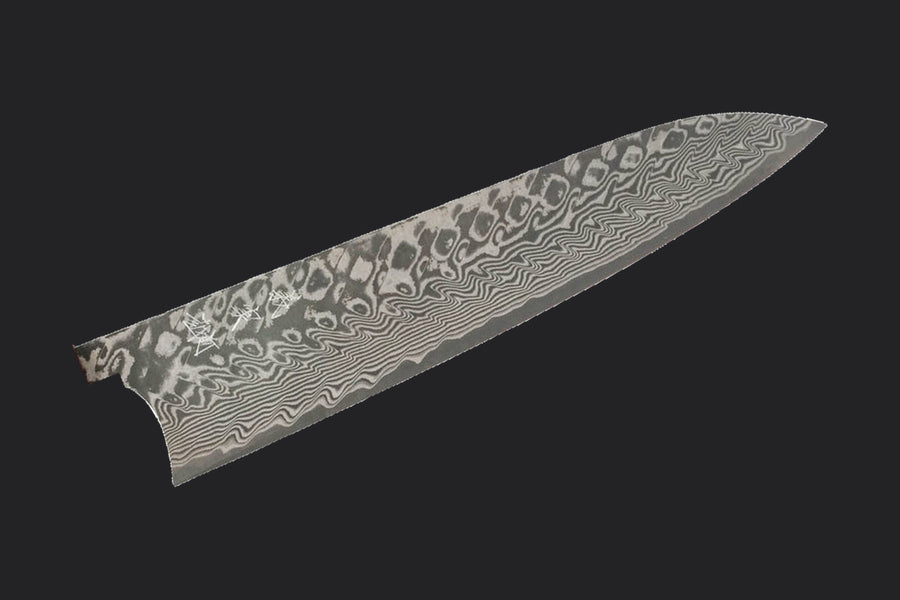
Cladded over the core steel is a beautiful damascus cladding. Unlike the Anmon series, this line doesn't have a dazzling raindrop damascus pattern. Instead, the alternating steel reveal themselves dense bands, with observable marks that indicate how they are struck and forms the final wavy pattern. Athough it is a dense pattern, the Kurozome etching have created a high contrast between two steels so each layer can be clearly identified. On the Gyuto and Petty with a Kiritsuke tip, since they have an additional grind put above the tip to thin them down further, the exposed pattern will have two density converging at the tip, making the beautiful pattern even more stunning.

The last layer of steel on top of the damascus takes up most of the flat area of the knife, it receives a Nashiji-like treatment, however, the finish is not uniform and there are still rough marks left from forging, indicating the strikes from tools and oxidation from heat treating that the blade have gone through. These spots of darker marks spreads organically across the blade, working in conjunction with the Nashiji finish to give the knife a weathered mineral look, almost like Nigara have forged its extensive history into the blade.

The final touch is the Kurozome finish, which uses acidic solution to darken the steel, as different composition react differently, some higher carbon steel will become darker than steel with chromium in it. This finish in my opinion is the finishing touch that brings the whole knife together, not only it gives contrast to the damascus, it coats the whole blade with a layer of dull, unifying yellow tint, along with the thickened Sanjo-style tang, the entire line emits a sense of density, which is what I believe the intent of the designer/maker from Nigara.

For the cutting performance, this blade won't excel against the thinner blades like Shiro Kamo Kurokumo or geometrically optimised blade from Yoshikane Hamono, its thicker bevel have already determined that it is a workhorse grind. Although it is not the best for food penetration, the edge sharpness is still quite up to our standard.

This Ginsan line produced by Nigara is one of the most complicated product line I've seen in terms of finishing techniques, yet it is well-curated so the end result is stunning to say at least. It will finally comes down to if you think the hefty price tag is worth it, but I believe it is not too much to ask for a quite practical stainless knife that is packed fully with wow factor.

Pros Cons
  • Great artistic
  • Highly collectable
  • Workhorse grind
  • Heavy
  • High budget
Care Instruction
  1. Don't cut hard things! Japanese knives are brittle so bone hacking is a NO NO!
  2. Wash with neutral detergent after use, and wipe dry;
  3. Please don't wash knife with dishwasher, it will damage the wood handle;
  4. Be careful not to leave the knife close to a heat source for a long time;
  5. It is a lot more dangerous to cut with a blunt knife than a sharp knife!
  6. It is best to sharpen a Japanese knife regularly on a waterstone.

Nigara

Hirosaki sword and knife artisan

Nigara (二唐刃物鍛造所) is a forge in Hirosaki, Aomori. Go Yoshizawa (吉澤剛) is its president and signs as the eighth generation; his father, Toshiju Yoshizawa (吉澤俊寿), the seventh generation, is chairman.

Nigara dates its line to 1803, when the family began as gunsmiths in the service of the Tsugaru domain, and it made Japanese swords for generations. In the Edo period the domain took it on as its weapons works, and it made even cannon and warships. After the Second World War the forge turned from military swords to farm tools and kitchen knives; in those years it made knives in winter and sold them in summer.

In the early Showa era a Nigara smith whose sword name was Kunitoshi (国俊) studied under Dr Kotaro Honda, director of Tohoku University's metals research institute. Nigara's company history says he excelled at sword making. He was recognised as a holder of an intangible cultural property of Aomori Prefecture and passed his skill on to the seventh generation. The sixth generation had no son, so Toshiju, a grandson through a daughter's line, joined as heir. The present company dates from 1949, and besides knives it does welding and steel construction work, with a welding department since 1963. Nigara showed at Maison et Objet in Paris in 2011 and at Ambiente in Frankfurt in 2013.

We have visited Nigara several times, once for a few days of hands-on training at the forge.

The Anmon Damascus knives we list come in SG2 as gyuto, kiritsuke gyuto, bunka, santoku, nakiri, petty and sujihiki, and as single-bevel yanagiba and takobiki in Blue 2 and Ginsan. SG2 tsuchime knives, kurouchi or matt migaki, cover gyuto, petty, santoku, nakiri, bunka and sujihiki, plus a double-bevel honesuki and a butcher. We also list VG10 Damascus tsuchime, Ginsan Kurozome Damascus and Aogami Super tsuchime knives, and an SPG STRIX tsuchime Damascus nakiri. The honyaki are Blue 2 with shaped hamon, as yanagiba, kiritsuke yanagiba and sakimaru, and a White 1 kiritsuke yanagiba.

“An Aomori knife company whose family made Japanese swords for generations, with an Anmon line of Damascus knives.”

Est. 1949 | 昭和24年
Known for Glamorous and innovative knife design, inherited forging skills.
Website nigaraknives.com Read more about Nigara

Nigara · Aomori

Knife details

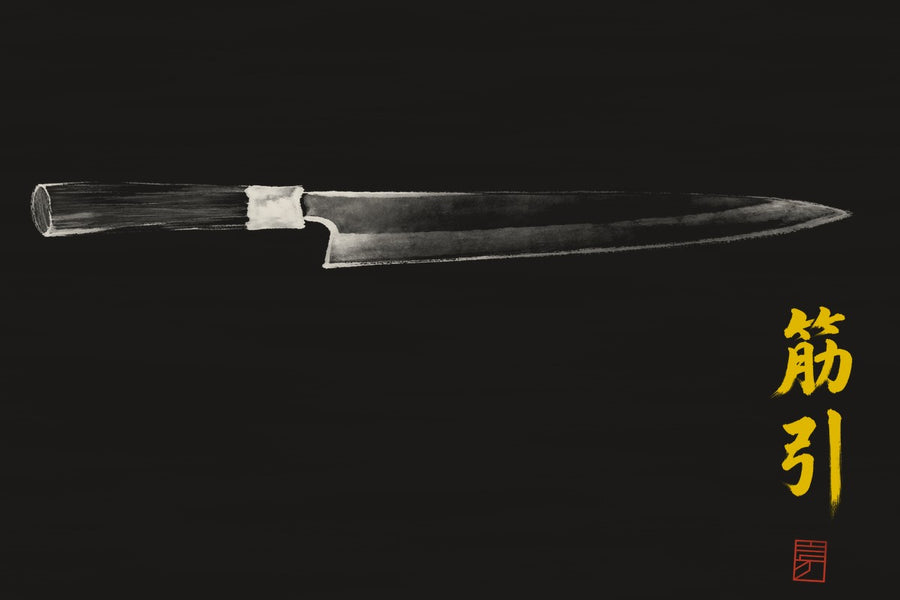
Sujihiki — knife profile
Profile

Sujihiki

筋引

Slicing knife · Double bevel

A long, narrow slicer for dividing large meat; Tojiro says it cuts sashimi too.

Read more
Steel properties
  1. Hardness Good
  2. Edge retention Good
  3. Toughness Very high
  4. Rust resistance High
  5. Ease of sharpening High
  6. Sharpness High
Our ratings, inferred from published lab tests and composition.

Our edge-retention grade is a kitchen rating. It weighs the hardness each steel is sold at, which keeps a thin edge from rolling, twice as heavily as lab wear tests, and the final grade is our judgment from selling and sharpening these knives for over a decade. Lab card-cutting tests measure abrasive wear only, so they can rank carbon steels lower. Tap ? for the lab figure.

Steel

Ginsan / Silver #3

GIN3

Stainless · Hitachi Metals (now Proterial)

Proterial's GIN 3 stainless: 0.95 to 1.10% carbon, 13.00 to 14.50% chromium, hardening hardness over 59 HRC.

Read more
CladdingCoreClad line
Construction

Sanmai - Stainless Damascus Clad

三枚ダマスカス

3 layers · damascus clad

Hard core between stainless damascus layers, bare at the edge. Thinning wears the pattern.

Read more
Etched — blade surface finish
Finish

Etched

エッチング

Acid-etched pattern

Acid darkens the layers at different rates to show the damascus. Heavy thinning fades it.

Read more
Triple Spacer Amboyna Burl handle
Handle

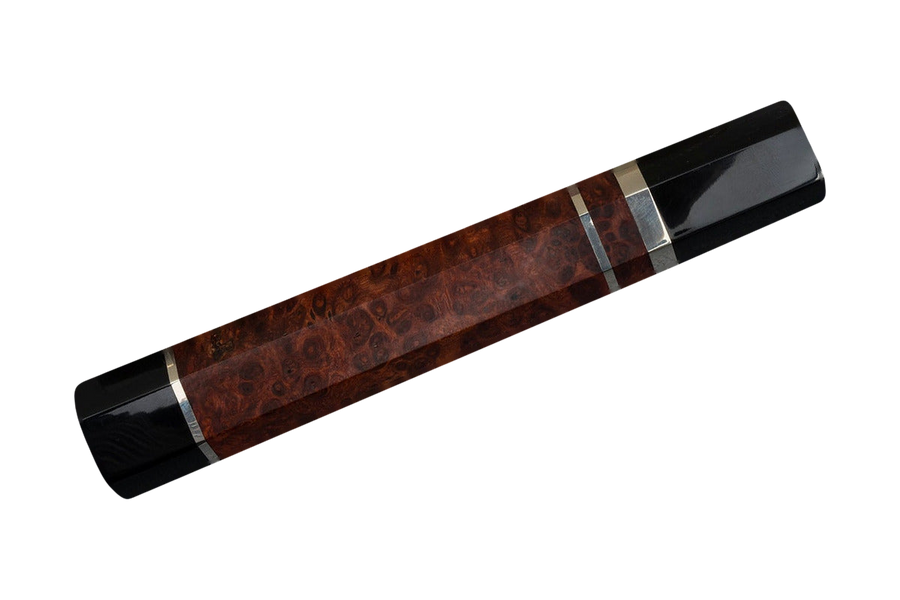
Triple Spacer Amboyna Burl

Octagonal WA

Octagonal stabilised amboyna burl with buffalo horn and three spacers. Burl figure varies.

Frequently asked questions

What size sujihiki should I buy?

Between 210 and 270 mm, depending on where it will work. One Japanese maker lists 210 to 240 mm, double-bevel, for home use and 240 to 270 mm, single- or double-bevel, for professional kitchens.

Another, in Sakai, recommends 240 mm at home, with the size of your board in mind, and 270 mm for professional use.

Sujihiki or yanagiba: which do I need?

Most home cooks need the sujihiki. Choose the yanagiba when slicing raw fish for sashimi and sushi is the main job and you are prepared to learn single bevel sharpening.

A sujihiki is a long, narrow, double bevel slicer. Tojiro describes it as the knife for dividing large pieces of meat, known abroad as a slicer or carving knife, and says its length lets it cut sashimi as well. It carves roasts, trims sinew and portions fish, works in either hand and sharpens like any double bevel knife. Sujihiki run from about 210 to 300 mm, and 240 mm suits most home boards.

A yanagiba is the single bevel sashimi knife. It is ground on one side with a hollow back, and each slice is one long pull from heel to tip, so raw fish is cut cleanly rather than sawn. The edge is too fine for bones or anything hard. It is made for one hand and most are right handed, so check the listing if you are left handed. Sharpening means working the whole bevel and keeping the back flat. Yanagiba run from about 240 to 330 mm, with 270 and 300 mm the common sizes.

So for roasts, portioning meat and the occasional side of fish, buy a sujihiki. For regular sashimi and sushi work, buy a yanagiba and keep it for fish.

Which knife do I need for sushi and sashimi at home?

For occasional sushi at home, a sharp sujihiki (筋引) does the job. Tojiro describes it as a long, double-bevel slicer that can also be used for sashimi, and a double bevel works in either hand.

If sashimi is the point of the meal, choose a yanagiba (柳刃). Tojiro calls it the Kansai-style sashimi knife, now used across Japan, and it slices in one long pull from heel to tip. It is single bevel, so buy the one made for your hand.

If you start from whole fish, add a deba (出刃). Tojiro describes it as very thick and heavy, made for breaking fish down. The deba takes the fish apart and the slicer then cuts the fillets.

What is Ginsan steel, and why do some Japanese knives use it?

Ginsan, also known as Silver 3, is a stainless steel from Proterial, the Yasugi Specialty Steel division. Proterial describes it as a stainless steel which has hardness and sharpness comparable to carbon steel, and lists its uses as kitchen knives and scissors.

Knife makers use it when they want the corrosion resistance of a stainless together with the hardness and sharpness that Proterial compares to carbon steel. The steel maker lists 59 HRC or over after hardening, but that is a heat treatment figure, not a finished knife figure.

Dry it after use, like any stainless knife. Its performance depends on the heat treatment and construction of the specific knife, not the steel name alone.

Is Ginsan stainless?

Yes. Proterial lists the steel as GIN 3 with 13.00 to 14.50% chromium, above the Japan Stainless Steel Association's 10.5% minimum for stainless steel.

Proterial describes it as a stainless steel with hardness and sharpness comparable to carbon steel, used in various kitchen knives and scissors, and the association notes that stainless, strictly, means it rusts less. Wash the knife and dry it after use.

What is the Nigara Ginsan Kurozome Damascus knife line, and who is it for?

The Nigara Ginsan Kurozome Damascus is a line of knives with a Ginsan steel core, clad in decorative Damascus and finished with a Kurozome (blackened) Nashiji texture.

We see its thicker bevel as a workhorse grind. We list it as gyuto (including K-tip gyuto), bunka and sujihiki.

How old is Nigara, and did it make swords?

The Nigara family line began in 1803, when the family served the Tsugaru domain as gunsmiths. For generations afterwards it made Japanese swords.

After the Second World War, the forge turned to blades for everyday life, including farm tools and kitchen knives.

Who leads Nigara today?

Go Yoshizawa, president of Nigara Hamono Forge, leads it today and signs as the eighth generation of the Nigara family line.

The company is Nigara Hamono Forge (二唐刃物鍛造所), in Kanazoku-machi, Hirosaki, Aomori.