Sakai Takayuki  |  SKU: SATA_ZADA_SA180

Sakai Takayuki Ginga ZA-18 Damascus Santoku 180mm

Sale price $287.00 Regular price $338.00

Pickup in Australia only

In Stock Now

Availability

Goes well with

Detailed Specifications
Line Sakai Takayuki Ginga ZA-18 Damascus
Profile Santoku / Santoku
Steel ZA-18 | Stainless
Blade Construction Sanmai - Stainless Damascus Clad
Typical hardness 60 to 62 HRC
Surface Finish Mirror Polish
Handle
Region Sakai
Best for
  • Household
  • Gift buyers
  • Enthusiasts

World-wide shipping via DHL Express, 3 to 6 days (not available in the UK).


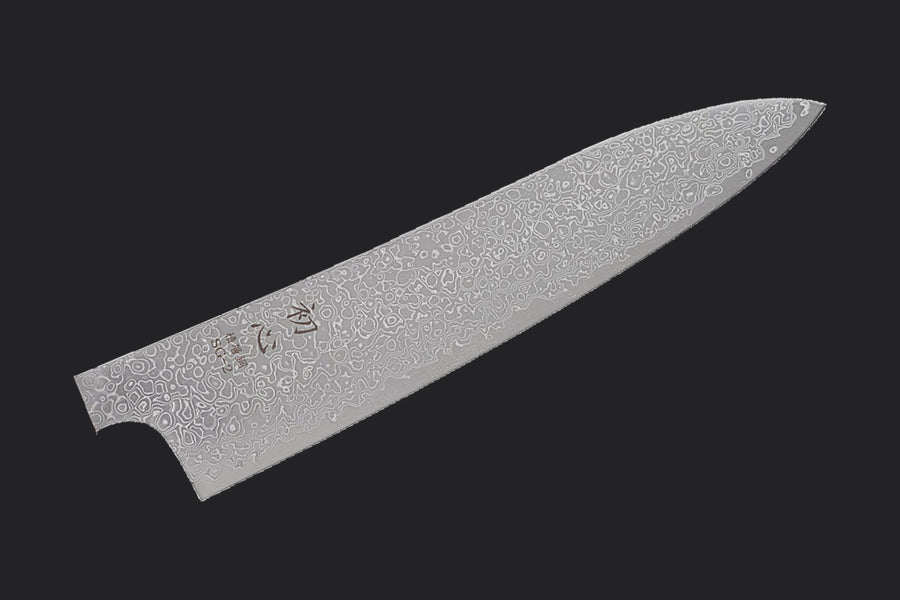
Ginga (銀河, Galaxy) is the best looking line from Sakai Takayuki. Each blade is clad in a mirror finished 69 layer damascus pattern over a ZA-18 core. The layering catches the light across the whole flat, and out of the box the finish is genuinely striking.

Like most hard stainless steels, ZA-18 asks for a bit of patience on the stones.

One honest note: a mirror finish shows water spots and fine scratches, so it takes a little care to keep it looking new. The line covers santoku, gyuto, nakiri, petty and sujihiki, all on an octagonal wenge wa handle with a horn ferrule. A lovely gift knife for someone who wants the damascus look with real performance underneath.

Pros Cons
  • Excellent performance
  • Great artistic
  • Ideal for the household
  • Mirror polish can be hard to maintain
  • Relatively hard to sharpen
Care Instruction
  1. Don't cut hard things! Japanese knives are brittle so bone hacking is a NO NO!
  2. Wash with neutral detergent after use, and wipe dry;
  3. Please don't wash knife with dishwasher, it will damage the wood handle;
  4. Be careful not to leave the knife close to a heat source for a long time;
  5. It is a lot more dangerous to cut with a blunt knife than a sharp knife!
  6. It is best to sharpen a Japanese knife regularly on a waterstone.

Sakai Takayuki

Aoki Hamono, the family company behind Sakai Takayuki.

Sakai Takayuki is the knife brand of Aoki Hamono Seisakusho (青木刃物製作所), a family company in Sakai, Osaka, now in its third generation. Ichiro Aoki founded the business in 1947; the second generation, Takayuki Aoki, gave the brand 堺孝行 its given name; and the third, Takahiro Aoki, is president. Sakai's knife tradition goes back over 600 years, which is the region's history, not the company's age. Aoki Hamono sells to customers in more than 20 countries.

The business began in Osaka as a wholesaler of Sakai forged knives. It opened an office in Sakai and took the name Aoki Hamono Seisakusho in 1963, and registered the Sakai Takayuki trademark in 1964. The Sanpou factory in Sakai followed in 1977, and blacksmiths and sharpeners joined it in 1978. In 2015 Sanpou was renovated with an automatic grinding machine for Japanese knives.

Sakai splits the work of knifemaking: forging, grinding and sharpening are done by different specialists. Aoki's craftsman page lists eight blacksmiths and seven sharpeners, six of them certified traditional craftsmen. Kenji Togashi is a certified blacksmith whose specialty is honyaki and forged knives. Itsuo Doi forges for Sakai Takayuki; he trained under his father, Keijiro Doi, whom Aoki calls a master smith. A smith of the Yamatsuka family works Ginsan, a stainless steel Aoki says is rare in Sakai, and learned to forge it from his father. Among the sharpeners, Mitsuo Yamatsuka is a certified traditional craftsman whose specialties are single-bevel, mirror and double-bevel sharpening, and Hirotsugu Tosa, who died in 2025, did honyaki and mirror-finish sharpening.

The company's range runs from Japanese and Western knives to pastry, Chinese and soba knives, and what we list is a slice of it. The single-bevel knives are the Tokujou line in White 2 carbon, Ginsan deba and yanagiba under Ginsanko and Gintan, and the stainless single-bevel INOX line. The double-bevel lines are Kurokage in VG10, the SPG2 line, Ginga in ZA-18 Damascus, and the Blue 2 knives Homura Guren and Aoniko. The honyaki we list are a Kenji Togashi honyaki gyuto and the GinRyu Swedish steel honyaki yanagiba, and the two craftsman lines are Byakko by Kenji Togashi and Hien by Itsuo Doi. We also list a bread knife and pastry spatulas.

“Three generations of Sakai knives since 1947.”

Est. 1947 | 昭和22年
Known for Classic Sakai knives, unique engraving.
Website aoki-hamono.co.jp Instagram @sakaitakayuki_knife_gallery Read more about Sakai Takayuki

Sakai Takayuki · Sakai

Knife details

Santoku — knife profile
Profile

Santoku

三徳

Santoku · Double bevel

An all-purpose knife for meat, fish and vegetables, with a wide blade and a rounded tip.

Read more
Steel properties
  1. Hardness Very good
  2. Edge retention Very good
  3. Toughness Low
  4. Rust resistance High
  5. Ease of sharpening Good
  6. Sharpness Good
Our ratings, inferred from published lab tests and composition.

Our edge-retention grade is a kitchen rating. It weighs the hardness each steel is sold at, which keeps a thin edge from rolling, twice as heavily as lab wear tests, and the final grade is our judgment from selling and sharpening these knives for over a decade. Lab card-cutting tests measure abrasive wear only, so they can rank carbon steels lower. Tap ? for the lab figure.

Steel

ZA-18

ZA-18ステンレス鋼

Stainless

We list ZA-18 in Sakai Takayuki's Ginga Damascus line and a Tsunehisa Damascus sujihiki.

Read more
CladdingCoreClad line
Construction

Sanmai - Stainless Damascus Clad

三枚ダマスカス

3 layers · damascus clad

Hard core between stainless damascus layers, bare at the edge. Thinning wears the pattern.

Read more
Mirror Polish — blade surface finish
Finish

Mirror Polish

鏡面

Mirror polish

Polished to a true mirror that shows hamon or damascus clearly. Every scratch shows.

Read more

Frequently asked questions

Gyuto or santoku: which should I choose?

The gyuto came to Japan with the beef-eating culture of the Meiji era, and that is where its name comes from. Tojiro says it is used for all kinds of cooking, which is why it is also called the chef's knife.

The santoku is a household knife that combines the good points of the nakiri and the gyuto. Tojiro describes it as all-purpose, from vegetables to meat and fish, double-bevel and built on the same construction as a Western knife.

Choose a gyuto if you want more length and reach. Choose a santoku if you want a shorter all-purpose knife. Tojiro's own size figures: gyuto 150 to 210mm for household use and up to 360mm for professional use, santoku 165 to 170mm for household use.

Rock chop or up-and-down chop: which knife shape suits me?

Match the shape to your stroke. Rock chopping keeps the tip on the board and rolls the curved belly through the food, so a gyuto or a Western chef's knife suits it, and Japanese knives rock fine as long as you rock gently.

Up-and-down chopping, the Chinese style, wants a straight run of edge, so a nakiri, usuba, santoku or bunka suits it better; a curved edge chopped straight down easily leaves pieces joined. Neither shape is better; it depends on how you cut.

What does santoku mean?

A Japanese dictionary explains the name of the santoku (三徳包丁) as coming from the three things it handles: meat, fish and vegetables. The same dictionary entry points from the santoku to the bunka (文化包丁), treating the two as one knife.

One Japanese knife maker guide distinguishes the two by the tip. It says that in the Showa era the bunka was made with its tip cut at an angle, and the santoku came after it by rounding that tip.

Is Sakai Takayuki the same company as Aoki Hamono?

Sakai Takayuki (堺孝行) is a brand of Aoki Hamono Seisakusho (青木刃物製作所) in Sakai, Osaka, and the company's own page says so directly. The trademarks for 堺孝行 and 堺菊孝 were registered in 1964.

The company started in Osaka in 1947 as a wholesaler of Sakai forged knives, set up a sales office in Sakai in 1963, and built a factory in Sakai in 1977. So when you see the Sakai Takayuki name, that is Aoki Hamono's own line.

Who makes Sakai Takayuki knives, and how?

Sakai Takayuki knives are made by Aoki Hamono Seisakusho and its craftsmen in Sakai, Osaka. The company's own traditional-craftsman page profiles its named Sakai smiths.

Aoki Hamono's own page says Sakai knives are made by division of labour: blacksmiths forge the blade, and sharpening craftsmen then grind and sharpen it. Aoki Hamono's Sanpou factory, home to its smiths and sharpeners since 1978, added an automatic grinding machine for Japanese knives in 2015.

Is a Sakai Takayuki honyaki worth it over the everyday lines?

Only if you want the honyaki for its own sake and already sharpen well. For daily cooking, one of the everyday Sakai Takayuki lines is the better buy.

A traditional honyaki is forged from one piece of carbon steel, coated with clay and quenched so the edge hardens fully while the spine stays softer. The boundary shows as the hamon, and there is no soft cladding behind the edge. Aoki Hamono, the company behind Sakai Takayuki, makes its White 2 honyaki series with a water quench, which it says is in pursuit of sharpness. Blades can crack in that quench and the hand finishing takes a long time, which is why a honyaki costs much more than a clad knife in the same steel.

What you gain is a very hard edge that holds up through long runs of slicing, which is why honyaki is prized for sashimi. What you give up is forgiveness. The edge does not take knocks, twisting or hard food well, sharpening is slow, and a careless attempt to straighten a warp can crack the blade. Tojiro, another Japanese maker, says that with modern forging not every honyaki beats a good clad kasumi knife.

Read the listing, not just the word. Some knives sold under the honyaki name are single steel stainless blades rather than clay hardened carbon steel. They need less rust care, but Aoki does not describe a clay quench for them, so do not buy them expecting a traditional clay hardened blade.

If you want a working knife, the Tokujou White 2 single bevel knives and the VG10 33 Layer Hammered Damascus line cover the same jobs, are easier to sharpen and are more forgiving.

Are Damascus knives worth it, or is it just looks?

On nearly every Japanese kitchen knife sold as Damascus, the pattern is there for looks. It sits in the soft cladding on the sides of the blade, and the plain core steel at the edge does the cutting. Pay more for Damascus if you enjoy how it looks, and for no other reason.

Most are built in three layers (sanmai): a hard core with a softer layer forge-welded to each side. On a Damascus knife that outer layer is itself made of many thin layers, etched or blasted so the pattern shows. The cladding is made separately from the core, so a maker can change the look without changing how the blade cuts. Two knives with the same core steel and the same grind perform the same, patterned or plain.

The cladding does real work, but plain cladding does it too. It supports the hard, brittle core, and when it is stainless it shields a carbon steel core from rust except at the edge. Our Damascus construction page shows the layers.

The pattern also changes with use. The contrast fades where you sharpen, and once the knife is thinned the cladding near the edge will not look as it did out of the box. If the budget is tight, spend it on the core steel and grind, or on a whetstone. If you like the pattern, buy it; wanting a good-looking knife is a fair reason to choose one.