Sakai Takayuki  |  SKU: SATA_TOKU_DE165

Sakai Takayuki White 2 Tokujou Deba 165mm

Sale price $354.00 Regular price $416.00

IMPORTANT: Carbon steel knives can rust or patina quickly if not cared for properly. They require regular cleaning, drying, and oiling. If you are unfamiliar with carbon steel maintenance, we recommend choosing a stainless steel option instead.

Pickup in Australia only

In Stock Now

Availability

Goes well with

Detailed Specifications
Line Sakai Takayuki Tokujou White 2
Profile Deba / Japanese fish knife
Bevel Type Single Bevel
Weight 246 g | 8.7 oz
Edge Length 168 mm | 6 39/64″
Heel Height 48 mm | 1 57/64″
Width @ Heel 6.4 mm | 1/4″
Width @ Mid 5.1 mm | 13/64″
Width @ 1cm from Tip 2.3 mm | 3/32″
Steel White 2 / Shirogami #2 | Carbon
Blade Construction Nimai - Soft Iron Clad
Maker's hardening hardness 60 HRC or more
Surface Finish Kasumi
Handle D Shaped Ho Wood Black Ferrule
Region Sakai
Best for
  • Pro chefs
  • Enthusiasts

World-wide shipping via DHL Express, 3 to 6 days (not available in the UK).


The Saikai Takayuki Tokujou(特上) is Takayuki's take on the intermediate level WA honcho. It is an upgrade from all aspects compare to the more entry level Kinsei line, offering better steel, sharpening and fit and finish at an acceptable price.

The Hitachi Yasugi White #2 carbon steel is a very common blade steel in the realm of single bevel WA hocho, it can be found from the basic blade all the way up to the prestige Mt. Fuji Mizu-Honyaki Yanagiba. Saikai Takayuki have decided to pair this steel with a soft iron Nimai construction and a smooth Kasumi finish, form a line with solid performance, pleasing look and clean, polished details.

The main target of this line in my opinion would be chefs who are upgrading from a basic single bevel knife, or someone with a bigger budget looking for a better knife to start their journey with. The quality and performance of these blades allow them to handle jobs of different level confidently, and I seen no reason that it can't be used at very high end scenarios other than the lack of wow factors that comes with a thousand dollar mirror polished Honyaki.

I suggest chefs to consider this line if they are are looking for a single bevel workhorse that they can use extensively for many years, the value of these blades is decent and the profiles available within this line is very comprehensive. This is more obvious when compare with Masamoto KS line, so unless you after the legendary name, the Tokujou line would truly be the choice for professionals.

Pros Cons
  • Excellent performance
  • Excellent fit and finish
  • Great for professionals
  • Prone to rust
Care Instruction
  1. Don't cut hard things! Japanese knives are brittle so bone hacking is a NO NO!
  2. Wash with neutral detergent after use, and wipe dry;
  3. Please don't wash knife with dishwasher, it will damage the wood handle;
  4. Be careful not to leave the knife close to a heat source for a long time;
  5. It is a lot more dangerous to cut with a blunt knife than a sharp knife!
  6. It is best to sharpen a Japanese knife regularly on a waterstone.
  7. Oil the (carbon) knife if storing for an extended period of time to prevent rust.

Sakai Takayuki

Aoki Hamono, the family company behind Sakai Takayuki.

Sakai Takayuki is the knife brand of Aoki Hamono Seisakusho (青木刃物製作所), a family company in Sakai, Osaka, now in its third generation. Ichiro Aoki founded the business in 1947; the second generation, Takayuki Aoki, gave the brand 堺孝行 its given name; and the third, Takahiro Aoki, is president. Sakai's knife tradition goes back over 600 years, which is the region's history, not the company's age. Aoki Hamono sells to customers in more than 20 countries.

The business began in Osaka as a wholesaler of Sakai forged knives. It opened an office in Sakai and took the name Aoki Hamono Seisakusho in 1963, and registered the Sakai Takayuki trademark in 1964. The Sanpou factory in Sakai followed in 1977, and blacksmiths and sharpeners joined it in 1978. In 2015 Sanpou was renovated with an automatic grinding machine for Japanese knives.

Sakai splits the work of knifemaking: forging, grinding and sharpening are done by different specialists. Aoki's craftsman page lists eight blacksmiths and seven sharpeners, six of them certified traditional craftsmen. Kenji Togashi is a certified blacksmith whose specialty is honyaki and forged knives. Itsuo Doi forges for Sakai Takayuki; he trained under his father, Keijiro Doi, whom Aoki calls a master smith. A smith of the Yamatsuka family works Ginsan, a stainless steel Aoki says is rare in Sakai, and learned to forge it from his father. Among the sharpeners, Mitsuo Yamatsuka is a certified traditional craftsman whose specialties are single-bevel, mirror and double-bevel sharpening, and Hirotsugu Tosa, who died in 2025, did honyaki and mirror-finish sharpening.

The company's range runs from Japanese and Western knives to pastry, Chinese and soba knives, and what we list is a slice of it. The single-bevel knives are the Tokujou line in White 2 carbon, Ginsan deba and yanagiba under Ginsanko and Gintan, and the stainless single-bevel INOX line. The double-bevel lines are Kurokage in VG10, the SPG2 line, Ginga in ZA-18 Damascus, and the Blue 2 knives Homura Guren and Aoniko. The honyaki we list are a Kenji Togashi honyaki gyuto and the GinRyu Swedish steel honyaki yanagiba, and the two craftsman lines are Byakko by Kenji Togashi and Hien by Itsuo Doi. We also list a bread knife and pastry spatulas.

“Three generations of Sakai knives since 1947.”

Est. 1947 | 昭和22年
Known for Classic Sakai knives, unique engraving.
Website aoki-hamono.co.jp Instagram @sakaitakayuki_knife_gallery Read more about Sakai Takayuki

Sakai Takayuki · Sakai

Knife details

Deba — knife profile
Profile

Deba

出刃

Japanese fish knife · Single or double bevel

A thick, heavy fish knife; dictionaries say it fillets and cuts fish and fowl bones.

Read more
Steel properties
  1. Hardness Very good
  2. Edge retention Good
  3. Toughness Good
  4. Rust resistance Low
  5. Ease of sharpening High
  6. Sharpness Very high
Our ratings, inferred from published lab tests and composition.

Our edge-retention grade is a kitchen rating. It weighs the hardness each steel is sold at, which keeps a thin edge from rolling, twice as heavily as lab wear tests, and the final grade is our judgment from selling and sharpening these knives for over a decade. Lab card-cutting tests measure abrasive wear only, so they can rank carbon steels lower. Tap ? for the lab figure.

Steel

White 2 / Shirogami #2

白二鋼

Carbon · Hitachi Metals (now Proterial)

Proterial carbon steel, 1.05 to 1.15% carbon, no chromium or tungsten; not stainless.

Read more
ShinogiCladdingClad lineHard steelHollow back
Construction

Nimai - Soft Iron Clad

二枚・軟鉄

2 layers · single bevel

Two layers, single bevel: hard steel on the back, soft iron elsewhere; it patinas.

Read more
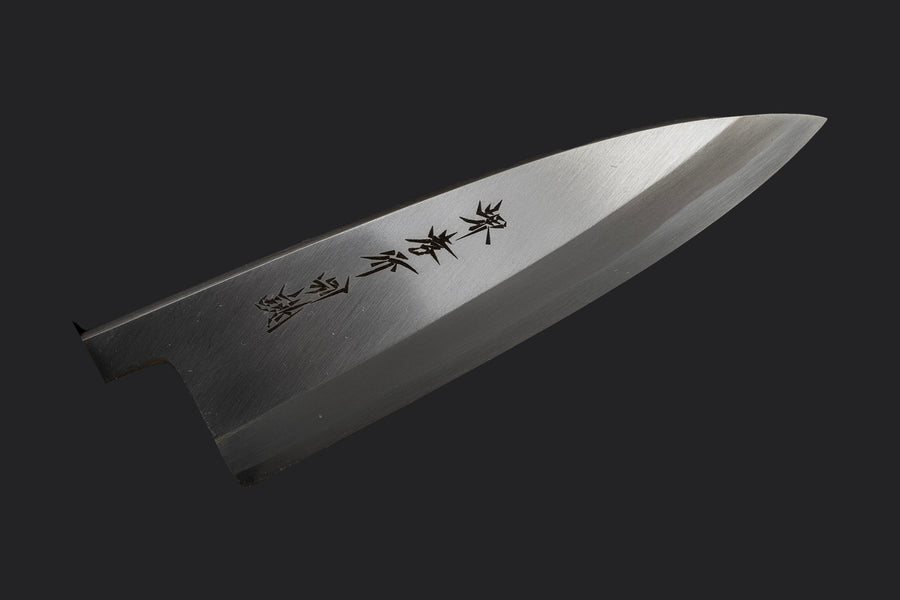
Kasumi — blade surface finish
Finish

Kasumi

霞

Misty polish

Hazy, matte bevel where soft iron meets hard core steel. The iron patinas and rusts.

Read more
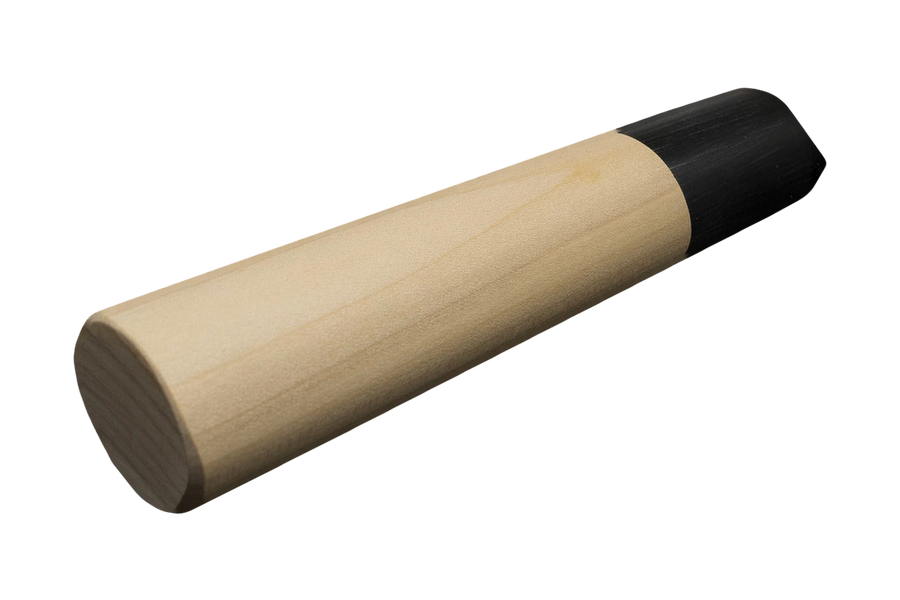
D Shaped Ho Wood Black Ferrule handle
Handle

D Shaped Ho Wood Black Ferrule

D Shape WA

Pale ho wood, D-section wa, with a black buffalo horn ferrule. The D is handed; check fit.

Frequently asked questions

Can a deba cut bone?

Yes, the bones of fish and fowl. Japanese dictionaries describe the deba (出刃包丁) as wide, thick-spined and heavy, used to fillet fish, to cut fish and fowl bone and all, and for rough chopping.

When you chop bone, use the heel of the blade (刃元), the Sakai cutlery association says. It is a fish and poultry knife, not a cleaver.

Can left-handed cooks use single bevel knives?

A standard single bevel knife is ground for right-handed use, and a left-handed one is made with the bevel reversed. Some makers offer left-handed versions.

Contact us and we will check what we can order or have in stock.

What is a mioroshi deba?

A mioroshi deba is a longer, slimmer version of the Japanese fish-butchering knife (deba), made for filleting. It keeps the deba's single bevel but is narrower, thinner at the spine and much lighter for its length.

A standard deba is thick and heavy, deep at the heel, and typically 150mm to 210mm long. Its weight and thick spine do the work when you take off a head or cut through a spine. The mioroshi deba gives up some of that weight for length: the ones we list are 210mm, 240mm and 270mm.

Our measurements show the difference. In Masamoto Sohonten's KS line, the 210mm mioroshi deba weighs 209g against 382g for the 210mm deba, and its spine above the heel is 4.8mm thick against 7.1mm.

Like the deba it is single bevel, so each knife is made for one hand. Most are right-handed, and we list left-handed ones too. Ours come from Sakai Takayuki, Masamoto Sohonten, Nakagawa and the Hatsukokoro Shirasagi line, in White 2 and Blue 1 carbon steel and in stainless.

Choose the standard deba if most of your work is heads and spines, because that work needs the weight. Choose the mioroshi deba when filleting is most of the job. Our deba guide explains the family, and both are listed with our deba and fish filleting knives.

Why is the back of a single-bevel knife hollow, and how do I sharpen it?

The shallow hollow in the back is called urasuki (裏スキ). Tojiro explains that it means the whole back never has to be ground when you sharpen, makes it easier to keep the back flat, and stops sharpening the back from affecting the edge. Only the thin flat rim around the hollow touches the stone.

Sharpen the front bevel first, laying it flat on the stone. Then lay the back completely flat and take a few light strokes, just enough to remove the burr. Never lift the spine to put an angle on the back, and keep the stone itself flat.

Which knife do I need for sushi and sashimi at home?

For occasional sushi at home, a sharp sujihiki (筋引) does the job. Tojiro describes it as a long, double-bevel slicer that can also be used for sashimi, and a double bevel works in either hand.

If sashimi is the point of the meal, choose a yanagiba (柳刃). Tojiro calls it the Kansai-style sashimi knife, now used across Japan, and it slices in one long pull from heel to tip. It is single bevel, so buy the one made for your hand.

If you start from whole fish, add a deba (出刃). Tojiro describes it as very thick and heavy, made for breaking fish down. The deba takes the fish apart and the slicer then cuts the fillets.

Shirogami 1 vs Shirogami 2: what is the difference?

Shirogami 1 (White 1) has more carbon than Shirogami 2 (White 2): Proterial lists 1.25 to 1.35% carbon for Shirogami 1 and 1.05 to 1.15% for Shirogami 2, with the same silicon (0.10 to 0.20%) and manganese (0.20 to 0.30%) ranges for both.

Proterial describes both as carbon steel with minimum impurities, Shirogami 1 with the highest hardness and Shirogami 2 with high hardness, and gives a hardening hardness of over 60 HRC for both. It lists Shirogami 1 for the highest quality tipped tools, planes, chisels and razors, and Shirogami 2 for high quality tipped tools, chisels, razors, sickles, axes and gravers.

What is the difference between White 1, White 2 and White 3?

White 1, White 2 and White 3 are Proterial's Shirogami 1, Shirogami 2 and Shirogami 3. Proterial lists carbon at 1.25 to 1.35% for Shirogami 1, 1.05 to 1.15% for Shirogami 2 and 0.80 to 0.90% for Shirogami 3, with the same silicon and manganese ranges for all three and no chromium listed.

Proterial describes all three as carbon steel with minimum impurities, at highest, high and middle hardness in that order, and gives a hardening hardness of over 60 HRC for each.

What is the difference between Blue 2 and White 2 steel?

Blue 2 is White 2 with tungsten and a little chromium added. Blue 2 holds its edge longer. White 2 sharpens faster and takes a very keen edge. Both are carbon steels that will rust if left wet.

The figures come from Proterial, which makes both. Each has 1.05 to 1.15% carbon. Blue 2 (Aogami 2) adds 1.00 to 1.50% tungsten and 0.20 to 0.50% chromium. White 2 (Shirogami 2) lists neither, and Proterial describes it as a carbon steel with minimum impurities. Proterial says the tungsten and chromium improve heat treatment and wear resistance, and gives a hardening hardness over 60 HRC for both.

In use, the tungsten forms hard carbides that resist wear, so a Blue 2 edge lasts longer between sharpenings. White 2 has none, so it comes back on a whetstone very quickly. The chromium in Blue 2 is far below the 10.5% a steel needs to be stainless, so it gives no real rust protection. Wipe either steel dry after use and expect a patina.

Choose Blue 2 if you want to sharpen less often. Choose White 2 if you enjoy sharpening and want the keenest edge. We list both widely: Blue 2 from Nigara, Myojin Riki and Anryu, and White 2 from Masamoto Sohonten, Sakai Takayuki and Yoshikane.