


Sukenari VG10 Damascus Yanagiba 330mm, Ebony Three Spacer Handle
Sukenari VG10 Damascus Yanagiba 330mm, Ebony Three Spacer Handle is backordered and will ship as soon as it is back in stock.
Pickup in Australia only
Sold out right now
Leave your email and we’ll send one message the moment it’s back in stock.
One email, no marketing. Privacy policy.
In Stock Now
-
Shigeki Tanaka VG10 Damascus Sakimaru-Takobiki 300mm w/ SayaSale price $1,242.00 Regular price $1,461.00Unit price
-
Tojiro VG10 Supreme 37 Layered Flowing Mist Gyuto 260mm FD-915Sale price $189.00 Regular price $270.00Unit price
-
Tojiro VG10 Supreme 63 Layered Nickel Damascus Gyuto 260mm FD-905Sale price $213.00 Regular price $304.00Unit price
-
Sakai Takayuki VG10 Bunka 160mm 33-Layer Hammered DamascusSale price $240.00 Regular price $281.00Unit price
-
Sakai Takayuki VG10 Butcher Knife 210mm (8.9") 33 Layer Hammered DamascusSale price $278.00 Regular price $326.00Unit price
-
Sakai Takayuki GinRyu (銀龍) Swedish Steel Honyaki Yanagiba 300mm, Marble Horn Ebony HandleSale price $1,147.00 Regular price $1,349.00Unit price
-
Yoshihiro Ginsan Yanagiba 360mm w/ Double Fullers and Ebony HandleSale price $1,529.00 Regular price $1,798.00Unit price
-
Sukenari SG2 Honyaki Yanagiba 300mm, Ebony Handle Brass FerruleSale price $2,293.00 Regular price $2,697.00Unit price
Availability
Delivery unavailable for this item. Available for in-store pickup only.
-
St Peters, NSW —2 Bishop St, Unit 2, St Peters NSW 2044
Goes well with
Detailed Specifications
| Profile | Yanagiba / Sashimi knife |
| Bevel Type | Single Bevel |
| Weight | 312 g | 11.0 oz |
| Edge Length | 327 mm | 12 7/8″ |
| Heel Height | 36 mm | 1 27/64″ |
| Width @ Heel | 4.1 mm | 5/32″ |
| Width @ Mid | 3.5 mm | 9/64″ |
| Width @ 1cm from Tip | 1.0 mm | 3/64″ |
| Steel | VG10 | Stainless |
| Maker's hardening hardness | 60 HRC or more |
| Handle | Octagonal Ebony with Black Horn Ferrule |

- Don't cut hard things! Japanese knives are brittle so bone hacking is a NO NO!
- Wash with neutral detergent after use, and wipe dry;
- Please don't wash knife with dishwasher, it will damage the wood handle;
- Be careful not to leave the knife close to a heat source for a long time;
- It is a lot more dangerous to cut with a blunt knife than a sharp knife!
- It is best to sharpen a Japanese knife regularly on a waterstone.
Knife details
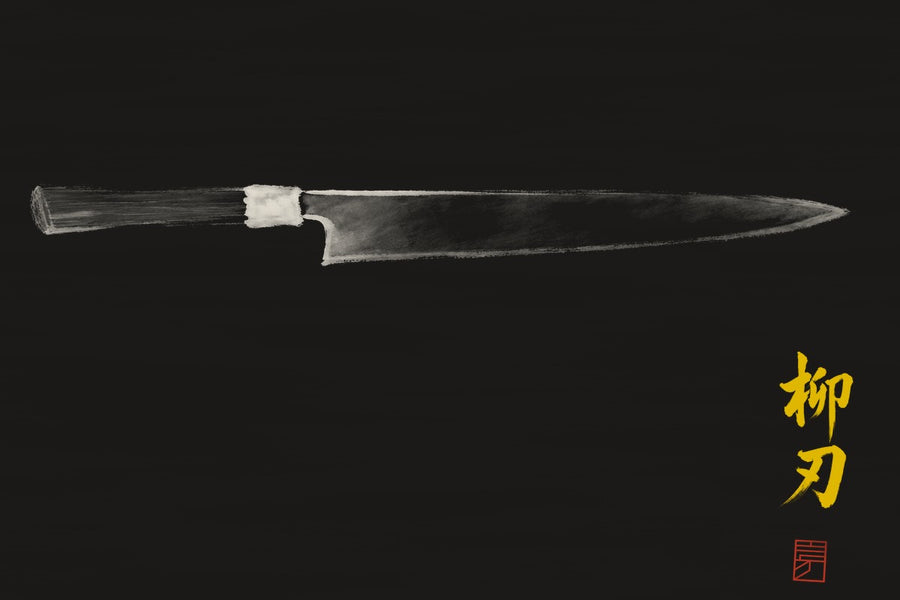
Yanagiba
柳刃
Sashimi knife · Single bevel
Long single-bevel sashimi slicer with a pointed tip. One clean draw cuts raw fish.
Read more-
Hardness
Good
How hard the steel is after heat treatment, measured in HRC. Harder steel can take a thinner, sharper edge but is more likely to chip. Maker's hardening hardness: 60 HRC or more
-
Edge retention
Good
How long the edge stays sharp in kitchen use before it needs sharpening. Lab figure: 479 mm of test card cut at 61.6 HRC (VG-10, Knife Steel Nerds CATRA test, 2020). Hardness used: 60.5 HRC, the usual hardness makers sell it at.
-
Toughness
Good
How well the steel resists chipping and cracking from bones, hard boards or twisting.
-
Rust resistance
High
How slowly the steel rusts or stains when left wet.
-
Ease of sharpening
Good
How quickly the steel comes back to sharp on a whetstone.
-
Sharpness
Good
How fine an edge the steel can take and hold. Judged from the hard carbides inside it: smaller and fewer carbides allow a keener edge.
Our ratings, inferred from published lab tests and composition.
Our edge-retention grade is a kitchen rating. It weighs the hardness each steel is sold at, which keeps a thin edge from rolling, twice as heavily as lab wear tests, and the final grade is our judgment from selling and sharpening these knives for over a decade. Lab card-cutting tests measure abrasive wear only, so they can rank carbon steels lower. Tap ? for the lab figure.
VG10
V金10
Stainless · Takefu Special Steel
Takefu stainless, 1% carbon, 15% chromium, 1.55% cobalt. Easy to sharpen.
Read more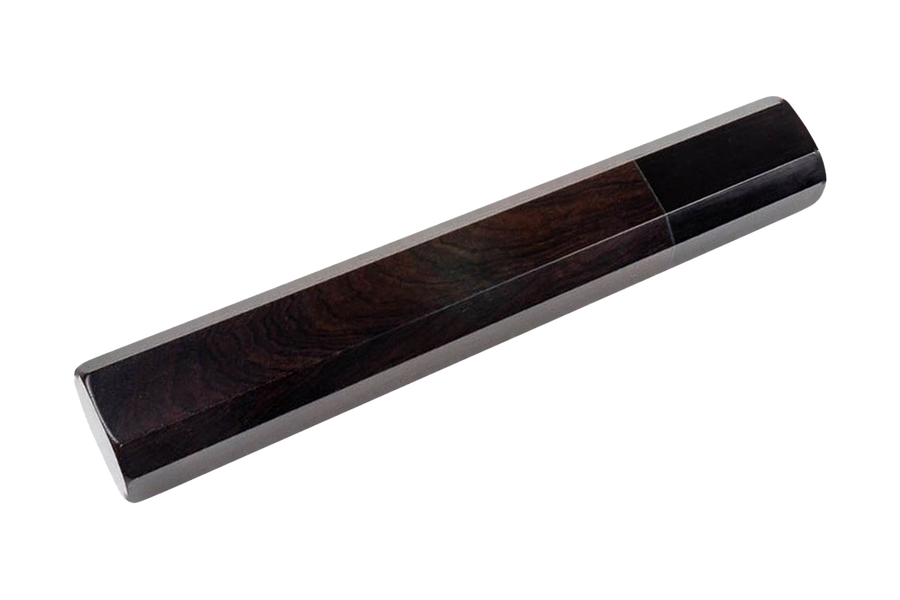
Octagonal Ebony with Black Horn Ferrule
Octagonal WA
Ebony, eight-sided, with a black buffalo horn ferrule: the standard all-black wa handle.
