Shigeki Tanaka  |  SKU: TANA_B2KUTS_BU165

Tanaka Blue 2 Kurouchi Tsuchime Stainless Clad Bunka 165mm

Sale price $221.00 Regular price $259.00

IMPORTANT: Carbon steel knives can rust or patina quickly if not cared for properly. They require regular cleaning, drying, and oiling. If you are unfamiliar with carbon steel maintenance, we recommend choosing a stainless steel option instead.

Pickup in Australia only

In Stock Now

Availability

Goes well with

Detailed Specifications
Line Shigeki Tanaka Blue 2 Stainless Clad Tsuchime
Profile Bunka / K-tip santoku
Bevel Type Double Bevel
Weight 179 g | 6.3 oz
Edge Length 170 mm | 6 11/16″
Heel Height 47 mm | 1 27/32″
Width @ Heel 3.1 mm | 1/8″
Width @ Mid 2.5 mm | 3/32″
Width @ 1cm from Tip 1.1 mm | 3/64″
Steel Blue 2 / Aogami #2 | Carbon
Blade Construction Sanmai - Stainless Clad
Maker's hardening hardness 60 HRC or more
Surface Finish Tsuchime
Handle Octagonal Black Chacate
Region Miki
Best for
  • Pro chefs
  • Enthusiasts

World-wide shipping via DHL Express, 3 to 6 days (not available in the UK).


Shigeki Tanaka’s stainless-clad Blue #2 line gives you the soul of a carbon knife without the fuss. At its core lies Hitachi’s legendary Blue #2 steel – heat-treated for a razor edge that lasts, paired with stainless cladding to resist stains and simplify care.

The tsuchime (hammered) finish isn’t just for looks – it breaks surface tension so food releases effortlessly, while adding a rugged, artisanal vibe.

Forged in Miki, Japan, Tanaka’s knives balance traditional craftsmanship and modern practicality. No fragile laser here – just a confident, midweight grind that handles professional use without babying.

For those who want carbon steel performance with less maintenance, this is your knife: sharp, sturdy, and stripped of pretension.

Pros Cons
  • Budget friendly
  • Excellent performance
  • Thin behind the edge
  • Prone to rust
Care Instruction
  1. Don't cut hard things! Japanese knives are brittle so bone hacking is a NO NO!
  2. Wash with neutral detergent after use, and wipe dry;
  3. Please don't wash knife with dishwasher, it will damage the wood handle;
  4. Be careful not to leave the knife close to a heat source for a long time;
  5. It is a lot more dangerous to cut with a blunt knife than a sharp knife!
  6. It is best to sharpen a Japanese knife regularly on a waterstone.
  7. Oil the (carbon) knife if storing for an extended period of time to prevent rust.

Shigeki Tanaka

Shigeki Tanaka (田中 誠貴), Miki, Hyogo

Shigeki Tanaka (田中 誠貴) makes knives in Miki, Hyogo, under the brand Shigeki-saku (誠貴作). His workshop's site says all its knives are fully forged and hand-hammered, so each one differs, just as no two faces are the same.

Read more

The site says he began making kitchen knives in 1994 and trained with a certified traditional craftsman blacksmith in Takefu, Fukui.

We stock his 210 mm gyuto with an ironwood Western handle, a 300 mm sakimaru takobiki with a saya, and a 195 mm chuka.

“A Miki smith whose workshop says all its knives are fully forged and hand-hammered.”

Est. 1946 | 昭和21年
Known for Kitchen knives his workshop says are fully forged and hand-hammered
Website kanegen4th.com Read more about Shigeki Tanaka

Shigeki Tanaka · Miki

Knife details

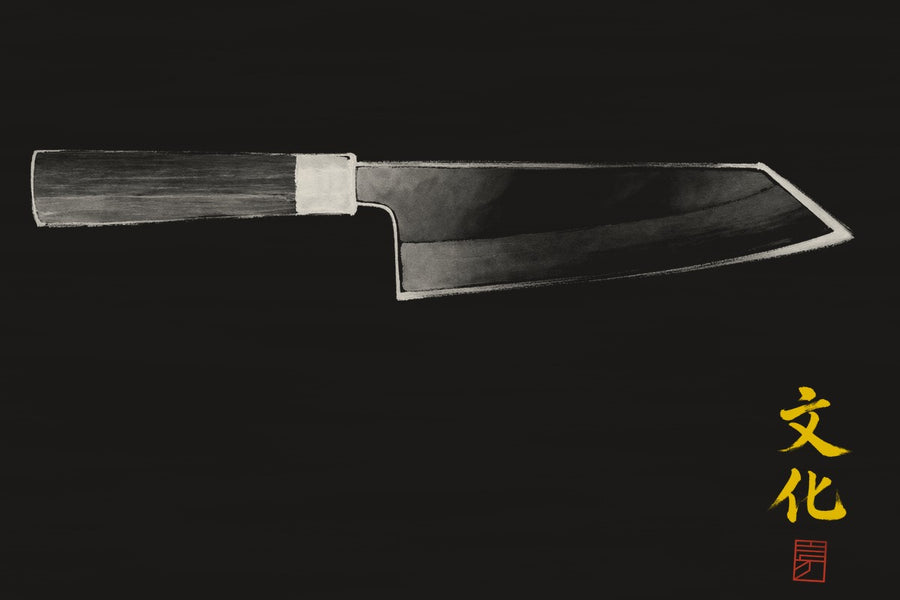
Bunka — knife profile
Profile

Bunka

文化

K-tip santoku · Double bevel

A compact all-rounder like a santoku; a Sakai maker says its angled K-tip suits fine work.

Read more
Steel properties
  1. Hardness Very good
  2. Edge retention Very good
  3. Toughness Very good
  4. Rust resistance Low
  5. Ease of sharpening High
  6. Sharpness Very high
Our ratings, inferred from published lab tests and composition.

Our edge-retention grade is a kitchen rating. It weighs the hardness each steel is sold at, which keeps a thin edge from rolling, twice as heavily as lab wear tests, and the final grade is our judgment from selling and sharpening these knives for over a decade. Lab card-cutting tests measure abrasive wear only, so they can rank carbon steels lower. Tap ? for the lab figure.

Steel

Blue 2 / Aogami #2

青二鋼

Carbon · Hitachi Metals (now Proterial)

Proterial carbon steel, 1.05 to 1.15% carbon with chromium and tungsten; not stainless.

Read more
CladdingCoreClad line
Construction

Sanmai - Stainless Clad

三枚

3 layers · stainless clad

Hard core between two stainless layers, bare only at the edge; the cladding resists rust.

Read more
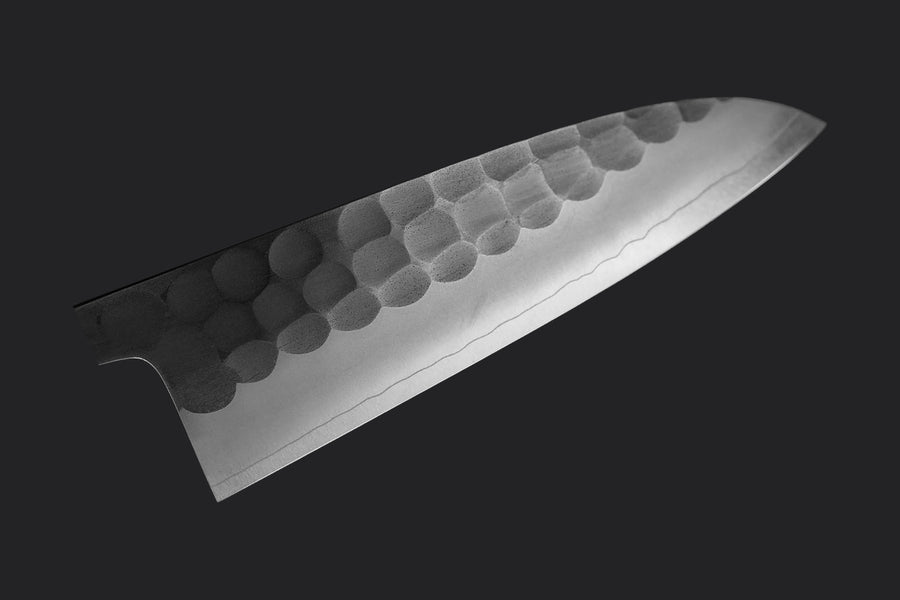
Tsuchime — blade surface finish
Finish

Tsuchime

槌目

Hammered surface

Hammer marks across the upper blade. The dimples may help food release.

Read more
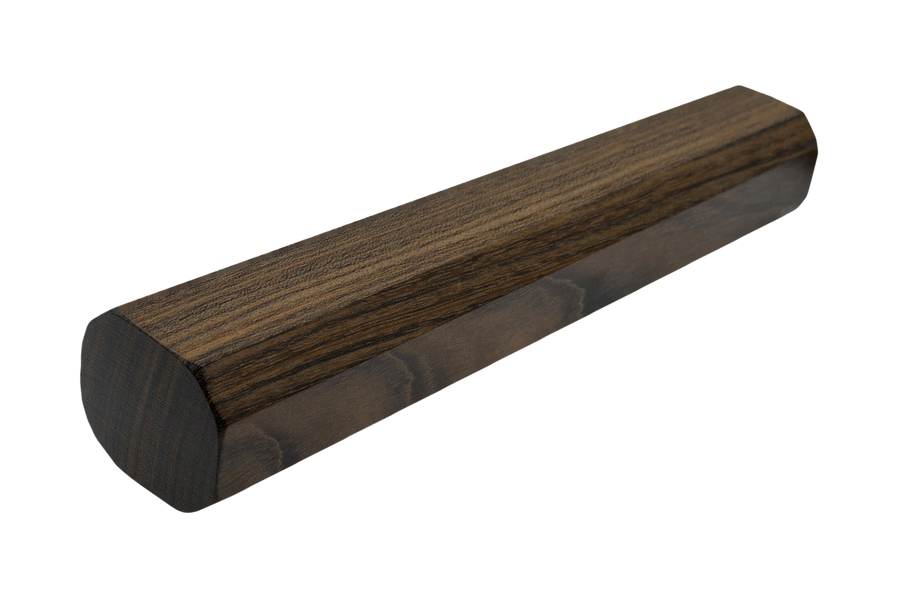
Octagonal Black Chacate handle
Handle

Octagonal Black Chacate

Octagonal WA

Black chacate, a dense dark African wood near ebony, eight-sided; may show pale sapwood.

Frequently asked questions

Why is it called a bunka knife?

The bunka knife (文化包丁) takes its name from bunka, culture. A Sakai knife maker ties the name to Japan's modernisation, when Western culture and Japanese tradition merged, and says it stands for that new era and for the knife's wide range of uses.

The same maker says that as diets broadened to meat, fish and vegetables, an all-purpose knife was wanted, and the bunka took features from both Japanese and Western knives.

What is the difference between a bunka and a santoku?

The tip. One Japanese knife maker describes the bunka (文化包丁, kengata) as combining the good points of the gyuto and the nakiri with the tip cut at an angle, and the santoku as coming after it, by rounding that tip.

Both are all-purpose knives for the home; santoku (三徳) means three virtues, for the three foods it cuts: meat, fish and vegetables.

Bunka, nakiri or usuba: which knife is best for vegetables?

For everyday vegetable prep, a nakiri (菜切) is the simple choice. Tojiro describes it as Japan's own vegetable knife: a square, double-bevel blade, so it cuts the same way in either hand.

A bunka (文化) is a home knife that Tojiro describes as combining the good points of the nakiri and the gyuto. Choose it if you want one knife for vegetables plus meat and fish, with an angled tip.

An usuba (薄刃) is a knife made for vegetable preparation in Japanese cooking. It is single bevel, so it is made for one hand, and Tojiro lists its jobs as peeling and hollowing at the heel, and katsuramuki, fine garnish cuts and rounding off cut edges along the middle of the edge. Choose it if you want to learn those techniques.

Will a carbon steel knife rust, and how do I look after it?

Yes, carbon steels such as Aogami (Blue) and Shirogami (White) are not stainless steels, so left wet they can spot or rust.

Care is simple once it becomes habit. Wipe the blade as you go, especially after acidic food like citrus, tomato or onion. When you finish, wash it in warm water with a little soap and dry it straight away with a towel. Do not let it air dry, leave it in the sink or the dish rack, or put it in the dishwasher. Store it dry: on a magnetic strip or in a ventilated block in a dry spot.

If the knife will sit unused for a while, wipe on a thin layer of oil before storing. In our video James shows that mineral oil can stand in for camellia (tsubaki) oil, and he picks one labelled medical grade; we list the Kitchen Knife / Cutting Board Mineral Oil Medical Grade for this. If you find light rust, lift it with a rust eraser and a little water, then dry and oil the blade; we list the CKK and Naniwa rust erasers.

What is the difference between Blue 2 and White 2 steel?

Blue 2 is White 2 with tungsten and a little chromium added. Blue 2 holds its edge longer. White 2 sharpens faster and takes a very keen edge. Both are carbon steels that will rust if left wet.

The figures come from Proterial, which makes both. Each has 1.05 to 1.15% carbon. Blue 2 (Aogami 2) adds 1.00 to 1.50% tungsten and 0.20 to 0.50% chromium. White 2 (Shirogami 2) lists neither, and Proterial describes it as a carbon steel with minimum impurities. Proterial says the tungsten and chromium improve heat treatment and wear resistance, and gives a hardening hardness over 60 HRC for both.

In use, the tungsten forms hard carbides that resist wear, so a Blue 2 edge lasts longer between sharpenings. White 2 has none, so it comes back on a whetstone very quickly. The chromium in Blue 2 is far below the 10.5% a steel needs to be stainless, so it gives no real rust protection. Wipe either steel dry after use and expect a patina.

Choose Blue 2 if you want to sharpen less often. Choose White 2 if you enjoy sharpening and want the keenest edge. We list both widely: Blue 2 from Nigara, Myojin Riki and Anryu, and White 2 from Masamoto Sohonten, Sakai Takayuki and Yoshikane.

Who is Shigeki Tanaka?

Shigeki Tanaka (田中誠貴) is a kitchen-knife craftsman based in Miki, Hyogo, Japan. The company page names him the representative of his family workshop, KANEGEN (田中一之刃物製作所), and his knives carry his own maker brand, Shigeki-saku (誠貴作).

Are Shigeki Tanaka knives hand-forged?

Yes. The workshop says everything it makes is fully forged and hand-hammered (本鍛造・手打ち), and that because of this each knife differs, one by one.

Shigeki Tanaka (田中 誠貴) sells under the mark 誠貴作 (Shigeki-saku).

How can I tell sanmai, warikomi, damascus and honyaki apart?

Start with the line on the blade. On a clad knife, sanmai or warikomi, a hard steel core is joined to a softer cladding, and the join shows on the bevel. Tojiro says this is where the name kasumi (霞, haze) comes from: the hard steel takes a shine while the soft metal looks hazy.

A honyaki (本焼) is made of one steel. Before hardening the smith coats the parts that should stay softer with clay, so only the edge hardens fully, and the boundary can show as a hamon (刃文).

Damascus is a pattern made by forging many layers of different metals together and then bringing the pattern out with the finish. If it matters how a knife is built, ask before you buy. Our sanmai, warikomi and honyaki pages show each construction.