Tojiro  |  SKU: TO-DP-SU270

Tojiro DP3 Sujihiki 270mm F-806

Sale price $172.00 Regular price $203.00

Pickup in Australia only

In Stock Now

Availability

Goes well with

Detailed Specifications
Line Tojiro DP
Profile Sujihiki / Slicing knife
Bevel Type Double Bevel
Weight 249 g | 8.8 oz
Edge Length 266 mm | 10 15/32″
Heel Height 39 mm | 1 17/32″
Width @ Heel 2.5 mm | 3/32″
Width @ Mid 2.5 mm | 3/32″
Width @ 1cm from Tip 1.0 mm | 3/64″
Steel VG10 | Stainless
Blade Construction Sanmai - Stainless Clad
Maker's hardening hardness 60 HRC or more
Surface Finish Migaki
Handle Western Pakka Wood with Bolster
Region Tsubame
Best for
  • First-timers
  • Students

World-wide shipping via DHL Express, 3 to 6 days (not available in the UK).


Tojiro DP is what I consider as the white Toyota equivalent in the Japanese knife market, it is affordable, massively produced by reputable manufacture with a long track record of being reliable for what you pay.

The core steel is the Takefu VG10, a middle to high tier stainless stainless steel that is widely adopted by many makers. However, Tojiro managed to get these knives to a very low price, to a price point where you can only find steel like AUS-8. The lowered price isn't achieved by compromising on performance, as the scale of the manufacturing can still ensure the quality of the heat treating and grinding, therefore, you are still getting a blade with sharpness and edge retention on par with some other VG-10 knives that are quite more expensive.

The trade-offs are the fit and finish of these knives, they are fine at first glance, but a closer inspection will reveals some small issues. The spine sometimes have scratches, same for joint between blade and bolsters, glue can be seen on the edge of handle scales and the choil is not rounded and you can peel potato with it... You can usually find one or two tiny unfinished details like these on a Tojiro DP, but usually they aretn't something that can't be fixed by a set of sandpaper in 20mins.

At the end of the day, the Tojiro DP will stay sharp and serve you well on chopping board, its low price and relative easy of sharpening can make it a good knife to learn sharpening on, the stainless Migaki finish can handle some beating and scratches, these features combine into a very good entry level user knife with outstanding affordability. Just like your first generic white Toyota, it may not have Alcntara interior, twin-turbo V8 and 4WD, but it is reliable, and able to handle 99% of the task with a very low price.

Pros Cons
  • Budget friendly
  • Easy to look after
  • Ideal for the household
  • Fit and finish can be improved
Care Instruction
  1. Don't cut hard things! Japanese knives are brittle so bone hacking is a NO NO!
  2. Wash with neutral detergent after use, and wipe dry;
  3. Please don't wash knife with dishwasher, it will damage the wood handle;
  4. Be careful not to leave the knife close to a heat source for a long time;
  5. It is a lot more dangerous to cut with a blunt knife than a sharp knife!
  6. It is best to sharpen a Japanese knife regularly on a waterstone.

Tojiro

Tojiro (藤次郎), Tsubame, Niigata

Tojiro (藤次郎株式会社) is a knife maker in Tsubame, Niigata, founded on 1 May 1953. Its president's message says that since its founding the company has pursued sharpness, the basic quality of a knife, carrying on traditional techniques while taking on new ones.

Read more

We stock Tojiro's DP3 knives in shapes from a paring knife to a sujihiki, its Zen series, its SG2 powdered steel gyuto and santoku, and its MV stainless deba and yanagiba, along with some of its kitchen tools.

“Tsubame knife maker since 1953.”

Est. 1953 | 昭和28年
Known for The DP, Zen and SG2 knife lines
Website tojiro-japan.com Instagram @tojiro_jp Read more about Tojiro

Tojiro · Tsubame

Knife details

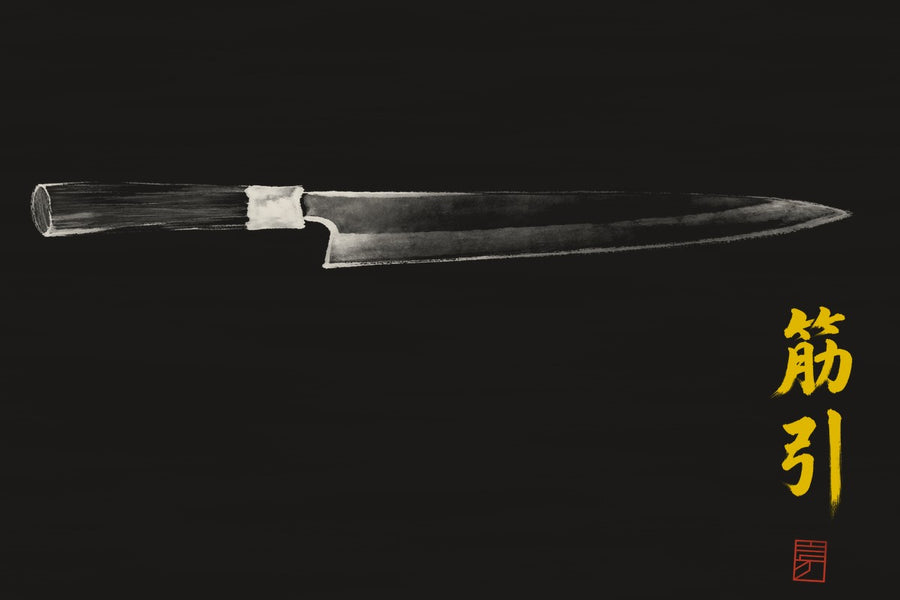
Sujihiki — knife profile
Profile

Sujihiki

筋引

Slicing knife · Double bevel

A long, narrow slicer for dividing large meat; Tojiro says it cuts sashimi too.

Read more
Steel properties
  1. Hardness Good
  2. Edge retention Good
  3. Toughness Good
  4. Rust resistance High
  5. Ease of sharpening Good
  6. Sharpness Good
Our ratings, inferred from published lab tests and composition.

Our edge-retention grade is a kitchen rating. It weighs the hardness each steel is sold at, which keeps a thin edge from rolling, twice as heavily as lab wear tests, and the final grade is our judgment from selling and sharpening these knives for over a decade. Lab card-cutting tests measure abrasive wear only, so they can rank carbon steels lower. Tap ? for the lab figure.

Steel

VG10

V金10

Stainless · Takefu Special Steel

Takefu stainless, 1% carbon, 15% chromium, 1.55% cobalt. Easy to sharpen.

Read more
CladdingCoreClad line
Construction

Sanmai - Stainless Clad

三枚

3 layers · stainless clad

Hard core between two stainless layers, bare only at the edge; the cladding resists rust.

Read more
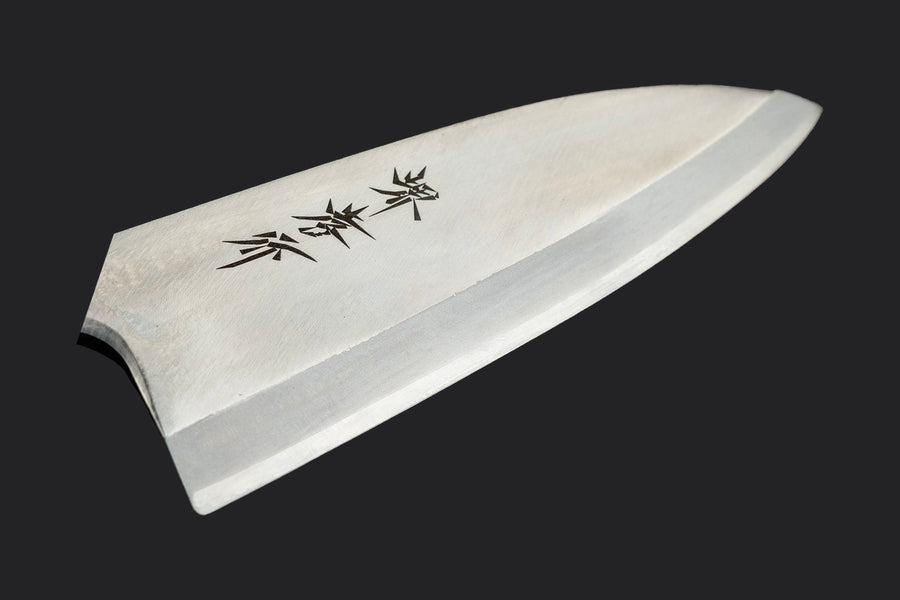
Migaki — blade surface finish
Finish

Migaki

磨き

Polished satin

Smooth polished surface, satin to soft sheen rather than mirror. Scratches show.

Read more
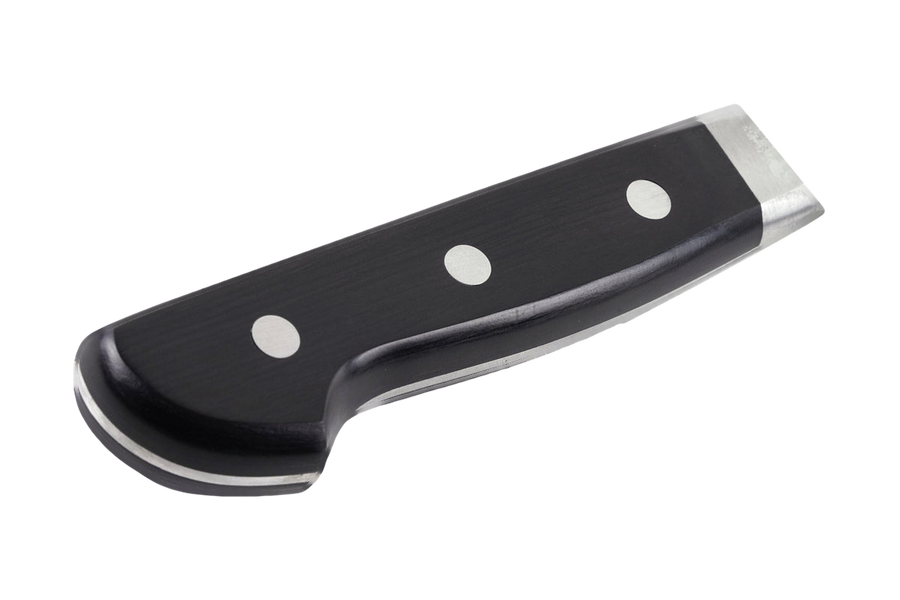
Western Pakka Wood with Bolster handle
Handle

Western Pakka Wood with Bolster

Western with bolster

Pakka wood western grip with a bolster. Resin-laminated wood resists water; entry-level.

Frequently asked questions

What size sujihiki should I buy?

Between 210 and 270 mm, depending on where it will work. One Japanese maker lists 210 to 240 mm, double-bevel, for home use and 240 to 270 mm, single- or double-bevel, for professional kitchens.

Another, in Sakai, recommends 240 mm at home, with the size of your board in mind, and 270 mm for professional use.

Sujihiki or yanagiba: which do I need?

Most home cooks need the sujihiki. Choose the yanagiba when slicing raw fish for sashimi and sushi is the main job and you are prepared to learn single bevel sharpening.

A sujihiki is a long, narrow, double bevel slicer. Tojiro describes it as the knife for dividing large pieces of meat, known abroad as a slicer or carving knife, and says its length lets it cut sashimi as well. It carves roasts, trims sinew and portions fish, works in either hand and sharpens like any double bevel knife. Sujihiki run from about 210 to 300 mm, and 240 mm suits most home boards.

A yanagiba is the single bevel sashimi knife. It is ground on one side with a hollow back, and each slice is one long pull from heel to tip, so raw fish is cut cleanly rather than sawn. The edge is too fine for bones or anything hard. It is made for one hand and most are right handed, so check the listing if you are left handed. Sharpening means working the whole bevel and keeping the back flat. Yanagiba run from about 240 to 330 mm, with 270 and 300 mm the common sizes.

So for roasts, portioning meat and the occasional side of fish, buy a sujihiki. For regular sashimi and sushi work, buy a yanagiba and keep it for fish.

Which knife do I need for sushi and sashimi at home?

For occasional sushi at home, a sharp sujihiki (筋引) does the job. Tojiro describes it as a long, double-bevel slicer that can also be used for sashimi, and a double bevel works in either hand.

If sashimi is the point of the meal, choose a yanagiba (柳刃). Tojiro calls it the Kansai-style sashimi knife, now used across Japan, and it slices in one long pull from heel to tip. It is single bevel, so buy the one made for your hand.

If you start from whole fish, add a deba (出刃). Tojiro describes it as very thick and heavy, made for breaking fish down. The deba takes the fish apart and the slicer then cuts the fillets.

Does VG10 rust?

Yes, it can. Takefu, which makes VG10 (V金10), lists it among its stainless steels, and the JSSA notes that stainless strictly means rust-resistant, not rust-proof.

Takefu lists VG10's chromium content as 15% and describes its corrosion resistance as excellent. We recommend drying the knife after washing.

How hard is VG10?

Takefu, the steelmaker behind VG10, gives HRC 60 or more as its hardening hardness, measured straight after quenching. The hardness of a finished knife depends on its maker.

Takefu says the steel's 15% chromium, 1% molybdenum and 1.55% cobalt give it high hardness and a long-lasting edge, and that it is easy to sharpen.

What is the difference between VG10 and SG2?

Both are Takefu blade steels, and they differ in class and in what Takefu publishes about each. Takefu lists VG10 as a stainless steel with 1.00% carbon, 15.00% chromium, 1.00% molybdenum, 0.25% vanadium and 1.55% cobalt, at a hardening hardness of HRC 60 or more.

Takefu describes SG2, its Super Gold 2, as a blade steel created by powder metallurgy, lists its composition as not disclosed, and SG2 runs 61 to 65 HRC depending on the maker. Takefu also calls SG2 a powdered stainless high-speed steel.

Is VG-10 a good steel for a first Japanese knife?

Yes. VG-10 is our default suggestion for a first Japanese knife, because it is stainless and easy to sharpen, and it holds a good working edge through everyday home cooking.

VG-10 is made by Takefu Special Steel, with about 1% carbon, 15% chromium and 1.55% cobalt, and is usually hardened to around 60 HRC. Takefu describes it as corrosion resistant and easy to sharpen. Day to day you rinse it and wipe it dry, with none of the rust watching carbon steel asks for.

It is also a kind steel to learn sharpening on. It takes an edge readily on a basic waterstone, so you can feel when your technique is working. A harder steel such as SG2 holds its edge longer but is less forgiving on the stone, as our VG-10 vs SG2 comparison explains.

Stainless steel can still stain: VG-10 will spot if it is left wet with acidic food on the edge, and it should never go in the dishwasher. Like any hard, thin Japanese edge, it should also stay away from bones, frozen food and glass boards. If your household is rough on knives, the slightly softer AUS-10 is the safer choice.

Steel is only part of the decision. Heat treatment and grind change how the same VG-10 cuts from one maker to the next, so choose the shape and size first. Our first Japanese knife guide walks through that.

What steel is the Tojiro DP?

Tojiro's own site lists model numbers such as F-808 and F-503 in its CLASSIC series, and describes those blades as VG10 (V金10号) at the core with 13-chrome stainless steel on the sides.

The honesuki we list in this line is titled Tojiro DP VG10 F-803 Honesuki 150mm.