Drag to spin · pinch or scroll to zoom

Sukenari  |  SKU: SU-HAP40NIMAI-YA330

Sukenari HAP40 Mirror Polished Yanagiba 330 mm, Ebony Brass Handle

Sale price $1,040.00 Regular price $1,223.00

Availability

Goes well with

Detailed Specifications
Line Sukenari HAP40 Single Bevel Mirror Polish
Profile Yanagiba / Sashimi knife
Weight 243 g | 8.6 oz
Edge Length 320 mm | 12 19/32″
Heel Height 35 mm | 1 3/8″
Width @ Heel 3.5 mm | 9/64″
Width @ Mid 2.5 mm | 3/32″
Width @ 1cm from Tip 1.1 mm | 3/64″
Steel HAP-40 | Powdered | Semi-stainless
Blade Construction Nimai - Stainless Clad
Typical hardness 64 to 68 HRC
Surface Finish Mirror Polish
Handle
Region Toyama
Best for
  • Enthusiasts
  • Pro chefs

World-wide shipping via DHL Express, 3 to 6 days (not available in the UK).


These HAP40 Yanagiba belong to a group of specialized knives that takes the innovative metallurgy technology, and mixing it with some Japanese traditional flavour. However, this line still employs a Nimai construction instead of a Honyaki, which makes them more affordable and easier to sharpen.

To elaborate on the aforementioned "specialized knives", they are blades that are made in the traditional for using traditional techniques, like a Honyaki Yanagiba, but uses newer stainless or even powder steels instead of Hitachi carbon steels. Pairing these high performance steels with a top notch finishing, these are the knives that push the boundary of Japanese knifemaking as "Practical Arts“. One famous example is Sakai Akazawa, which has multiple products including Honyaki VG-10 or ZDP-189 forged by the legendary bladesmith Yoshikazu Ikeda. We too keep some SG2 Honyaki Yanagiba from Sukenari in store.

As great and beautiful these knives are, the price and scarcity of them have made them nearly inaccessible to most of us, this is where I think this Sukenari HAP40 line comes in place. As it is still uses the powder tool steel which got that very good edge retention, your are not gonna miss any performance compair with those Honyaki knives, but the Nimai structure have made this line much easier to produce and sharpen, thus the price of this line have come to a much affordable range for what it is.

The finish of this line is done very well, the uniformity of the finish across this blade is very good, with hardly any inconsistency that I can spot. If you are planning to venture into the world of these high end Yanagiba, this line can be something to consider about as it fit in the spot between a high-end Honyaki and a carbon steel Kasumi Nimai.

Pros Cons
  • Easy to look after
  • Excellent performance
  • Excellent fit and finish
  • Mirror polish can be hard to maintain
  • Relatively hard to sharpen
Care Instruction
  1. Don't cut hard things! Japanese knives are brittle so bone hacking is a NO NO!
  2. Wash with neutral detergent after use, and wipe dry;
  3. Please don't wash knife with dishwasher, it will damage the wood handle;
  4. Be careful not to leave the knife close to a heat source for a long time;
  5. It is a lot more dangerous to cut with a blunt knife than a sharp knife!
  6. It is best to sharpen a Japanese knife regularly on a waterstone.
  7. Semi-stainless steel won't rust easily but may still patina

Sukenari

Sukenari, professional kitchen knives from Toyama

Sukenari Co. makes, sells and repairs professional kitchen knives in Fuchu-machi, Toyama City, under the registered mark 佑成. The company was founded in 1933.

The company's own greeting page explains the mark: its first character is written with the person radical and 右, meaning right, and carries the wish that these knives can become the cook's indispensable right arm.

Read more

A 2016 profile by TONIO, Toyama's industry support body, says the founder trained at an old-established Tokyo knife maker and opened the shop in his home region in November 1945, after a wartime evacuation there. Knife regions split forging, sharpening and handle fitting between specialists; that profile says Sukenari makes its knives start to finish under one roof, as that Tokyo house did. Its own site says craftsmen still make every stage by hand, one knife at a time.

The same profile credits Sukenari with honyaki in White 1, a very hard steel that is hard to work and that, it says, only a handful of makers in Japan can handle. It also describes know-how built for ZDP189, harder than White 1, and TONIO-backed forging trials, with metallurgy and measured heat treatment, that led to its ZDP189 wa-gyuto. The profile also tells of OEM work for other professional knife makers and wholesalers since the 2008 downturn. We first visited in April 2016, when Nobuo Hanaki, then president, showed us the forging.

On our August 2026 visit, Sukenari told us the family were originally honyaki smiths for Masamoto, so in the early days they made only honyaki. New smiths there still learn honyaki first, as the foundation of the craft. As they put it, most workshops do it the other way round.

We list ZDP-189 hairline gyuto, K-tip gyuto and santoku; ZDP-247 hairline or Damascus gyuto, K-tip gyuto, santoku and sujihiki; SG2 hairline or Damascus gyuto, K-tip gyuto, gyu-hiki and santoku; HAP40 slim K-tip gyuto and mirror polished yanagiba; VG XEOS Damascus gyuto; VG10 Damascus yanagiba; YXR7 petty; Aogami Super hairline gyu-hiki; Blue 2 deba, K-tip yanagiba and Kanto usuba; White 2 K-tip kiritsuke and K-tip yanagiba. We also list an SG2 honyaki yanagiba, including a K-tip, an SG2 nimai (two-layer) sakimaru takobiki, and VG XEOS nimai yanagiba and kiritsuke yanagiba.

“A Toyama maker of professional kitchen knives since 1933.”

Est. 1933 | 昭和8年
Known for Knives made start to finish under one roof
Website sukenari.jp Instagram @sukenari_official Read more about Sukenari

Sukenari · Toyama

Knife details

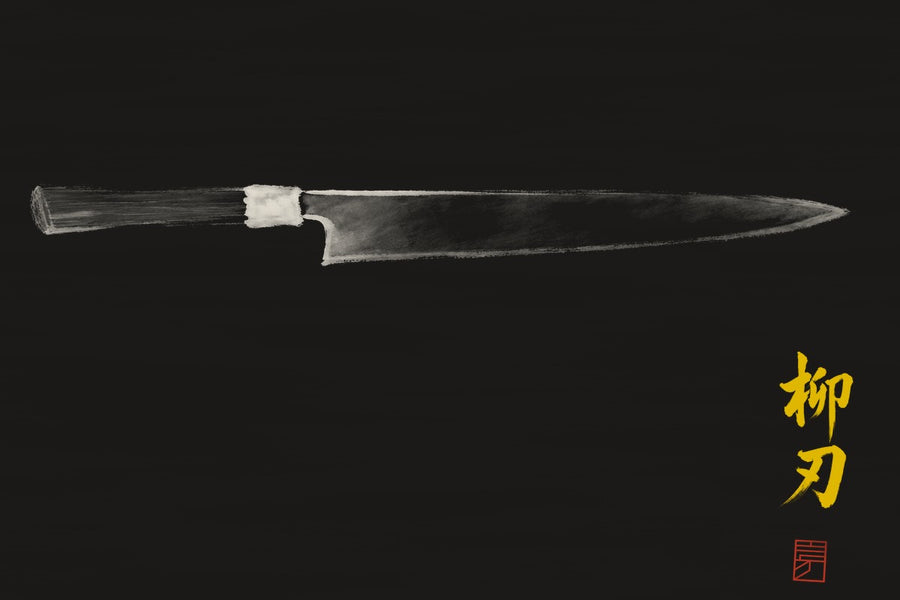
Yanagiba — knife profile
Profile

Yanagiba

柳刃

Sashimi knife · Single bevel

Long single-bevel sashimi slicer with a pointed tip. One clean draw cuts raw fish.

Read more
Steel properties
  1. Hardness Extremely high
  2. Edge retention Very high
  3. Toughness Good
  4. Rust resistance Low
  5. Ease of sharpening Low
  6. Sharpness High
Our ratings, inferred from published lab tests and composition.

Our edge-retention grade is a kitchen rating. It weighs the hardness each steel is sold at, which keeps a thin edge from rolling, twice as heavily as lab wear tests, and the final grade is our judgment from selling and sharpening these knives for over a decade. Lab card-cutting tests measure abrasive wear only, so they can rank carbon steels lower. Tap ? for the lab figure.

Steel

HAP-40

粉末ハイス鋼 HAP40

Semi-stainless · Hitachi Metals (now Proterial)

Proterial powder high-speed steel; Proterial cites high abrasion resistance and toughness.

Read more
ShinogiCladdingClad lineHard steelHollow back
Construction

Nimai - Stainless Clad

二枚・ステンレス

2 layers · single bevel

Two layers, single bevel: hard steel on the back, stainless cladding over the other.

Read more
Mirror Polish — blade surface finish
Finish

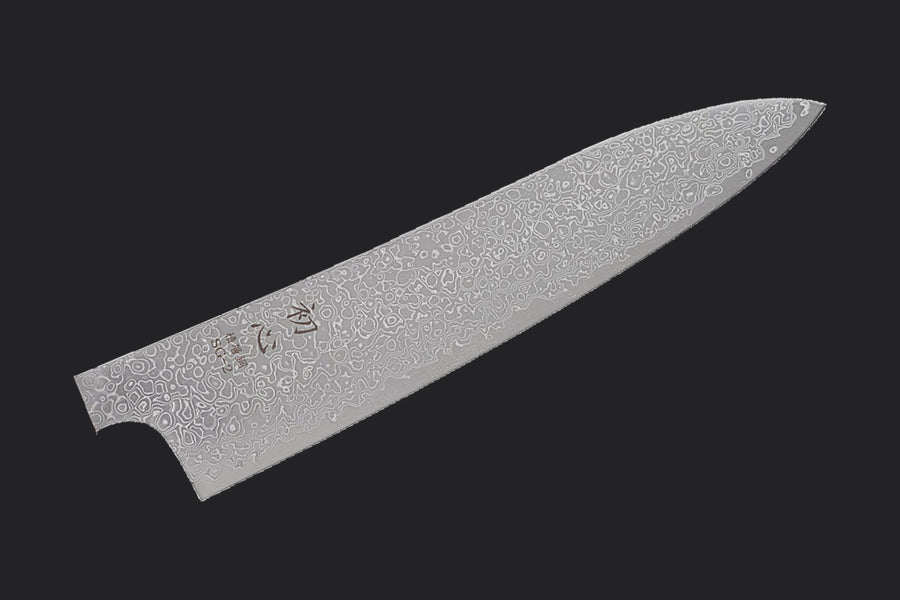
Mirror Polish

鏡面

Mirror polish

Polished to a true mirror that shows hamon or damascus clearly. Every scratch shows.

Read more

Frequently asked questions

What is a yanagiba knife used for in sushi preparation?

A yanagiba (柳刃包丁) is a sashimi knife for slicing raw fish. A knife maker's guide says a sashimi knife cuts without breaking the fibres of the flesh, and that it is longer and narrower than other knives because slicing sashimi with crisp edges needs the length.

The whole length goes through one pulling cut. The Sakai cutlery association calls the yanagiba the sashimi knife used mainly in the Kansai region.

What size yanagiba should I buy?

Size a yanagiba to the fish you prepare: a knife maker's guide gives 270 to 360 mm for professional use and 240 to 270 mm for home use, with 270 mm at home if you slice larger fish.

The guide says the whole length goes through one pulling cut, so do not choose too short a knife, and at home it points to the size of your board and your work space. We list the yanagiba (柳刃) from 210 to 360 mm, some made for left-handed use.

Can a yanagiba cut through fish bones?

No. The Sakai cutlery association describes the yanagiba (柳刃包丁) edge as so acute that it cannot be used on hard things such as bones.

For bones the association describes the deba (出刃包丁), whose heel is used to hit them.

Takohiki or yanagiba: what is the difference?

An encyclopedia describes sashimi knives as thin and narrow, calling the pointed ones yanagiba and the unpointed ones takohiki. A sakimaru takohiki is the rounded-tip variant, so it has a rounded point despite its takohiki name.

A trade body, the Sakai cutlery association, calls the takohiki (たこ引き包丁) the Kanto-type sashimi knife, and the yanagiba the sashimi knife used mainly in Kansai, with an acute edge that is not for bone.

Sujihiki or yanagiba: which do I need?

Most home cooks need the sujihiki. Choose the yanagiba when slicing raw fish for sashimi and sushi is the main job and you are prepared to learn single bevel sharpening.

A sujihiki is a long, narrow, double bevel slicer. Tojiro describes it as the knife for dividing large pieces of meat, known abroad as a slicer or carving knife, and says its length lets it cut sashimi as well. It carves roasts, trims sinew and portions fish, works in either hand and sharpens like any double bevel knife. Sujihiki run from about 210 to 300 mm, and 240 mm suits most home boards.

A yanagiba is the single bevel sashimi knife. It is ground on one side with a hollow back, and each slice is one long pull from heel to tip, so raw fish is cut cleanly rather than sawn. The edge is too fine for bones or anything hard. It is made for one hand and most are right handed, so check the listing if you are left handed. Sharpening means working the whole bevel and keeping the back flat. Yanagiba run from about 240 to 330 mm, with 270 and 300 mm the common sizes.

So for roasts, portioning meat and the occasional side of fish, buy a sujihiki. For regular sashimi and sushi work, buy a yanagiba and keep it for fish.

Why is the back of a single-bevel knife hollow, and how do I sharpen it?

The shallow hollow in the back is called urasuki (裏スキ). Tojiro explains that it means the whole back never has to be ground when you sharpen, makes it easier to keep the back flat, and stops sharpening the back from affecting the edge. Only the thin flat rim around the hollow touches the stone.

Sharpen the front bevel first, laying it flat on the stone. Then lay the back completely flat and take a few light strokes, just enough to remove the burr. Never lift the spine to put an angle on the back, and keep the stone itself flat.

Which knife do I need for sushi and sashimi at home?

For occasional sushi at home, a sharp sujihiki (筋引) does the job. Tojiro describes it as a long, double-bevel slicer that can also be used for sashimi, and a double bevel works in either hand.

If sashimi is the point of the meal, choose a yanagiba (柳刃). Tojiro calls it the Kansai-style sashimi knife, now used across Japan, and it slices in one long pull from heel to tip. It is single bevel, so buy the one made for your hand.

If you start from whole fish, add a deba (出刃). Tojiro describes it as very thick and heavy, made for breaking fish down. The deba takes the fish apart and the slicer then cuts the fillets.

Is HAP-40 stainless?

No. Semi-stainless is the trade label used on our HAP-40 steel page, not a statement that HAP-40 meets the stainless steel definition.

Proterial's typical composition for HAP-40 puts chromium at 3.7 to 4.7%, under the 10.5% or more that defines stainless steel, so it can rust. Proterial lists HAP-40 under the JIS designation SKH40. We recommend drying it after use.

You May Also Like