Drag to spin · pinch or scroll to zoom

Hatsukokoro  |  SKU: HT-SLDHKRDM-GY210

Hatsukokoro Hikari SLD Damascus Gyuto 210mm

Sale price $243.00 Regular price $286.00

Availability

Goes well with

Detailed Specifications
Line Hatsukokoro Hikari SLD Damascus
Profile Gyuto / Chef's knife
Bevel Type Double Bevel
Weight 136 g | 4.8 oz
Edge Length 214 mm | 8 27/64″
Heel Height 49 mm | 1 59/64″
Width @ Heel 1.8 mm | 5/64″
Width @ Mid 1.5 mm | 1/16″
Width @ 1cm from Tip 0.9 mm | 1/32″
Steel SLD | Semi-stainless
Blade Construction Sanmai - Stainless Damascus Clad
Maker's hardening hardness 58 HRC or more
Surface Finish Etched
Handle Octagonal Black Chacate
Region Hyogo
Best for
  • First-timers
  • Pro chefs
  • Students

World-wide shipping via DHL Express, 3 to 6 days (not available in the UK).


Hikari SLD Damascus is the alternative version of the original Hikari line introduced by Hatsukokoro, although it doesn’t feature its original dazzling surface finish, the increasingly proficient etching done by Hatsukokoro have led to a tasteful contrast on this Damascus clad knife. The knife profile from the original Hikari is carried over, making it a unique choice for chefs and cooks with certain cutting preferences.

The SLD is not a common steel seen on the market, being an tool/injection mold steel, it has incredible wear resistance, the high chromium content have ensured a good enough rust resistance but due to the high carbon content and consequential chromium carbide formation, it can be a little reactive in certain climatic conditions. Thanks to this material choice, Hikari’s edge have a touch of the aggressiveness that you would feel from a carbon steel, it’s that smooth feeling you would get when the edge can bite right into soft but tough food without much rubbing or sliding,

Hikari line has a thin blade thickness, which gets carried over to the Damascus version, the very low spine thickness of 1.9mm above the heels ensures a low resistance cutting through some of the denser produce. There is some thickness left behind the edge, so it may not be the smoothest knife to cut with, but the convex grind that follows this edge can effectively push thin slices of food off the surface of the knife, allowing a pretty good food release for a knife this thin.

The aforementioned profile is the unique feature offered by Hikari. Usually Gyuto would feature a much flatter edge that is ideal for push cutting and slicing, whereas the European chef knife is better for rock cutting using its curved belly. But when we picked up the Hikari, we noticed the strong curve across the entire range. When I put the 210mm Gyuto side by side with a Zwilling 8 inch, I’m plenty surprised by the almost identical edge profile. Not just the Gyuto, both petty and Ko-Santoku are very curved, the Santoku is the only design that is relatively flat in the current lineup. This means most of these knives would be pretty good at rocking chopping, and for customers that ask us if there is a sharp Japanese knife that can support their habit, we finally have an answer to them.

The very friendly price might pave the last step for this knife to be an entry level bestseller, the etched damascus is the icing on the top to boost the aesthetic of the blade, making it a cool piece to pull out when cooking at home. It is not the best performing knife you can get at this price, but a slightly thicker and stronger edge is going to be less prone to damage. It's a pretty balanced design with a special perk, and that’s what makes it stand out as a unique option in the entry level range.

Pros Cons
  • Budget friendly
  • Ideal for the household
  • Exceptional profile
  • Etched damascus can be hard to maintain
  • On the thicker side
Care Instruction
  1. Don't cut hard things! Japanese knives are brittle so bone hacking is a NO NO!
  2. Wash with neutral detergent after use, and wipe dry;
  3. Please don't wash knife with dishwasher, it will damage the wood handle;
  4. Be careful not to leave the knife close to a heat source for a long time;
  5. It is a lot more dangerous to cut with a blunt knife than a sharp knife!
  6. It is best to sharpen a Japanese knife regularly on a waterstone.
  7. Semi-stainless steel won't rust easily but may still patina

Hatsukokoro

Hatsukokoro, a knife brand from Amagasaki

Hatsukokoro (初心) is a knife brand from Amagasaki, Hyogo, launched in 2019. It is a brand rather than a forge: it works with knife makers instead of forging itself.

The name comes from the proverb 初心忘るべからず, roughly never forget your beginner's mind. For the same characters the brand chose the gentler reading hatsukokoro over shoshin.

The brand's own catalogue names the place behind some of its lines, and the maker behind a few: Shinkiro comes from Fukushima, and Hayabusa HAP40, Saihyo and Sunaarashi from Seki City, while for others the maker or the place stays private. Some of our listing titles also carry the maker alongside the brand, such as Hatsukokoro x Yoshikane and the Hatsukokoro x Yoshihiro Yauji collaboration.

The Hatsukokoro lines we list include both carbon and stainless steels. Our listings include Hayabusa in SG2 and Aogami Super, Saihyo in SG2 and Ginrei in Ginsan. Carbon steel kurouchi lines include Aosagi, Aokitae, Kurokaze and Kurogane.

“A knife brand from Amagasaki that works with knife makers rather than forging.”

Est. 2019 | 令和元年
Known for Lines made with partner makers, from Seki City to Fukushima
Website handk.co Instagram @handk_official Read more about Hatsukokoro

Hatsukokoro · Hyogo

Knife details

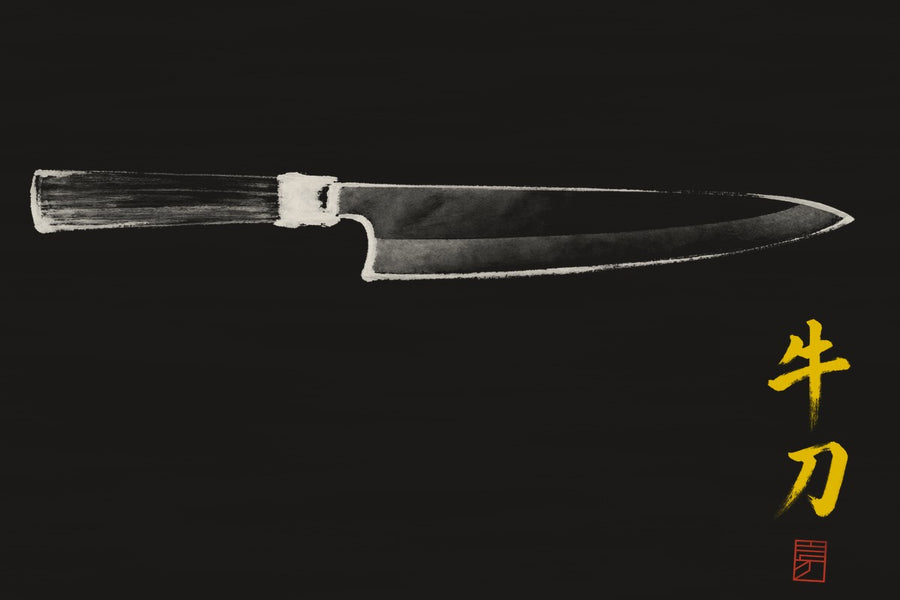
Gyuto — knife profile
Profile

Gyuto

牛刀

Chef's knife · Double bevel

Double-bevel all-purpose chef's knife with a pointed tip; thinner than a Western one.

Read more
Steel properties
  1. Hardness Very high
  2. Edge retention Very good
  3. Toughness Good
  4. Rust resistance Fair
  5. Ease of sharpening Fair
  6. Sharpness Fair
Our ratings, inferred from published lab tests and composition.

Our edge-retention grade is a kitchen rating. It weighs the hardness each steel is sold at, which keeps a thin edge from rolling, twice as heavily as lab wear tests, and the final grade is our judgment from selling and sharpening these knives for over a decade. Lab card-cutting tests measure abrasive wear only, so they can rank carbon steels lower. Tap ? for the lab figure.

Steel

SLD

SLD鋼

Semi-stainless · Hitachi Metals (now Proterial)

Proterial cold work die steel near D2: 1.5% carbon, 12% chromium, hardening hardness over 58 HRC. Good edge life.

Read more
CladdingCoreClad line
Construction

Sanmai - Stainless Damascus Clad

三枚ダマスカス

3 layers · damascus clad

Hard core between stainless damascus layers, bare at the edge. Thinning wears the pattern.

Read more
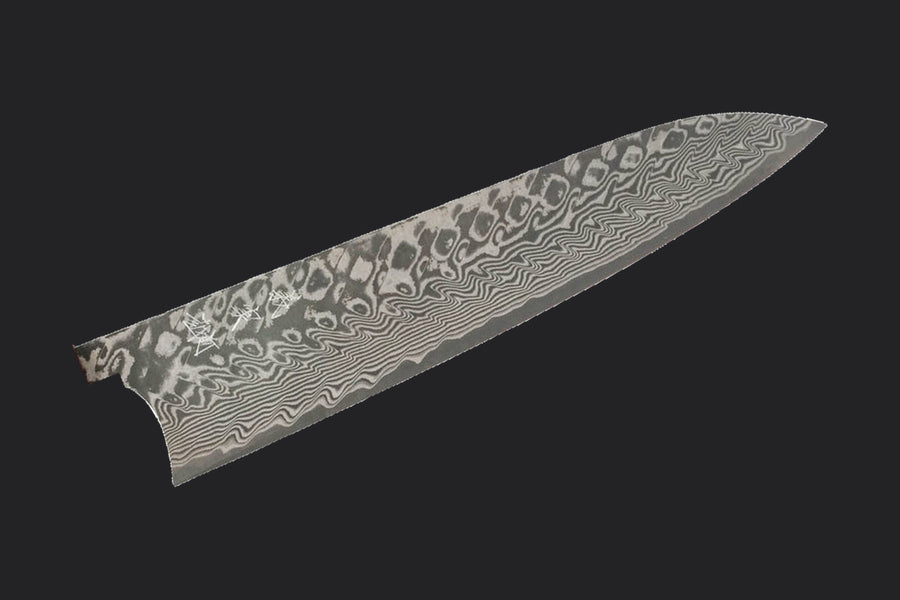
Etched — blade surface finish
Finish

Etched

エッチング

Acid-etched pattern

Acid darkens the layers at different rates to show the damascus. Heavy thinning fades it.

Read more
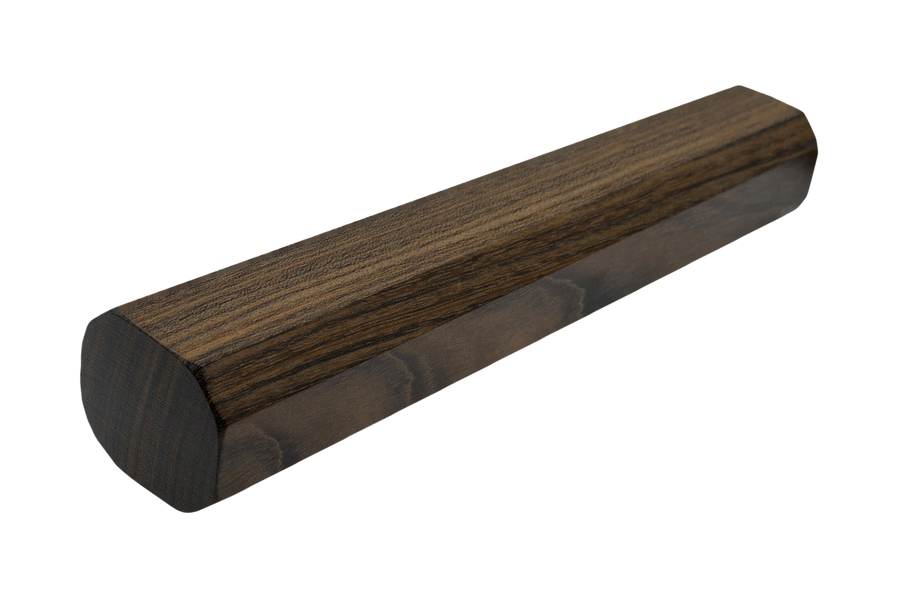
Octagonal Black Chacate handle
Handle

Octagonal Black Chacate

Octagonal WA

Black chacate, a dense dark African wood near ebony, eight-sided; may show pale sapwood.

Frequently asked questions

Gyuto or santoku: which should I choose?

The gyuto came to Japan with the beef-eating culture of the Meiji era, and that is where its name comes from. Tojiro says it is used for all kinds of cooking, which is why it is also called the chef's knife.

The santoku is a household knife that combines the good points of the nakiri and the gyuto. Tojiro describes it as all-purpose, from vegetables to meat and fish, double-bevel and built on the same construction as a Western knife.

Choose a gyuto if you want more length and reach. Choose a santoku if you want a shorter all-purpose knife. Tojiro's own size figures: gyuto 150 to 210mm for household use and up to 360mm for professional use, santoku 165 to 170mm for household use.

What is a gyuto knife used for?

The gyuto (牛刀) is a chef's knife for all kinds of cooking, and it is basically double-bevel. A knife maker's guide says it came to Japan in the Meiji era with the culture of eating beef, which gave it its name, but it does not cut only meat.

A Japanese dictionary describes the gyuto as slimmer than a santoku, with a pointed tip, used widely for meat, fish and vegetables.

What gyuto length should I choose?

A knife maker's guide lists 150 to 210 mm, double-bevel, for home use, and 180 to 360 mm, single- or double-bevel, for professional kitchens.

We suggest starting with a 210 mm gyuto for a home kitchen, and stepping up to 240 mm if you regularly cut large pieces and have the board for it.

240mm vs 210mm gyuto: which size should I choose?

Get the 210mm. We only point people to a 240mm when they have about 45cm of usable board, cook in volume, and regularly break down big roasts or whole fish.

On the gyutos we've measured for our product pages, the extra length is real. As of October 2026, the 210mm gyutos we list have a median edge of 213mm from heel to tip, across the 111 we have measured; the 240mm ones have a median of 240mm, across 100. The 240s are also heavier, 212g against 175g at the median, and a touch taller at the heel, 50mm against 48mm, across the same 100 and 111 knives.

Weight overlaps between the two sizes. As of October 2026, 11 of the 100 measured 240s weigh less than the median 210 at 175g. The 240s we measured weigh 146 to 323g, and the 111 measured 210s 121 to 255g. The number in the name does not decide how heavy a knife is, so check the measured weight on the product page.

Japanese or German kitchen knives: which should I buy?

Buy Japanese if you want a thinner, harder knife and will treat it with some care. Buy German if the knife has to put up with rough use, rock chopping and a honing steel. We sell Japanese knives only, so you know where we stand, but the differences are real.

Hardness is the main one. German makers publish about 56 to 58 HRC for their chef's knives. Japanese steels sit higher: Takefu Special Steel rates VG10 at 60 HRC or more, and Proterial gives Blue 2 (Aogami 2) over 60 HRC after hardening. Harder steel holds a fine edge longer and lets the maker grind the blade thinner, so it moves through food with less effort. Softer steel dulls sooner, but its edge tends to roll where a harder one would chip, so it forgives more.

Shape follows. A German chef's knife has a deep curved belly made for rocking. A Japanese gyuto is flatter towards the heel, which suits push and pull cuts. German makers now publish edge angles of about 14 to 15 degrees per side, and Japanese double bevel knives are usually sharpened at about 12 to 16, so the real gap is thickness and hardness rather than the angle.

Care differs too. A honing steel suits the softer German edge. A Japanese knife is sharpened on a whetstone and should stay away from bones, frozen food and very hard squash. Both want a wooden or plastic board.

If you are moving across from German knives, a stainless gyuto of about 210 mm is the easiest step. The Sakai Takayuki VG10 33 Layer Hammered Damascus gyuto has a Western handle and will feel familiar in the hand.

What is the flat spot on a knife, and is it the same as the "sweet spot"?

The flat spot is the straight run of edge from the heel towards the middle, the part that meets the board along its length. It is commonly known as the sweet spot; some people also use "sweet spot" for the balance point, so ask which one someone means.

Past the flat, the edge curves up towards the tip (the belly), which suits a swinging or pulling stroke. Sharpeners also say "flat spot" for a worn patch of edge, so when you mean the shape, "the flat part of the edge" is clearer.

Gyuto or chef's knife: what is the difference?

A gyuto is a chef's knife, and its shape is largely modelled on the French chef's knife: a fairly flat run of edge near the heel, then a curve up to the tip. A German-style chef's knife has a bigger belly and curves along much more of its edge.

The flat run suits push and pull cuts, and the belly is made for rocking. That flat run is commonly known as the sweet spot.

Is a Japanese knife set worth buying, or should I buy knives one at a time?

Buy one at a time. Start with a chef's knife (gyuto) or a santoku and add a knife only when you notice you are missing one. A boxed set makes you pay for knives you will rarely pick up to get the one you use daily, and we sell very few of them.

If you want knives that match, build a small set yourself.

  • The main knife is a 210mm gyuto, or a 165 to 180mm santoku if your board is small. It does most of the work.
  • Add a small utility knife (petty) of about 150mm for peeling, trimming and other close work.
  • Add a third only if your cooking calls for it: a vegetable knife (nakiri) for daily vegetable prep, or a slicing knife (sujihiki) for carving roasts and portioning meat or fish.

Our Knife Bundles collection groups knives by line, such as the Hatsukokoro Hayabusa VG10 and our own K&S AUS-10 Monosteel, so handles and finish match.

A set bought in one go only makes sense when you know you will use every knife in it. If you already own a chef's knife you are happy with, skip a second all-purpose knife and put the money into a whetstone. Our first Japanese knife guide covers choosing the first one.

You May Also Like