Makoto Kurosaki  |  SKU: MKT-SMDRZK-SS-STK170

Makoto Kurosaki Samidorizuki SGStrix Santoku 170mm

Sale price $363.00 Regular price $427.00

Pickup in Australia only

In Stock Now

Availability

Goes well with

Detailed Specifications
Line Makoto Kurosaki Samidorizuki SGStrix
Profile Santoku / Santoku
Bevel Type Double Bevel
Weight 148 g | 5.2 oz
Edge Length 166 mm | 6 17/32″
Heel Height 49 mm | 1 59/64″
Width @ Heel 2.0 mm | 5/64″
Width @ Mid 1.9 mm | 5/64″
Width @ 1cm from Tip 1.5 mm | 1/16″
Steel SPG STRIX | Powdered | Stainless
Blade Construction Sanmai - Stainless Clad
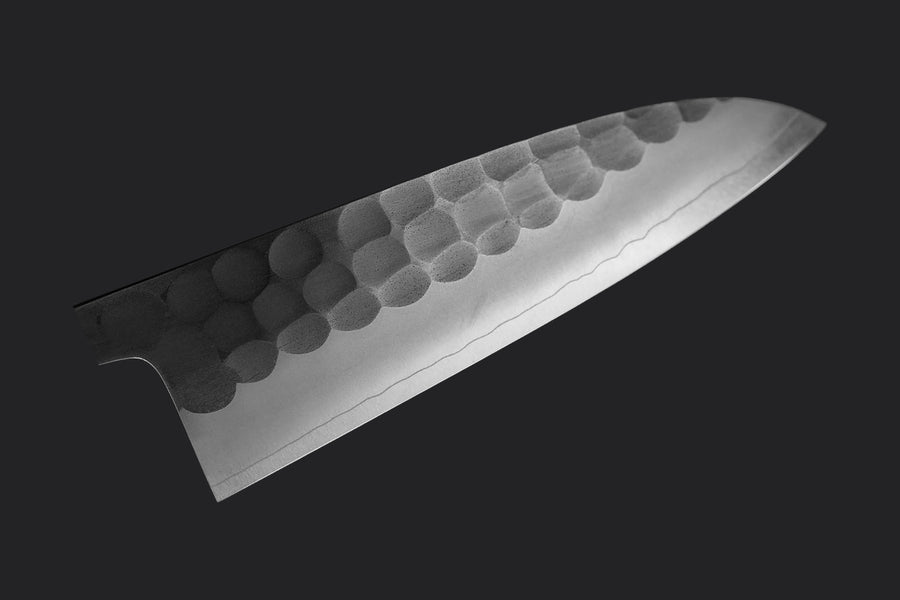
Surface Finish Tsuchime
Handle Special Handle
Region Takefu
Best for
  • Enthusiasts
  • Pro chefs
  • Household

World-wide shipping via DHL Express, 3 to 6 days (not available in the UK).


The Samidorizuki line carries SPG STRIX, a powdered stainless steel from Takefu Special Steel hardened to 63 to 65 HRC. It is built on a strengthened metallic base, so despite the high hardness it sharpens with feedback closer to a carbon steel than a typical powder stainless.

Each blade is a double bevel sanmai build, on an octagonal stabilised birch handle. The gyuto weighs 170 g with a 215 mm edge and a spine that tapers from 2.1 mm at the heel to 1.3 mm near the tip; the compact 170 mm santoku is 148 g, and the 135 mm petty handles the peeling and detail work at 81 g.

At 63 to 65 HRC the edge holds up well, and the steel is designed so it sharpens with the feedback of a carbon steel on your usual stones. For cooks who want high hardness without the fuss of carbon steel, this series threads that needle well.

Video Review

Pros Cons
  • Excellent performance
  • Ideal for the household
  • Great for professionals
Care Instruction
  1. Don't cut hard things! Japanese knives are brittle so bone hacking is a NO NO!
  2. Wash with neutral detergent after use, and wipe dry;
  3. Please don't wash knife with dishwasher, it will damage the wood handle;
  4. Be careful not to leave the knife close to a heat source for a long time;
  5. It is a lot more dangerous to cut with a blunt knife than a sharp knife!
  6. It is best to sharpen a Japanese knife regularly on a waterstone.

Makoto Kurosaki

Makoto Kurosaki (黒崎真) is a professional sharpener based at Takefu Knife Village in Echizen, Fukui, where he runs his own sharpening workshop, Style K, opened in 2018. He is the older brother of blacksmith Yu Kurosaki, and his work shows a family eye for clean, crisp knife design, but his own role is the one behind the edge: taking forged blades and grinding and sharpening them into knives that actually cut. His Kaen line, with its hexagonal tsuchime patterns and VG10/VG2 coreless damascus, pairs that clean look with thin, light geometry.

In 2020 he was certified a Dento Kogeishi (traditional craftsman), and his recent lines use modern steels such as Takefu's SPG Strix powdered stainless, hardened to 63-65 HRC while keeping a carbon-like sharpening feel. The workshop is now organised as Echizen Kurosaki K.K. (越前くろさき). He is a sharpener (togishi), not a blacksmith, so his craft is the finishing that turns a forged blank into a working knife.

“The sharpener's craft: clean, crisp lines and near-laser grinds from Echizen.”

Est. 2018 | 平成30年
Known for Clean, crisp knife lines and thin, high-performance grinds; work in SPG Strix powder stainless and coreless VG10/VG2 damascus.
Website takefu-knifevillage.jp Read more about Makoto Kurosaki

Makoto Kurosaki · Takefu

Knife details

Santoku — knife profile
Profile

Santoku

三徳

Santoku · Double bevel

An all-purpose knife for meat, fish and vegetables, with a wide blade and a rounded tip.

Read more
Steel properties
  1. Toughness Good
  2. Rust resistance High
  3. Ease of sharpening Fair
  4. Sharpness High

Our ratings, inferred from published lab tests and composition.

Steel

SPG STRIX

Stainless · Takefu Special Steel

Takefu stainless powder steel; Takefu says it sharpens like carbon steel.

Read more
CladdingCoreClad line
Construction

Sanmai - Stainless Clad

三枚

3 layers · stainless clad

Hard core between two stainless layers, bare only at the edge; the cladding resists rust.

Read more
Tsuchime — blade surface finish
Finish

Tsuchime

槌目

Hammered surface

Hammer marks across the upper blade. The dimples may help food release.

Read more
Handle

Special Handle

Octagonal WA

The maker's own handle; material not disclosed. See the product photos for its look.

Frequently asked questions

Gyuto or santoku: which should I choose?

The gyuto came to Japan with the beef-eating culture of the Meiji era, and that is where its name comes from. Tojiro says it is used for all kinds of cooking, which is why it is also called the chef's knife.

The santoku is a household knife that combines the good points of the nakiri and the gyuto. Tojiro describes it as all-purpose, from vegetables to meat and fish, double-bevel and built on the same construction as a Western knife.

Choose a gyuto if you want more length and reach. Choose a santoku if you want a shorter all-purpose knife. Tojiro's own size figures: gyuto 150 to 210mm for household use and up to 360mm for professional use, santoku 165 to 170mm for household use.

Rock chop or up-and-down chop: which knife shape suits me?

Match the shape to your stroke. Rock chopping keeps the tip on the board and rolls the curved belly through the food, so a gyuto or a Western chef's knife suits it, and Japanese knives rock fine as long as you rock gently.

Up-and-down chopping, the Chinese style, wants a straight run of edge, so a nakiri, usuba, santoku or bunka suits it better; a curved edge chopped straight down easily leaves pieces joined. Neither shape is better; it depends on how you cut.

What does santoku mean?

A Japanese dictionary explains the name of the santoku (三徳包丁) as coming from the three things it handles: meat, fish and vegetables. The same dictionary entry points from the santoku to the bunka (文化包丁), treating the two as one knife.

One Japanese knife maker guide distinguishes the two by the tip. It says that in the Showa era the bunka was made with its tip cut at an angle, and the santoku came after it by rounding that tip.

Why is SPG STRIX easy to sharpen for such a hard steel?

Takefu, which makes SPG STRIX, designed it that way. It says a blade steel's hardness comes from its metal base and its carbides, and it made this stainless powder steel by strengthening the base, which it says gives ease of sharpening like carbon steel at about HRC 65.

Takefu calls it a powder steel developed for blades and does not disclose its composition. We recommend drying the knife after washing.

How can I tell sanmai, warikomi, damascus and honyaki apart?

Start with the line on the blade. On a clad knife, sanmai or warikomi, a hard steel core is joined to a softer cladding, and the join shows on the bevel. Tojiro says this is where the name kasumi (霞, haze) comes from: the hard steel takes a shine while the soft metal looks hazy.

A honyaki (本焼) is made of one steel. Before hardening the smith coats the parts that should stay softer with clay, so only the edge hardens fully, and the boundary can show as a hamon (刃文).

Damascus is a pattern made by forging many layers of different metals together and then bringing the pattern out with the finish. If it matters how a knife is built, ask before you buy. Our sanmai, warikomi and honyaki pages show each construction.