Drag to spin · pinch or scroll to zoom

Myojin Riki  |  SKU: MJ-COSP-BU180

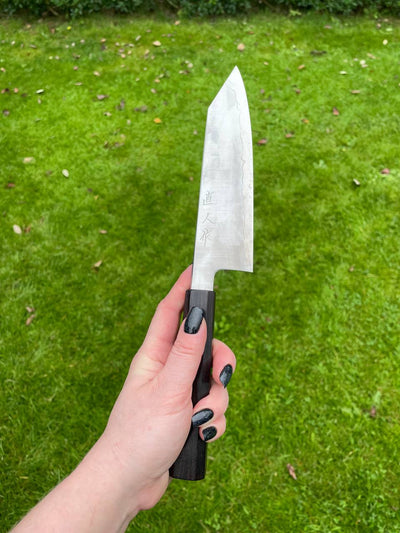
Myojin Cobalt Special COSP Bunka 180mm Ebony Handle

Sale price $344.00 Regular price $404.00

Availability

Detailed Specifications
Line Myojin Cobalt Special COSP
Profile Bunka / K-tip santoku
Bevel Type Double Bevel
Weight 131 g | 4.6 oz
Edge Length 169 mm | 6 21/32″
Heel Height 48 mm | 1 57/64″
Width @ Heel 2.1 mm | 5/64″
Width @ Mid 1.9 mm | 5/64″
Width @ 1cm from Tip 0.8 mm | 1/32″
Steel COSP (Cobalt Special) | Stainless
Blade Construction Sanmai - Stainless Clad
Maker's hardening hardness 60 HRC or more
Surface Finish Ukiba
Handle Octagonal Ebony
Region Tosa
Best for
  • First-timers
  • Pro chefs

World-wide shipping via DHL Express, 3 to 6 days (not available in the UK).


The Cobalt Special (COSP) knives from Myojin Riki feature blades crafted from Cobalt Special steel, a high-end Japanese stainless steel known for superior edge retention, sharpness, and corrosion resistance. Enriched with carbon and chromium, it offers excellent durability. The addition of cobalt, molybdenum, and vanadium enhances its hardness and wear resistance, making it ideal for everyday use.

Pros Cons
  • Easy to look after
  • Excellent fit and finish
  • Thin behind the edge
  • More sharpening needed
Care Instruction
  1. Don't cut hard things! Japanese knives are brittle so bone hacking is a NO NO!
  2. Wash with neutral detergent after use, and wipe dry;
  3. Please don't wash knife with dishwasher, it will damage the wood handle;
  4. Be careful not to leave the knife close to a heat source for a long time;
  5. It is a lot more dangerous to cut with a blunt knife than a sharp knife!
  6. It is best to sharpen a Japanese knife regularly on a waterstone.

Customer reviews

5.0
Based on 2 verified reviews
★★★★★Great value workhorse

A solid stainless steel workhorse and a great choice for the price. Nice finish, comfortable handle, rounded spine and choil, and it looks amazing
★★★★★

Great balance in hand

Myojin Riki

Myojin Riki Seisakusho, a Tosa knife workshop

The workshop 明神利器製作所, whose knives we list as Myojin Riki, is in Susaki, Kochi. Kochi City's craft page names its second generation as 明神 直人.

Kochi City's page on Tosa crafts describes the workshop as carrying work from forging to finishing in one continuous process. The page says it sharpens a hamaguri-ba (蛤刃) edge, ground convex, a technique the workshop's second generation learned through several years of training in Fukui, and that it also takes sharpening-only orders from outside Kochi Prefecture.

Among the lines we list, the Hatsukokoro x Myojin Shirasagi single-bevel knives cover Blue 2 kurouchi yanagiba, K-tip yanagiba, sakimaru yanagiba and honesuki, White 2 deba, left-handed mioroshi deba, left-handed yanagiba and honesuki, and a Ginsan yanagiba. We also list Myojin Cobalt Special gyuto, santoku and bunka.

“A Tosa workshop in Susaki, Kochi, described by Kochi City's craft page as working from forging through finishing.”

Known for A convex hamaguri-ba edge, as Kochi City's craft page describes
Instagram @tetsujin_labo Read more about Myojin Riki

Myojin Riki · Tosa

Knife details

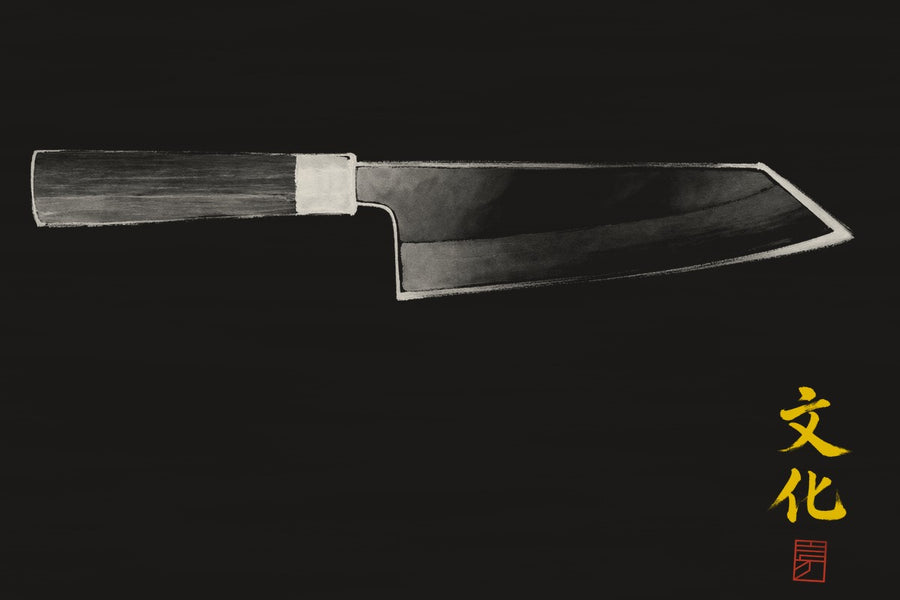
Bunka — knife profile
Profile

Bunka

文化

K-tip santoku · Double bevel

A compact all-rounder like a santoku; a Sakai maker says its angled K-tip suits fine work.

Read more
Steel properties
  1. Hardness Good
  2. Edge retention Good
  3. Toughness Good
  4. Rust resistance High
  5. Ease of sharpening Good
  6. Sharpness Good
Our ratings, inferred from published lab tests and composition.

Our edge-retention grade is a kitchen rating. It weighs the hardness each steel is sold at, which keeps a thin edge from rolling, twice as heavily as lab wear tests, and the final grade is our judgment from selling and sharpening these knives for over a decade. Lab card-cutting tests measure abrasive wear only, so they can rank carbon steels lower. Tap ? for the lab figure.

Steel

COSP (Cobalt Special)

コバルトスペシャル鋼

Stainless · Takefu Special Steel

Takefu stainless with 2.50% cobalt; Takefu says the cobalt helps the edge last.

Read more
CladdingCoreClad line
Construction

Sanmai - Stainless Clad

三枚

3 layers · stainless clad

Hard core between two stainless layers, bare only at the edge; the cladding resists rust.

Read more
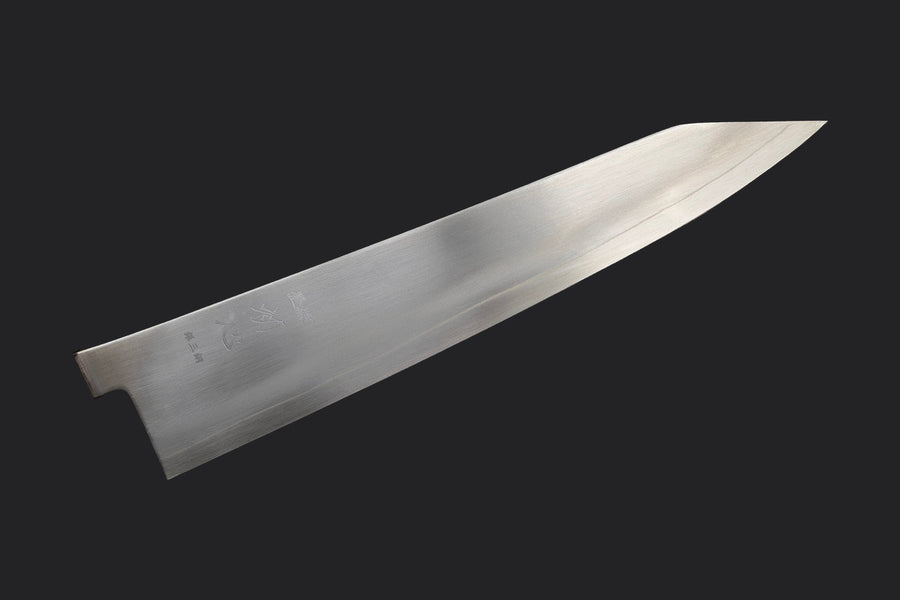
Ukiba — blade surface finish
Finish

Ukiba

Floating-edge finish

Polished core with a sandblasted matt band above the clad line; the edge seems to float.

Read more
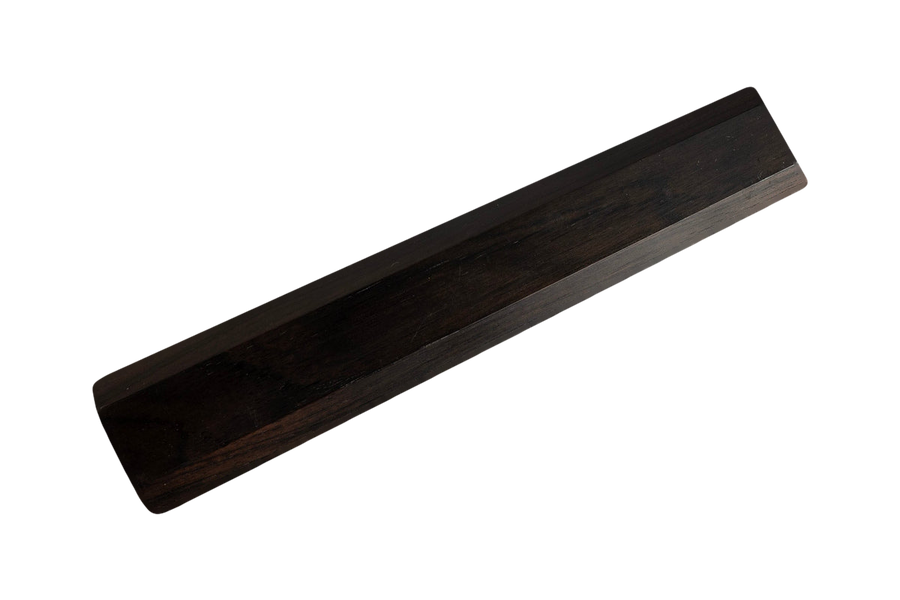
Octagonal Ebony handle
Handle

Octagonal Ebony

Octagonal WA

Dense, dark ebony in the eight-sided wa shape. The flats give a sure grip for either hand.

Frequently asked questions

Why is it called a bunka knife?

The bunka knife (文化包丁) takes its name from bunka, culture. A Sakai knife maker ties the name to Japan's modernisation, when Western culture and Japanese tradition merged, and says it stands for that new era and for the knife's wide range of uses.

The same maker says that as diets broadened to meat, fish and vegetables, an all-purpose knife was wanted, and the bunka took features from both Japanese and Western knives.

What is the difference between a bunka and a santoku?

The tip. One Japanese knife maker describes the bunka (文化包丁, kengata) as combining the good points of the gyuto and the nakiri with the tip cut at an angle, and the santoku as coming after it, by rounding that tip.

Both are all-purpose knives for the home; santoku (三徳) means three virtues, for the three foods it cuts: meat, fish and vegetables.

Bunka, nakiri or usuba: which knife is best for vegetables?

For everyday vegetable prep, a nakiri (菜切) is the simple choice. Tojiro describes it as Japan's own vegetable knife: a square, double-bevel blade, so it cuts the same way in either hand.

A bunka (文化) is a home knife that Tojiro describes as combining the good points of the nakiri and the gyuto. Choose it if you want one knife for vegetables plus meat and fish, with an angled tip.

An usuba (薄刃) is a knife made for vegetable preparation in Japanese cooking. It is single bevel, so it is made for one hand, and Tojiro lists its jobs as peeling and hollowing at the heel, and katsuramuki, fine garnish cuts and rounding off cut edges along the middle of the edge. Choose it if you want to learn those techniques.

What is Cobalt Special (CoSP) steel?

Cobalt Special (CoSP) is Takefu's stainless blade steel for cutlery: Takefu's page describes it as super high-grade and made by a special remelting process that gives a uniform composition and finely dispersed carbides.

Takefu's table gives 1.05% carbon, 16.00% chromium, 1.50% molybdenum, 0.25% vanadium, 0.25% tungsten and 2.50% cobalt, with a hardening hardness of HRC 60 or more. In Takefu's description, tungsten improves tempering resistance, molybdenum adds corrosion resistance, vanadium gives a finer microstructure, and cobalt strengthens the matrix and helps keep a long-lasting edge. Its 16.00% chromium is above the JSSA's 10.5% minimum for stainless, which the JSSA says strictly means rusts less; wash and dry the knife after use.

What is the hamaguri-ba edge on the knives we list as Myojin Riki?

A hamaguri-ba edge, written 蛤刃, is a convex edge shape, and it is the shape the workshop 明神利器製作所 sharpens its knives to. Kochi City's craft page records that the workshop's second generation, whose name the page gives as 直人, learned it over several years of training in Fukui.

The same page says the workshop also takes sharpening-only orders from outside Kochi.

Does Myojin Riki forge its own knives?

Yes. Kochi City's craft page for his workshop 明神利器製作所 says the work runs from forging through finishing in one continuous process, 鍛造から仕上げまで一貫して行う.

That page lists the workshop in Susaki, Kochi.

Are Myojin Riki knives worth it?

We think so, and mostly for the edge. The workshop 明神利器製作所, whose knives we list as Myojin Riki, is in Susaki, Kochi. Kochi City's craft page says it takes its knives from forging to finishing in one process, and that its second generation, 明神 直人, does the sharpening. He learned the hamaguri-ba (蛤刃) edge during several years of training in Fukui.

That page says the edge is ground with a slight roundness toward the cutting edge, neither too thin nor too thick. It says a knife finished this way bites into food well, cuts cleanly and releases food well.

We list Hatsukokoro x Myojin Shirasagi knives in White #2 and Blue #2 steel, including yanagiba, deba and usuba, and Myojin Cobalt Special knives. Stock changes, so check each listing. The Myojin Riki maker page has more on the workshop.

How can I tell sanmai, warikomi, damascus and honyaki apart?

Start with the line on the blade. On a clad knife, sanmai or warikomi, a hard steel core is joined to a softer cladding, and the join shows on the bevel. Tojiro says this is where the name kasumi (霞, haze) comes from: the hard steel takes a shine while the soft metal looks hazy.

A honyaki (本焼) is made of one steel. Before hardening the smith coats the parts that should stay softer with clay, so only the edge hardens fully, and the boundary can show as a hamon (刃文).

Damascus is a pattern made by forging many layers of different metals together and then bringing the pattern out with the finish. If it matters how a knife is built, ask before you buy. Our sanmai, warikomi and honyaki pages show each construction.

You May Also Like