Tosa  |  SKU: TOSA_TRSK_DE150

Tosa Tanren SK Steel Deba 150mm

Sale price $134.00 Regular price $158.00

IMPORTANT: Carbon steel knives can rust or patina quickly if not cared for properly. They require regular cleaning, drying, and oiling. If you are unfamiliar with carbon steel maintenance, we recommend choosing a stainless steel option instead.

Availability

Goes well with

Detailed Specifications
Line Tosa Tanren SK Steel Single Bevels
Profile Deba / Japanese fish knife
Bevel Type Single Bevel
Weight 232 g | 8.2 oz
Edge Length 157 mm | 6 3/16″
Heel Height 50 mm | 1 31/32″
Width @ Heel 7.2 mm | 9/32″
Width @ Mid 5.3 mm | 13/64″
Width @ 1cm from Tip 2.7 mm | 7/64″
Steel SK Steel | Carbon
Blade Construction Nimai - Soft Iron Clad
Typical hardness 58 to 62 HRC
Surface Finish Kasumi
Handle D Shaped Ho Wood Black Ferrule
Region Tosa
Best for
  • First-timers
  • Pro chefs

World-wide shipping via DHL Express, 3 to 6 days (not available in the UK).


The Tosa Tanren(土佐鍛錬, Tosa Forging) SK Steel is some of the best entry level option for single bevel knives. Despite not having the most premium steel and the fancy look, it is a very competent tool for the job, and an even better tool for people to learn how to live with a traditional deba.

The SK steel may not be a commonly seen grade. It is a JIS grade high carbon steel that is not a part of the Hitachi Yasugi steel family, but have a similar carbon content as White #3 at 0.8-0.9%. It may not seem to be a lot but in typical western smithy the 1084 and 1095(with 0.84% and 0,95% carbon respectively) would already be seen as pretty high carbon steel. So, although it might not be premium, the SK is not gonna be anywhere near a poor steel to make knife with. Instead, since it's priced to be very beginner friendly, a steel that is easier to sharpen will pair very well with an entry level stone and allows a beginner to learn how to sharpen single bevel knives much easier.

The highlight is the sharpener, which is the renowned Myojin Riki Sesakusho. As far as we know, the sharpening and polishing of the single bevels are not done by Naohito Myojin, but the level of finish achieved on these blades are pretty high. You can rarely spot any defects of unevenness over the Migaki finished Urasuki and the flat hira, and the corner on the spine is lightly touched up to smoothen out the sharp edge. I really can’t ask much for an entry level knife lineup at this price.

This is a line that aimed clearly towards the beginner market, and for a single bevel user, I would highly recommend getting a set of properly built knives so you could understand and familiarise yourself with how a traditional Japanese blade behaves, whether when using it or when sharpening it. The SK line is a humble beginning that is well suited for this purpose, and along with the great fit and finish, they’ve got great value too.

Pros Cons
  • Excellent fit and finish
  • Budget friendly
  • Great for professionals
  • Prone to rust
  • Non-premium steel
Care Instruction
  1. Don't cut hard things! Japanese knives are brittle so bone hacking is a NO NO!
  2. Wash with neutral detergent after use, and wipe dry;
  3. Please don't wash knife with dishwasher, it will damage the wood handle;
  4. Be careful not to leave the knife close to a heat source for a long time;
  5. It is a lot more dangerous to cut with a blunt knife than a sharp knife!
  6. It is best to sharpen a Japanese knife regularly on a waterstone.
  7. Oil the (carbon) knife if storing for an extended period of time to prevent rust.

Myojin Riki

Myojin Riki Seisakusho, a Tosa knife workshop

The workshop 明神利器製作所, whose knives we list as Myojin Riki, is in Susaki, Kochi. Kochi City's craft page names its second generation as 明神 直人.

Kochi City's page on Tosa crafts describes the workshop as carrying work from forging to finishing in one continuous process. The page says it sharpens a hamaguri-ba (蛤刃) edge, ground convex, a technique the workshop's second generation learned through several years of training in Fukui, and that it also takes sharpening-only orders from outside Kochi Prefecture.

Among the lines we list, the Hatsukokoro x Myojin Shirasagi single-bevel knives cover Blue 2 kurouchi yanagiba, K-tip yanagiba, sakimaru yanagiba and honesuki, White 2 deba, left-handed mioroshi deba, left-handed yanagiba and honesuki, and a Ginsan yanagiba. We also list Myojin Cobalt Special gyuto, santoku and bunka.

“A Tosa workshop in Susaki, Kochi, described by Kochi City's craft page as working from forging through finishing.”

Known for A convex hamaguri-ba edge, as Kochi City's craft page describes
Instagram @tetsujin_labo Read more about Myojin Riki

Myojin Riki · Tosa

Knife details

Deba — knife profile
Profile

Deba

出刃

Japanese fish knife · Single or double bevel

A thick, heavy fish knife; dictionaries say it fillets and cuts fish and fowl bones.

Read more
Steel properties
  1. Hardness Good
  2. Edge retention Good
  3. Toughness Good
  4. Rust resistance Low
  5. Ease of sharpening High
  6. Sharpness Very high
Our ratings, inferred from published lab tests and composition.

Our edge-retention grade is a kitchen rating. It weighs the hardness each steel is sold at, which keeps a thin edge from rolling, twice as heavily as lab wear tests, and the final grade is our judgment from selling and sharpening these knives for over a decade. Lab card-cutting tests measure abrasive wear only, so they can rank carbon steels lower. Tap ? for the lab figure.

Steel

SK Steel

SK材

Carbon · Various

A JIS family of carbon tool steels, not stainless. We list Fujitora, Tosa Tanren and Higonokami knives in it.

Read more
ShinogiCladdingClad lineHard steelHollow back
Construction

Nimai - Soft Iron Clad

二枚・軟鉄

2 layers · single bevel

Two layers, single bevel: hard steel on the back, soft iron elsewhere; it patinas.

Read more
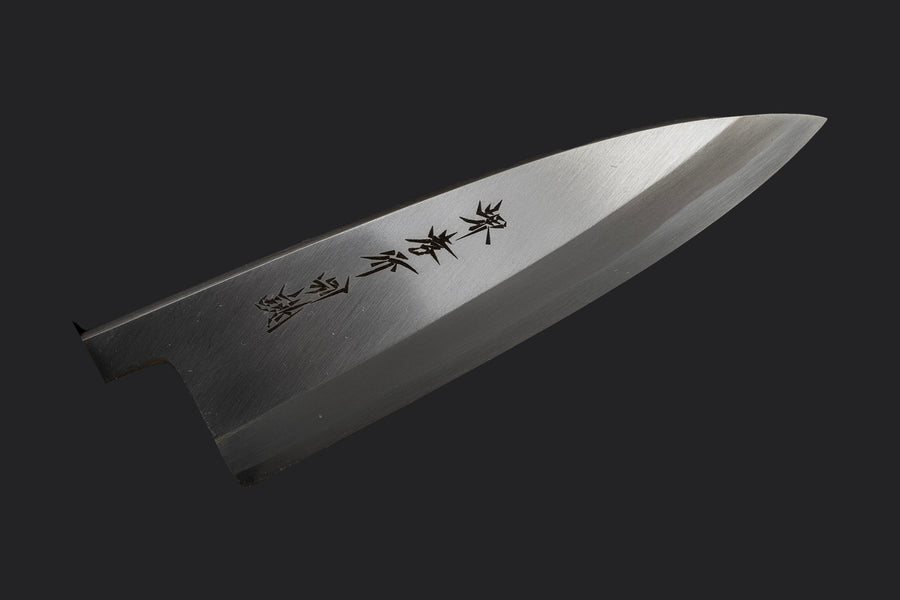
Kasumi — blade surface finish
Finish

Kasumi

霞

Misty polish

Hazy, matte bevel where soft iron meets hard core steel. The iron patinas and rusts.

Read more
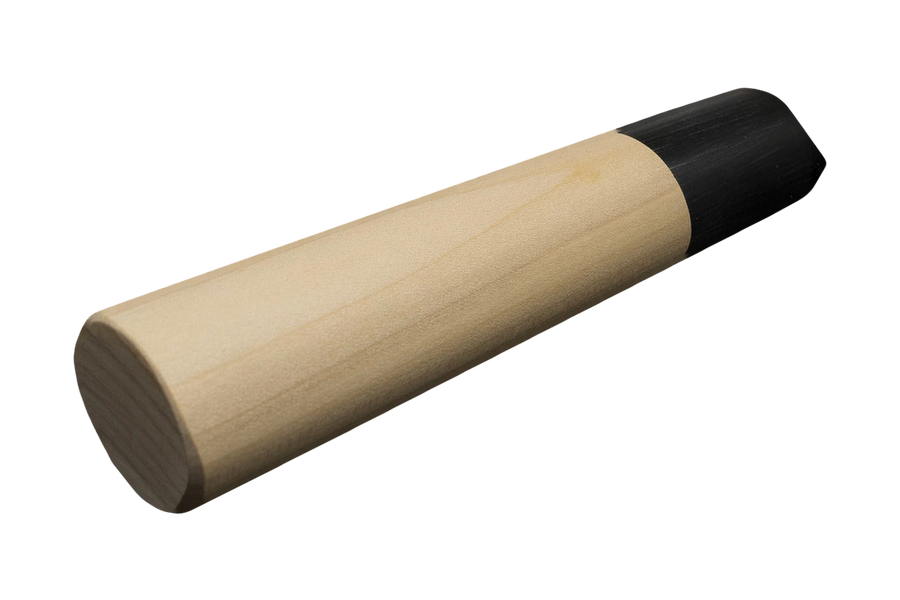
D Shaped Ho Wood Black Ferrule handle
Handle

D Shaped Ho Wood Black Ferrule

D Shape WA

Pale ho wood, D-section wa, with a black buffalo horn ferrule. The D is handed; check fit.

Frequently asked questions

Can a deba cut bone?

Yes, the bones of fish and fowl. Japanese dictionaries describe the deba (出刃包丁) as wide, thick-spined and heavy, used to fillet fish, to cut fish and fowl bone and all, and for rough chopping.

When you chop bone, use the heel of the blade (刃元), the Sakai cutlery association says. It is a fish and poultry knife, not a cleaver.

Can left-handed cooks use single bevel knives?

A standard single bevel knife is ground for right-handed use, and a left-handed one is made with the bevel reversed. Some makers offer left-handed versions.

Contact us and we will check what we can order or have in stock.

What is a mioroshi deba?

A mioroshi deba is a longer, slimmer version of the Japanese fish-butchering knife (deba), made for filleting. It keeps the deba's single bevel but is narrower, thinner at the spine and much lighter for its length.

A standard deba is thick and heavy, deep at the heel, and typically 150mm to 210mm long. Its weight and thick spine do the work when you take off a head or cut through a spine. The mioroshi deba gives up some of that weight for length: the ones we list are 210mm, 240mm and 270mm.

Our measurements show the difference. In Masamoto Sohonten's KS line, the 210mm mioroshi deba weighs 209g against 382g for the 210mm deba, and its spine above the heel is 4.8mm thick against 7.1mm.

Like the deba it is single bevel, so each knife is made for one hand. Most are right-handed, and we list left-handed ones too. Ours come from Sakai Takayuki, Masamoto Sohonten, Nakagawa and the Hatsukokoro Shirasagi line, in White 2 and Blue 1 carbon steel and in stainless.

Choose the standard deba if most of your work is heads and spines, because that work needs the weight. Choose the mioroshi deba when filleting is most of the job. Our deba guide explains the family, and both are listed with our deba and fish filleting knives.

Why is the back of a single-bevel knife hollow, and how do I sharpen it?

The shallow hollow in the back is called urasuki (裏スキ). Tojiro explains that it means the whole back never has to be ground when you sharpen, makes it easier to keep the back flat, and stops sharpening the back from affecting the edge. Only the thin flat rim around the hollow touches the stone.

Sharpen the front bevel first, laying it flat on the stone. Then lay the back completely flat and take a few light strokes, just enough to remove the burr. Never lift the spine to put an angle on the back, and keep the stone itself flat.

Which knife do I need for sushi and sashimi at home?

For occasional sushi at home, a sharp sujihiki (筋引) does the job. Tojiro describes it as a long, double-bevel slicer that can also be used for sashimi, and a double bevel works in either hand.

If sashimi is the point of the meal, choose a yanagiba (柳刃). Tojiro calls it the Kansai-style sashimi knife, now used across Japan, and it slices in one long pull from heel to tip. It is single bevel, so buy the one made for your hand.

If you start from whole fish, add a deba (出刃). Tojiro describes it as very thick and heavy, made for breaking fish down. The deba takes the fish apart and the slicer then cuts the fillets.

Is SK steel stainless?

No. SK is the symbol for the carbon tool steels in JIS G 4401, and in the table Kobe Steel publishes, chromium may not exceed 0.30% in any SK grade.

The Japan Stainless Steel Association defines stainless steel as an alloy with at least 10.5% chromium, so SK steel is not stainless. We suggest washing and drying the knife after use.

What is the hamaguri-ba edge on the knives we list as Myojin Riki?

A hamaguri-ba edge, written 蛤刃, is a convex edge shape, and it is the shape the workshop 明神利器製作所 sharpens its knives to. Kochi City's craft page records that the workshop's second generation, whose name the page gives as 直人, learned it over several years of training in Fukui.

The same page says the workshop also takes sharpening-only orders from outside Kochi.

Does Myojin Riki forge its own knives?

Yes. Kochi City's craft page for his workshop 明神利器製作所 says the work runs from forging through finishing in one continuous process, 鍛造から仕上げまで一貫して行う.

That page lists the workshop in Susaki, Kochi.

You May Also Like