Takamura  |  SKU: TKMR_CMTCM_SA170

Takamura Chromax Tsuchime Santoku 170mm

Sale price $199.00 Regular price $234.00

Pickup in Australia only

In Stock Now

Availability

Goes well with

Detailed Specifications
Line Takamura Chromax Tsuchime
Profile Santoku / Santoku
Bevel Type Double Bevel
Weight 152 g | 5.4 oz
Edge Length 172 mm | 6 49/64″
Heel Height 46 mm | 1 13/16″
Width @ Heel 1.5 mm | 1/16″
Width @ Mid 1.5 mm | 1/16″
Width @ 1cm from Tip 0.8 mm | 1/32″
Steel Chromax | Semi-stainless
Blade Construction Sanmai - Stainless Clad
Maker's hardening hardness 61 HRC or more
Surface Finish Tsuchime
Handle Western Pakka Wood with Bolster
Region Echizen
Best for
  • Pro chefs
  • Enthusiasts

World-wide shipping via DHL Express, 3 to 6 days (not available in the UK).


•Signature blade geometry from Takamura: One of the best performing knives that excels at cutting dense produces. Achieved through very low thickness (1.5mm at spine across the entire knife) and a hand sharpened bevel with just enough convex for food release.

•Chromax steel, a semi-stainless steel that is almost identical to A2/SKD, with some resistance to rust than pure carbon steel but retains the ability to gain a very sharp edge.

•Great consistency in finish, clean Migaki bevel that forms nice contrast against textured Tsuchime

•Excellent value for a Santoku with top notch performance

•Limited availability, like any other Takamura knives

Pros Cons
  • Excellent performance
  • Thin behind the edge
  • Budget friendly
  • Prone to rust
  • A little bit brittle
Care Instruction
  1. Don't cut hard things! Japanese knives are brittle so bone hacking is a NO NO!
  2. Wash with neutral detergent after use, and wipe dry;
  3. Please don't wash knife with dishwasher, it will damage the wood handle;
  4. Be careful not to leave the knife close to a heat source for a long time;
  5. It is a lot more dangerous to cut with a blunt knife than a sharp knife!
  6. It is best to sharpen a Japanese knife regularly on a waterstone.
  7. Semi-stainless steel won't rust easily but may still patina

Takamura Hamono Seisakujo

Takamura Hamono, an Echizen workshop since 1945

Takamura Hamono is the Echizen workshop known by its mark Takamura saku (高村作), founded in December 1945 by its first generation after the Second World War. Its stated creed is good material, good forging and heat treatment, and good sharpening, and it says it makes its knives start to finish in house.

Read more

Takamura's own history page writes the founder's name only in kanji (高村勇); we know him as Isamu Takamura. The page says he was born in 1910, began smith training at 13 in 1923, and in December 1945 set up the forge that is now Takamura Hamono. Its early products were nakiri and farm blades, and as the times changed, home and professional kitchen knives became its main work. In 1954 the second generation, Toshiyuki, set out to make a stainless knife that cuts well, and the workshop forged stainless knives in integrated production from 1958, with tsuchime stainless knives following in 1964.

Its history lists the powder steel milestones: powder high-speed steel clad knives from 1982, powder stainless high-speed steel clad knives from 1985, and forged powder stainless Damascus knives from 1987. Takamura says it began making knives in such new materials earlier than anyone else. The history also records small ceremonial knives the workshop made for Ise Jingu, including for the Shikinen Sengu. Toshiyuki received the Fukui governor's award for excellent skill in 1987, was named a Contemporary Master Craftsman in 2015 and received the Medal with Yellow Ribbon in 2016. Takamura says its professional knives sell in more than 20 countries, including Germany, Sweden and Australia.

Its history also lists the Brazen TAKAMURA professional line (2002) and the Uchigumo forged powder stainless Damascus (2003), and the company says its iiza yobocho series won the iF Design Award 2017 gold, a first for Japan's knife industry. We list its SG2 Migaki in gyuto and santoku, and the Chromax Tsuchime santoku.

“An Echizen workshop making kitchen knives since 1945, known by its mark Takamura saku.”

Est. 1945 | 昭和20年
Known for Powder steel knives, which its history lists from 1982
Website takamurahamono.jp Instagram @terukazutakamura Read more about Takamura Hamono Seisakujo

Takamura Hamono Seisakujo · Echizen

Knife details

Santoku — knife profile
Profile

Santoku

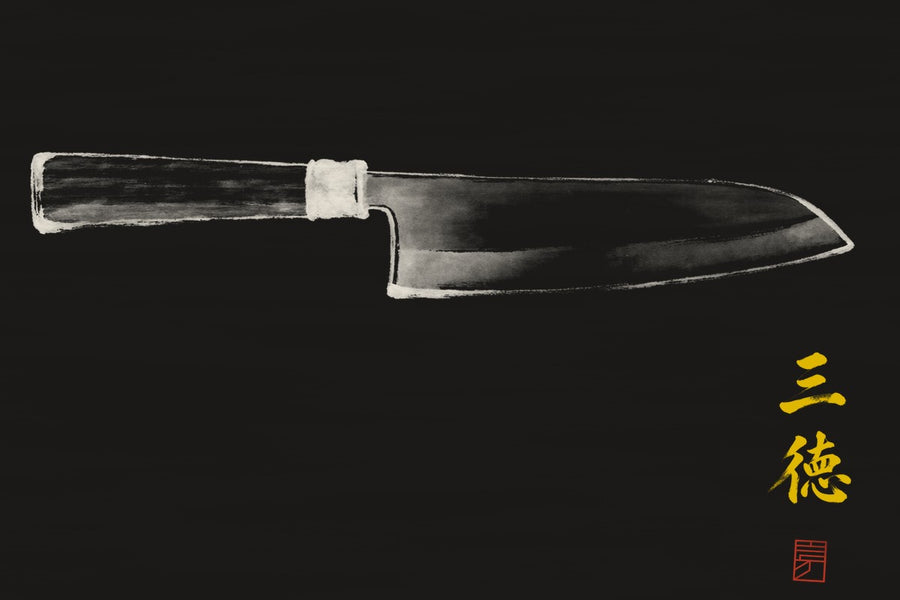
三徳

Santoku · Double bevel

An all-purpose knife for meat, fish and vegetables, with a wide blade and a rounded tip.

Read more
Steel properties
  1. Hardness Very good
  2. Edge retention Good
  3. Toughness Good
  4. Rust resistance Fair
  5. Ease of sharpening Good
  6. Sharpness Good
Our ratings, inferred from published lab tests and composition.

Our edge-retention grade is a kitchen rating. It weighs the hardness each steel is sold at, which keeps a thin edge from rolling, twice as heavily as lab wear tests, and the final grade is our judgment from selling and sharpening these knives for over a decade. Lab card-cutting tests measure abrasive wear only, so they can rank carbon steels lower. Tap ? for the lab figure.

Steel

Chromax

クロマックス鋼

Semi-stainless · Takefu Special Steel

Takefu semi-stainless, conventionally melted, 1% carbon, 5% chromium, hardening hardness 61 HRC or more. Easy to sharpen and tough.

Read more
CladdingCoreClad line
Construction

Sanmai - Stainless Clad

三枚

3 layers · stainless clad

Hard core between two stainless layers, bare only at the edge; the cladding resists rust.

Read more
Tsuchime — blade surface finish
Finish

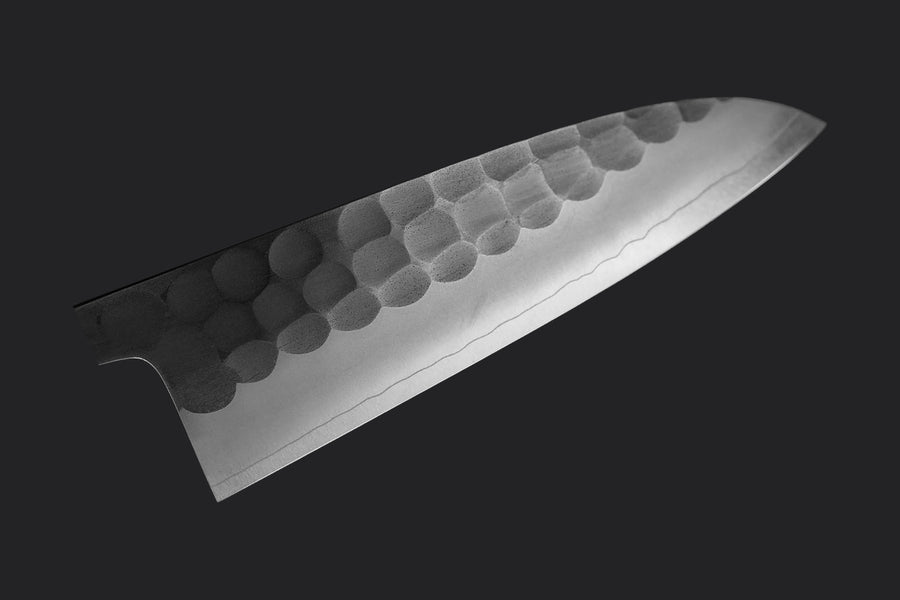
Tsuchime

槌目

Hammered surface

Hammer marks across the upper blade. The dimples may help food release.

Read more
Western Pakka Wood with Bolster handle
Handle

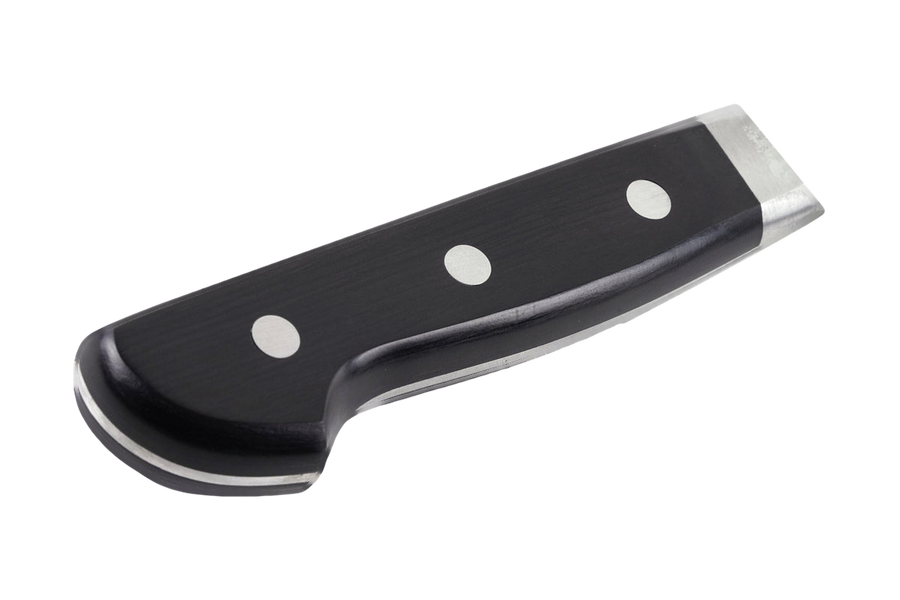
Western Pakka Wood with Bolster

Western with bolster

Pakka wood western grip with a bolster. Resin-laminated wood resists water; entry-level.

Frequently asked questions

Gyuto or santoku: which should I choose?

The gyuto came to Japan with the beef-eating culture of the Meiji era, and that is where its name comes from. Tojiro says it is used for all kinds of cooking, which is why it is also called the chef's knife.

The santoku is a household knife that combines the good points of the nakiri and the gyuto. Tojiro describes it as all-purpose, from vegetables to meat and fish, double-bevel and built on the same construction as a Western knife.

Choose a gyuto if you want more length and reach. Choose a santoku if you want a shorter all-purpose knife. Tojiro's own size figures: gyuto 150 to 210mm for household use and up to 360mm for professional use, santoku 165 to 170mm for household use.

Rock chop or up-and-down chop: which knife shape suits me?

Match the shape to your stroke. Rock chopping keeps the tip on the board and rolls the curved belly through the food, so a gyuto or a Western chef's knife suits it, and Japanese knives rock fine as long as you rock gently.

Up-and-down chopping, the Chinese style, wants a straight run of edge, so a nakiri, usuba, santoku or bunka suits it better; a curved edge chopped straight down easily leaves pieces joined. Neither shape is better; it depends on how you cut.

What does santoku mean?

A Japanese dictionary explains the name of the santoku (三徳包丁) as coming from the three things it handles: meat, fish and vegetables. The same dictionary entry points from the santoku to the bunka (文化包丁), treating the two as one knife.

One Japanese knife maker guide distinguishes the two by the tip. It says that in the Showa era the bunka was made with its tip cut at an angle, and the santoku came after it by rounding that tip.

Is Chromax stainless?

Takefu calls Stainless Chromax a composite: one of its V-Gin1, Gin2 or V-Gin3B steels as the core, clad in soft stainless steel. Takefu lists those core steels as semi-stainless (セミステンレス系).

Takefu lists 4.50 to 5.50% chromium for V-Gin1, 7.00 to 8.00% for Gin2 and 6.00 to 7.00% for V-Gin3B, and says V-Gin1 resists corrosion far better than carbon steel. The Japan Stainless Steel Association defines stainless steel as having at least 10.5% chromium. We suggest drying the knife after washing.

What does the stamp on a Takamura blade say?

The workshop is known by the mark 高村作, read Takamura saku, which means made by Takamura. The workshop's own site introduces Takamura Hamono Seisakujo by that mark.

The site tells how the founder, Isamu, set the workshop up after the Second World War, and speaks of his three sons.

How can I tell sanmai, warikomi, damascus and honyaki apart?

Start with the line on the blade. On a clad knife, sanmai or warikomi, a hard steel core is joined to a softer cladding, and the join shows on the bevel. Tojiro says this is where the name kasumi (霞, haze) comes from: the hard steel takes a shine while the soft metal looks hazy.

A honyaki (本焼) is made of one steel. Before hardening the smith coats the parts that should stay softer with clay, so only the edge hardens fully, and the boundary can show as a hamon (刃文).

Damascus is a pattern made by forging many layers of different metals together and then bringing the pattern out with the finish. If it matters how a knife is built, ask before you buy. Our sanmai, warikomi and honyaki pages show each construction.