Drag to spin · pinch or scroll to zoom

Iron Clad  |  SKU: TNHS-AUS8-YA300KS

Tsunehisa AUS8 Yanagiba 300mm Monosteel Kashi

Sale price $191.00 Regular price $224.00

Pickup in Australia only

In Stock Now

Availability

Goes well with

Detailed Specifications
Line Tsunehisa AUS8 Monosteel
Profile Yanagiba / Sashimi knife
Bevel Type Single Bevel
Weight 196 g | 6.9 oz
Edge Length 293 mm | 11 17/32″
Heel Height 38 mm | 1 1/2″
Width @ Heel 3.0 mm | 1/8″
Width @ Mid 2.8 mm | 7/64″
Width @ 1cm from Tip 0.8 mm | 1/32″
Steel AUS-8 | Stainless
Blade Construction Monosteel
Typical hardness 57 to 59 HRC
Surface Finish Migaki
Handle Japanese Kashi Octagonal
Region Fukuyama
Best for
  • First-timers
  • Students

World-wide shipping via DHL Express, 3 to 6 days (not available in the UK).


Tsunehisa's AUS8 Monosteel line is built for real kitchens. Each blade is one solid piece of AUS8 stainless steel, from spine to edge, with no cladding.

AUS8 holds a good edge through busy shifts, takes impact without chipping, shrugs off stains and rust, and sharpens easily when the time comes. Just wash and dry. The blades are heat-treated to 59-60 HRC.

The range covers Gyuto, Santoku and other profiles, comfortable in the hand and ready for onions, herbs or proteins.

An honest, low-drama work knife from a Japanese maker.

Pros Cons
  • Budget friendly
  • Excellent performance
  • Fit and finish can be improved
  • Non-premium steel
Care Instruction
  1. Don't cut hard things! Japanese knives are brittle so bone hacking is a NO NO!
  2. Wash with neutral detergent after use, and wipe dry;
  3. Please don't wash knife with dishwasher, it will damage the wood handle;
  4. Be careful not to leave the knife close to a heat source for a long time;
  5. It is a lot more dangerous to cut with a blunt knife than a sharp knife!
  6. It is best to sharpen a Japanese knife regularly on a waterstone.

Tsunehisa

Tsunehisa, the house brand of Shibata Knives

Tsunehisa (恒久) is the house brand of Shibata Knives, the knife company Takayuki Shibata owns and runs. It is a brand rather than a single workshop.

The name means permanence, and Shibata Knives says it chooses knives that will have a long life. Takayuki Shibata started Tsunehisa in 2015 as his third knife brand, to help manage growing orders.

Read more

Shibata Knives describes Tsunehisa as a brand that inherits traditional Japanese forging techniques while taking in the latest materials and technologies, aiming at function and design for long use. It says its experienced staff inspect each knife under strict quality control, and it offers after-sales maintenance and sharpening.

The lines we list are grouped by steel. Ginsan comes in migaki, nashiji and nawame finishes, as gyuto, santoku, nakiri and petty, with a deba in the same steel. White 1 comes stainless clad as migaki and tsuchime gyuto, Aogami Super as kurouchi tsuchime sujihiki and petty, and Blue 2 as the Samurai sakimaru sujihiki.

The Damascus lines are in VG10, AUS10 and ZA18, the AUS10 also with a tsuchime finish. The rest are AUS8 tsuchime, a VG1 gyuto and an SLD Washiji santoku. Handles come in wa and yo styles.

“The house brand of Shibata Knives; the name means permanence.”

Est. 2015 | 平成27年
Known for Knives chosen and inspected by Shibata Knives
Instagram @tsunehisa Read more about Tsunehisa

Tsunehisa · Fukuyama

Knife details

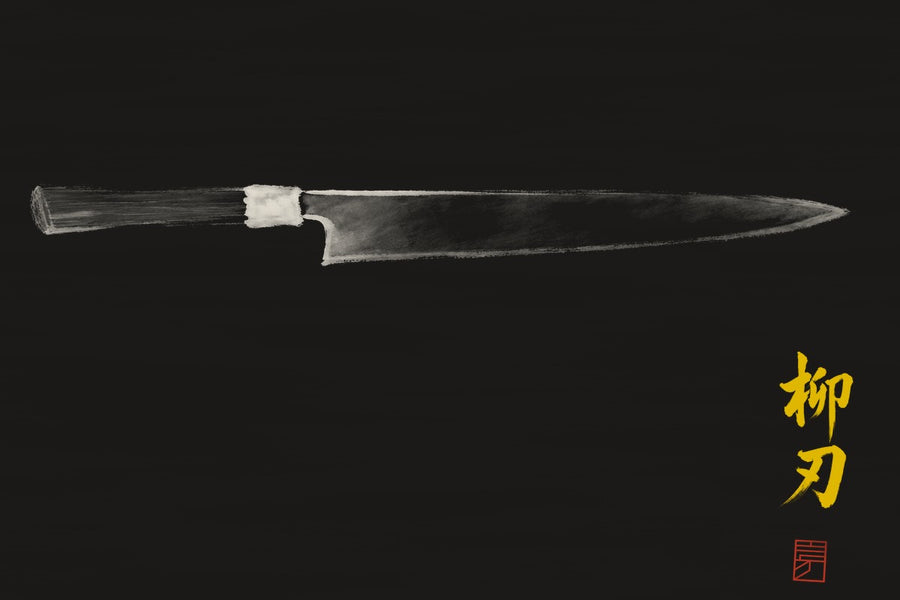
Yanagiba — knife profile
Profile

Yanagiba

柳刃

Sashimi knife · Single bevel

Long single-bevel sashimi slicer with a pointed tip. One clean draw cuts raw fish.

Read more
Steel properties
  1. Hardness Low
  2. Edge retention Low
  3. Toughness Very high
  4. Rust resistance High
  5. Ease of sharpening High
  6. Sharpness Good
Our ratings, inferred from published lab tests and composition.

Our edge-retention grade is a kitchen rating. It weighs the hardness each steel is sold at, which keeps a thin edge from rolling, twice as heavily as lab wear tests, and the final grade is our judgment from selling and sharpening these knives for over a decade. Lab card-cutting tests measure abrasive wear only, so they can rank carbon steels lower. Tap ? for the lab figure.

Steel

AUS-8

AUS-8

Stainless · Aichi

Aichi Steel's AUS series; Fukaumi lists 0.70 to 0.80% carbon, 13 to 14.5% chromium, 59 HRC reference.

Read more
ShinogiStainless steelfully hardenedHollow back
Construction

Monosteel

モノスチール

One steel throughout · stainless

One steel hardened throughout, no cladding. Tough and simple; a little harder to thin.

Read more
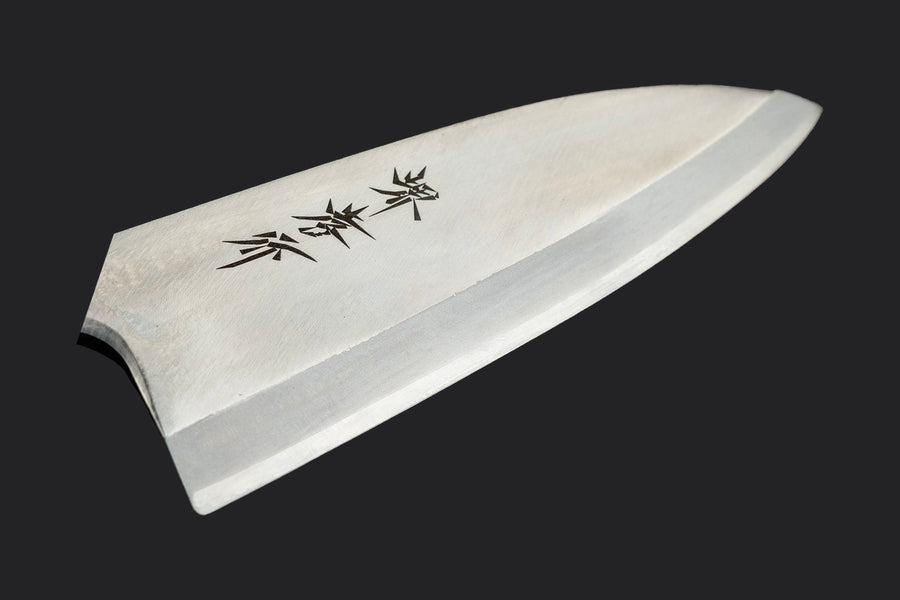
Migaki — blade surface finish
Finish

Migaki

磨き

Polished satin

Smooth polished surface, satin to soft sheen rather than mirror. Scratches show.

Read more
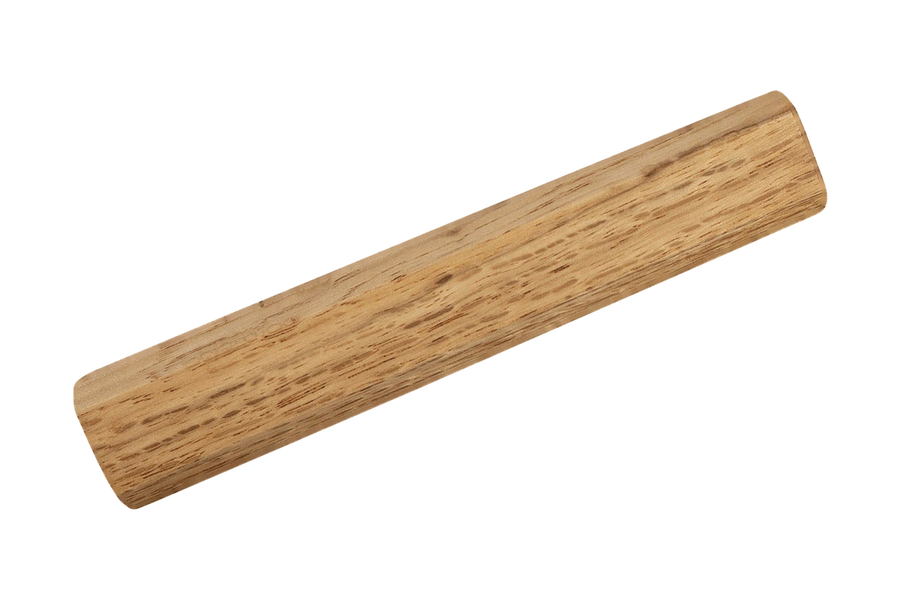
Japanese Kashi Octagonal handle
Handle

Japanese Kashi Octagonal

Octagonal WA

Kashi, Japanese white oak, eight-sided, no ferrule. Hard and stable; may show ray figure.

Frequently asked questions

What is a yanagiba knife used for in sushi preparation?

A yanagiba (柳刃包丁) is a sashimi knife for slicing raw fish. A knife maker's guide says a sashimi knife cuts without breaking the fibres of the flesh, and that it is longer and narrower than other knives because slicing sashimi with crisp edges needs the length.

The whole length goes through one pulling cut. The Sakai cutlery association calls the yanagiba the sashimi knife used mainly in the Kansai region.

What size yanagiba should I buy?

Size a yanagiba to the fish you prepare: a knife maker's guide gives 270 to 360 mm for professional use and 240 to 270 mm for home use, with 270 mm at home if you slice larger fish.

The guide says the whole length goes through one pulling cut, so do not choose too short a knife, and at home it points to the size of your board and your work space. We list the yanagiba (柳刃) from 210 to 360 mm, some made for left-handed use.

Can a yanagiba cut through fish bones?

No. The Sakai cutlery association describes the yanagiba (柳刃包丁) edge as so acute that it cannot be used on hard things such as bones.

For bones the association describes the deba (出刃包丁), whose heel is used to hit them.

Takohiki or yanagiba: what is the difference?

An encyclopedia describes sashimi knives as thin and narrow, calling the pointed ones yanagiba and the unpointed ones takohiki. A sakimaru takohiki is the rounded-tip variant, so it has a rounded point despite its takohiki name.

A trade body, the Sakai cutlery association, calls the takohiki (たこ引き包丁) the Kanto-type sashimi knife, and the yanagiba the sashimi knife used mainly in Kansai, with an acute edge that is not for bone.

Sujihiki or yanagiba: which do I need?

Most home cooks need the sujihiki. Choose the yanagiba when slicing raw fish for sashimi and sushi is the main job and you are prepared to learn single bevel sharpening.

A sujihiki is a long, narrow, double bevel slicer. Tojiro describes it as the knife for dividing large pieces of meat, known abroad as a slicer or carving knife, and says its length lets it cut sashimi as well. It carves roasts, trims sinew and portions fish, works in either hand and sharpens like any double bevel knife. Sujihiki run from about 210 to 300 mm, and 240 mm suits most home boards.

A yanagiba is the single bevel sashimi knife. It is ground on one side with a hollow back, and each slice is one long pull from heel to tip, so raw fish is cut cleanly rather than sawn. The edge is too fine for bones or anything hard. It is made for one hand and most are right handed, so check the listing if you are left handed. Sharpening means working the whole bevel and keeping the back flat. Yanagiba run from about 240 to 330 mm, with 270 and 300 mm the common sizes.

So for roasts, portioning meat and the occasional side of fish, buy a sujihiki. For regular sashimi and sushi work, buy a yanagiba and keep it for fish.

Why is the back of a single-bevel knife hollow, and how do I sharpen it?

The shallow hollow in the back is called urasuki (裏スキ). Tojiro explains that it means the whole back never has to be ground when you sharpen, makes it easier to keep the back flat, and stops sharpening the back from affecting the edge. Only the thin flat rim around the hollow touches the stone.

Sharpen the front bevel first, laying it flat on the stone. Then lay the back completely flat and take a few light strokes, just enough to remove the burr. Never lift the spine to put an angle on the back, and keep the stone itself flat.

Which knife do I need for sushi and sashimi at home?

For occasional sushi at home, a sharp sujihiki (筋引) does the job. Tojiro describes it as a long, double-bevel slicer that can also be used for sashimi, and a double bevel works in either hand.

If sashimi is the point of the meal, choose a yanagiba (柳刃). Tojiro calls it the Kansai-style sashimi knife, now used across Japan, and it slices in one long pull from heel to tip. It is single bevel, so buy the one made for your hand.

If you start from whole fish, add a deba (出刃). Tojiro describes it as very thick and heavy, made for breaking fish down. The deba takes the fish apart and the slicer then cuts the fillets.

Who makes AUS-8?

AUS-8 is made by Aichi Steel, whose page on stainless steels for blades groups the AUS grades with its 13-chromium steels. There, AUS-6M, AUS-8 and AUS-10 are the grades that add still more carbon and add vanadium and molybdenum, which Aichi says further improves hardness, wear resistance and tempering resistance.

By the JSSA's definition, stainless means 10.5% or more chromium, and the JSSA notes that stainless, strictly, means it rusts less, so wash the knife after use and dry it.