Drag to spin · pinch or scroll to zoom

Tsunehisa  |  SKU: TNHS_VG10DA_SU24

Tsunehisa VG10 Damascus Sujihiki 240mm WA handle

Sale price $278.00 Regular price $326.00

Pickup in Australia only

In Stock Now

Availability

Detailed Specifications
Line Tsunehisa VG10 Damascus
Profile Sujihiki / Slicing knife
Bevel Type Double Bevel
Weight 136 g | 4.8 oz
Edge Length 242 mm | 9 17/32″
Heel Height 33 mm | 1 19/64″
Width @ Heel 1.6 mm | 1/16″
Width @ Mid 1.6 mm | 1/16″
Width @ 1cm from Tip 1.0 mm | 3/64″
Steel VG10 | Stainless
Blade Construction Sanmai - Stainless Damascus Clad
Maker's hardening hardness 60 HRC or more
Surface Finish Mirror Polish
Handle Japanese Kashi Octagonal
Region Fukuyama
Best for
  • Household
  • Gift buyers
  • Pro chefs

World-wide shipping via DHL Express, 3 to 6 days (not available in the UK).


The Tsunehisa’s VG10 Damascus line is an excellent beginner choice for those who are switching from western style knives, it offers the features that people long for from a Japanese blade while keeping familiar elements that they have become accustomed to. This line warps these features in a polished and elegant package, offered to you at a competitive price.

The steel used by this line offers a solid foundation to build on, VG10 as a steel that is tested and proven over time, offers balanced edge retention, toughness and full stainlessness. The knife itself shall be categorised as a “Machine Made”, with blades made with pre-laminated steel stamped in batch. This doesn’t seem to match its slightly higher cost than other knives of similar specifications but I would say the level of finish justifies it. Damascus cladding is polished to a near-mirror finish, with sandblasting revealing the contrasting pattern that dances as you move it against a light source. The bolster’s polish is rather refined, and the fitting between it, the tang and handle scales are consistently met together. The maker even has a special sizing for the slimmer sujihiki, which unlike Tojiro and many other makers, is slim, light and elegant. When you pick the red handle version from this line, you might even mistake it as the famous Takamura Uchigumo at a glance. At the same time, Tsunehisa also offers through-tang variant, which allows more freedom for exchanging different handles and adjusting feeling and balance for it.

These blades are constructed rather thin, with a sub-2mm thickness across the spine for most models. This certainly makes them excellent cutters especially on hard and dense foods: carrot, onions, sweet potatoes, you name it, the only criticism I may raise would just be the sticking of thin slices on the blade, but this is hardly a viable solution for a knife this thin and finished in this way. The thin blade is paired with a western handle, and leads to a generally handle-heavy balance across the entire line, this is a balance that long term western knife users are familiar with and able to get used to quickly, but now it is paired with a Japanese edge that cuts much more smoothly.

This is a line designed and built with beauty in mind, although not outstanding in the value compartment, I still think this is something to consider if you are looking for the first Japanese knife to get when switching over from a European one.

Pros Cons
  • Thin behind the edge
  • Excellent fit and finish
  • Easy to look after
  • High budget
Care Instruction
  1. Don't cut hard things! Japanese knives are brittle so bone hacking is a NO NO!
  2. Wash with neutral detergent after use, and wipe dry;
  3. Please don't wash knife with dishwasher, it will damage the wood handle;
  4. Be careful not to leave the knife close to a heat source for a long time;
  5. It is a lot more dangerous to cut with a blunt knife than a sharp knife!
  6. It is best to sharpen a Japanese knife regularly on a waterstone.

Tsunehisa

Tsunehisa, the house brand of Shibata Knives

Tsunehisa (恒久) is the house brand of Shibata Knives, the knife company Takayuki Shibata owns and runs. It is a brand rather than a single workshop.

The name means permanence, and Shibata Knives says it chooses knives that will have a long life. Takayuki Shibata started Tsunehisa in 2015 as his third knife brand, to help manage growing orders.

Read more

Shibata Knives describes Tsunehisa as a brand that inherits traditional Japanese forging techniques while taking in the latest materials and technologies, aiming at function and design for long use. It says its experienced staff inspect each knife under strict quality control, and it offers after-sales maintenance and sharpening.

The lines we list are grouped by steel. Ginsan comes in migaki, nashiji and nawame finishes, as gyuto, santoku, nakiri and petty, with a deba in the same steel. White 1 comes stainless clad as migaki and tsuchime gyuto, Aogami Super as kurouchi tsuchime sujihiki and petty, and Blue 2 as the Samurai sakimaru sujihiki.

The Damascus lines are in VG10, AUS10 and ZA18, the AUS10 also with a tsuchime finish. The rest are AUS8 tsuchime, a VG1 gyuto and an SLD Washiji santoku. Handles come in wa and yo styles.

“The house brand of Shibata Knives; the name means permanence.”

Est. 2015 | 平成27年
Known for Knives chosen and inspected by Shibata Knives
Instagram @tsunehisa Read more about Tsunehisa

Tsunehisa · Fukuyama

Knife details

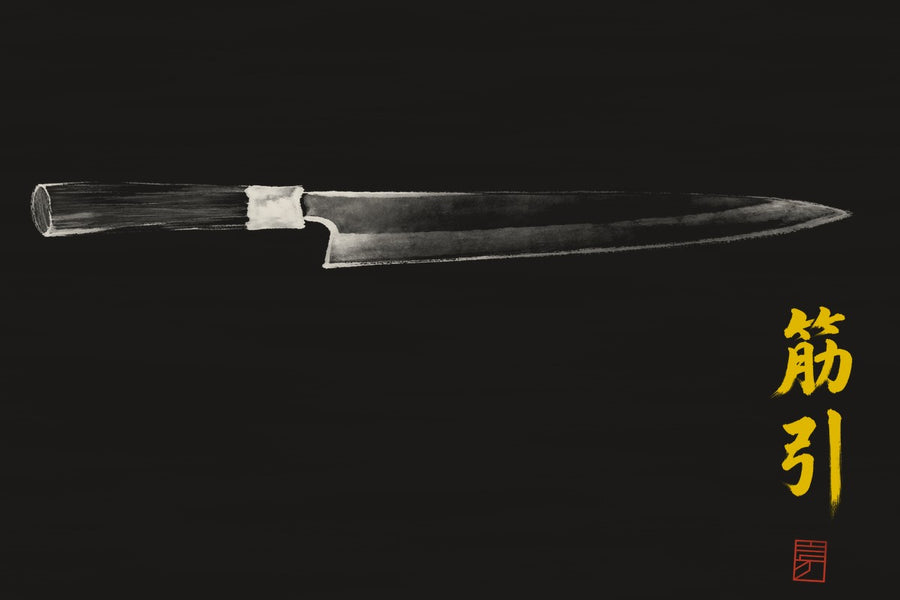
Sujihiki — knife profile
Profile

Sujihiki

筋引

Slicing knife · Double bevel

A long, narrow slicer for dividing large meat; Tojiro says it cuts sashimi too.

Read more
Steel properties
  1. Hardness Good
  2. Edge retention Good
  3. Toughness Good
  4. Rust resistance High
  5. Ease of sharpening Good
  6. Sharpness Good
Our ratings, inferred from published lab tests and composition.

Our edge-retention grade is a kitchen rating. It weighs the hardness each steel is sold at, which keeps a thin edge from rolling, twice as heavily as lab wear tests, and the final grade is our judgment from selling and sharpening these knives for over a decade. Lab card-cutting tests measure abrasive wear only, so they can rank carbon steels lower. Tap ? for the lab figure.

Steel

VG10

V金10

Stainless · Takefu Special Steel

Takefu stainless, 1% carbon, 15% chromium, 1.55% cobalt. Easy to sharpen.

Read more
CladdingCoreClad line
Construction

Sanmai - Stainless Damascus Clad

三枚ダマスカス

3 layers · damascus clad

Hard core between stainless damascus layers, bare at the edge. Thinning wears the pattern.

Read more
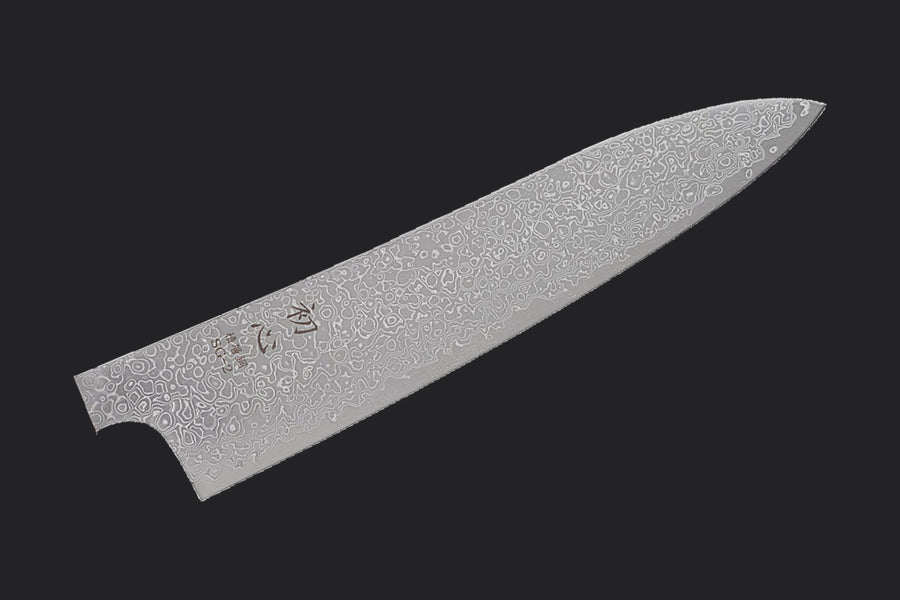
Mirror Polish — blade surface finish
Finish

Mirror Polish

鏡面

Mirror polish

Polished to a true mirror that shows hamon or damascus clearly. Every scratch shows.

Read more
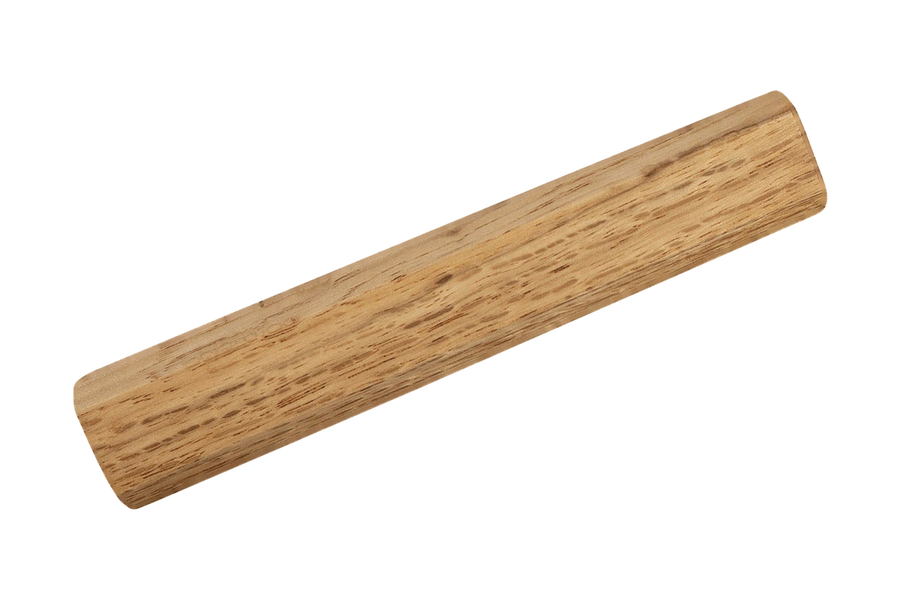
Japanese Kashi Octagonal handle
Handle

Japanese Kashi Octagonal

Octagonal WA

Kashi, Japanese white oak, eight-sided, no ferrule. Hard and stable; may show ray figure.

Frequently asked questions

What size sujihiki should I buy?

Between 210 and 270 mm, depending on where it will work. One Japanese maker lists 210 to 240 mm, double-bevel, for home use and 240 to 270 mm, single- or double-bevel, for professional kitchens.

Another, in Sakai, recommends 240 mm at home, with the size of your board in mind, and 270 mm for professional use.

Sujihiki or yanagiba: which do I need?

Most home cooks need the sujihiki. Choose the yanagiba when slicing raw fish for sashimi and sushi is the main job and you are prepared to learn single bevel sharpening.

A sujihiki is a long, narrow, double bevel slicer. Tojiro describes it as the knife for dividing large pieces of meat, known abroad as a slicer or carving knife, and says its length lets it cut sashimi as well. It carves roasts, trims sinew and portions fish, works in either hand and sharpens like any double bevel knife. Sujihiki run from about 210 to 300 mm, and 240 mm suits most home boards.

A yanagiba is the single bevel sashimi knife. It is ground on one side with a hollow back, and each slice is one long pull from heel to tip, so raw fish is cut cleanly rather than sawn. The edge is too fine for bones or anything hard. It is made for one hand and most are right handed, so check the listing if you are left handed. Sharpening means working the whole bevel and keeping the back flat. Yanagiba run from about 240 to 330 mm, with 270 and 300 mm the common sizes.

So for roasts, portioning meat and the occasional side of fish, buy a sujihiki. For regular sashimi and sushi work, buy a yanagiba and keep it for fish.

Which knife do I need for sushi and sashimi at home?

For occasional sushi at home, a sharp sujihiki (筋引) does the job. Tojiro describes it as a long, double-bevel slicer that can also be used for sashimi, and a double bevel works in either hand.

If sashimi is the point of the meal, choose a yanagiba (柳刃). Tojiro calls it the Kansai-style sashimi knife, now used across Japan, and it slices in one long pull from heel to tip. It is single bevel, so buy the one made for your hand.

If you start from whole fish, add a deba (出刃). Tojiro describes it as very thick and heavy, made for breaking fish down. The deba takes the fish apart and the slicer then cuts the fillets.

Does VG10 rust?

Yes, it can. Takefu, which makes VG10 (V金10), lists it among its stainless steels, and the JSSA notes that stainless strictly means rust-resistant, not rust-proof.

Takefu lists VG10's chromium content as 15% and describes its corrosion resistance as excellent. We recommend drying the knife after washing.

How hard is VG10?

Takefu, the steelmaker behind VG10, gives HRC 60 or more as its hardening hardness, measured straight after quenching. The hardness of a finished knife depends on its maker.

Takefu says the steel's 15% chromium, 1% molybdenum and 1.55% cobalt give it high hardness and a long-lasting edge, and that it is easy to sharpen.

What is the difference between VG10 and SG2?

Both are Takefu blade steels, and they differ in class and in what Takefu publishes about each. Takefu lists VG10 as a stainless steel with 1.00% carbon, 15.00% chromium, 1.00% molybdenum, 0.25% vanadium and 1.55% cobalt, at a hardening hardness of HRC 60 or more.

Takefu describes SG2, its Super Gold 2, as a blade steel created by powder metallurgy, lists its composition as not disclosed, and SG2 runs 61 to 65 HRC depending on the maker. Takefu also calls SG2 a powdered stainless high-speed steel.

Is VG-10 a good steel for a first Japanese knife?

Yes. VG-10 is our default suggestion for a first Japanese knife, because it is stainless and easy to sharpen, and it holds a good working edge through everyday home cooking.

VG-10 is made by Takefu Special Steel, with about 1% carbon, 15% chromium and 1.55% cobalt, and is usually hardened to around 60 HRC. Takefu describes it as corrosion resistant and easy to sharpen. Day to day you rinse it and wipe it dry, with none of the rust watching carbon steel asks for.

It is also a kind steel to learn sharpening on. It takes an edge readily on a basic waterstone, so you can feel when your technique is working. A harder steel such as SG2 holds its edge longer but is less forgiving on the stone, as our VG-10 vs SG2 comparison explains.

Stainless steel can still stain: VG-10 will spot if it is left wet with acidic food on the edge, and it should never go in the dishwasher. Like any hard, thin Japanese edge, it should also stay away from bones, frozen food and glass boards. If your household is rough on knives, the slightly softer AUS-10 is the safer choice.

Steel is only part of the decision. Heat treatment and grind change how the same VG-10 cuts from one maker to the next, so choose the shape and size first. Our first Japanese knife guide walks through that.

What does the name Tsunehisa mean?

Tsunehisa (恒久) means permanence. Shibata Knives describes Tsunehisa as its original brand, and says it selects knives that will have a long life, inspecting each one before delivery. Its own words are that it delivers knives worthy of a permanent position in your home.

The brand is built on traditional Japanese forging techniques with modern materials, and Shibata Knives offers after-sales maintenance and sharpening for the line.