Myojin Riki  |  SKU: MYOJ_B2KTM_PE165

Tetsujin Blue 2 Kasumi Petty 165mm Ebony Handle

Sale price $363.00 Regular price $427.00

IMPORTANT: Carbon steel knives can rust or patina quickly if not cared for properly. They require regular cleaning, drying, and oiling. If you are unfamiliar with carbon steel maintenance, we recommend choosing a stainless steel option instead.

Pickup in Australia only

In Stock Now

Availability

Goes well with

Detailed Specifications
Line Tetsujin Blue 2 Kasumi
Profile Petty / Utility knife
Bevel Type Double Bevel
Weight 85 g | 3.0 oz
Edge Length 156 mm | 6 9/64″
Heel Height 31 mm | 1 7/32″
Width @ Heel 2.4 mm | 3/32″
Width @ Mid 1.9 mm | 5/64″
Width @ 1cm from Tip 0.7 mm | 1/32″
Steel Blue 2 / Aogami #2 | Carbon
Blade Construction Sanmai - Soft Iron Clad
Maker's hardening hardness 60 HRC or more
Surface Finish Kasumi
Handle Octagonal Ebony
Region Tosa
Best for
  • Enthusiasts
  • Pro chefs

World-wide shipping via DHL Express, 3 to 6 days (not available in the UK).


Tetsujin Kasumi is the "budget" version of the well-known Tanryusen line. Utlizing the excellent Hitachi Blue 2 Steel, matched with a less exotic yet equally elegant Kasumi finish.

Same as Tanryusen, this Blue 2 Kasumi line is forged by Toru Tamura (田村 徹) and sharpened by Naohito Myojin (明神 直人).

Pros Cons
  • Excellent performance
  • Thin behind the edge
  • Excellent fit and finish
  • High budget
  • Need extra care
Care Instruction
  1. Don't cut hard things! Japanese knives are brittle so bone hacking is a NO NO!
  2. Wash with neutral detergent after use, and wipe dry;
  3. Please don't wash knife with dishwasher, it will damage the wood handle;
  4. Be careful not to leave the knife close to a heat source for a long time;
  5. It is a lot more dangerous to cut with a blunt knife than a sharp knife!
  6. It is best to sharpen a Japanese knife regularly on a waterstone.
  7. Oil the (carbon) knife if storing for an extended period of time to prevent rust.

Myojin Riki

Myojin Riki Seisakusho, a Tosa knife workshop

The workshop 明神利器製作所, whose knives we list as Myojin Riki, is in Susaki, Kochi. Kochi City's craft page names its second generation as 明神 直人.

Kochi City's page on Tosa crafts describes the workshop as carrying work from forging to finishing in one continuous process. The page says it sharpens a hamaguri-ba (蛤刃) edge, ground convex, a technique the workshop's second generation learned through several years of training in Fukui, and that it also takes sharpening-only orders from outside Kochi Prefecture.

Among the lines we list, the Hatsukokoro x Myojin Shirasagi single-bevel knives cover Blue 2 kurouchi yanagiba, K-tip yanagiba, sakimaru yanagiba and honesuki, White 2 deba, left-handed mioroshi deba, left-handed yanagiba and honesuki, and a Ginsan yanagiba. We also list Myojin Cobalt Special gyuto, santoku and bunka.

“A Tosa workshop in Susaki, Kochi, described by Kochi City's craft page as working from forging through finishing.”

Known for A convex hamaguri-ba edge, as Kochi City's craft page describes
Instagram @tetsujin_labo Read more about Myojin Riki

Myojin Riki · Tosa

Knife details

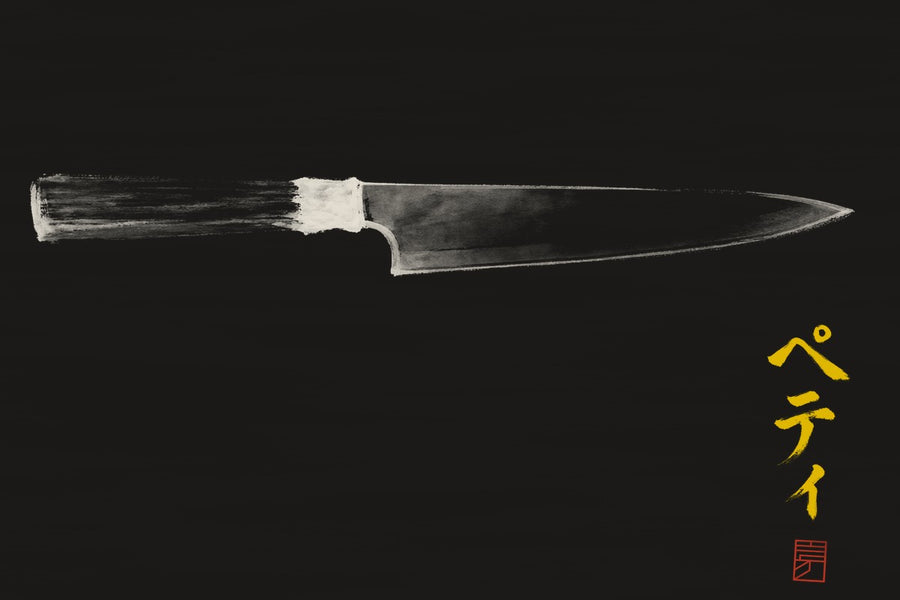
Petty — knife profile
Profile

Petty

ペティ

Utility knife · Double bevel

Small, slim double-bevel utility knife for peeling, trimming and small board jobs.

Read more
Steel properties
  1. Hardness Very good
  2. Edge retention Very good
  3. Toughness Very good
  4. Rust resistance Low
  5. Ease of sharpening High
  6. Sharpness Very high
Our ratings, inferred from published lab tests and composition.

Our edge-retention grade is a kitchen rating. It weighs the hardness each steel is sold at, which keeps a thin edge from rolling, twice as heavily as lab wear tests, and the final grade is our judgment from selling and sharpening these knives for over a decade. Lab card-cutting tests measure abrasive wear only, so they can rank carbon steels lower. Tap ? for the lab figure.

Steel

Blue 2 / Aogami #2

青二鋼

Carbon · Hitachi Metals (now Proterial)

Proterial carbon steel, 1.05 to 1.15% carbon with chromium and tungsten; not stainless.

Read more
CladdingCoreClad line
Construction

Sanmai - Soft Iron Clad

三枚・軟鉄

3 layers · soft iron clad

Hard core between two soft iron layers, bare at the edge. The iron patinas and rusts.

Read more
Kasumi — blade surface finish
Finish

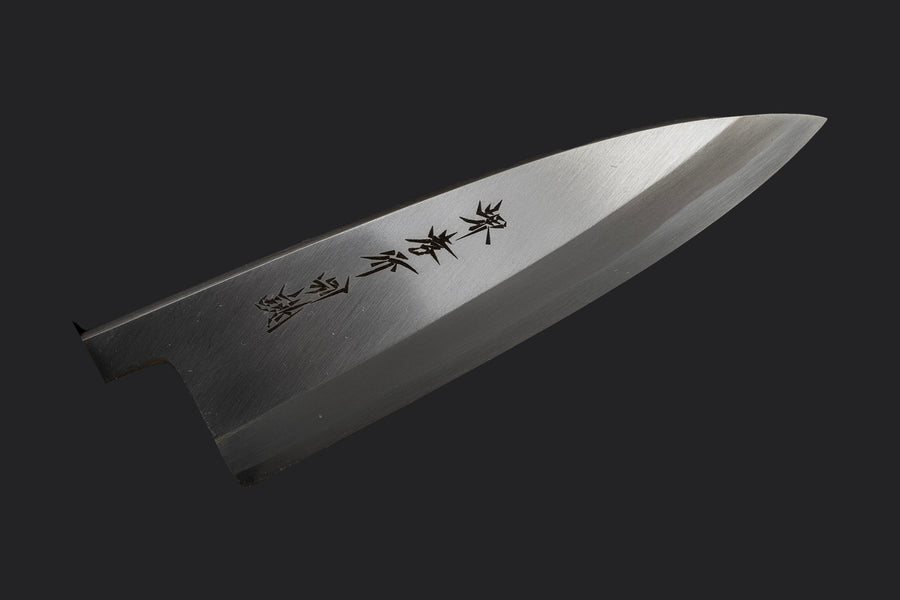
Kasumi

霞

Misty polish

Hazy, matte bevel where soft iron meets hard core steel. The iron patinas and rusts.

Read more
Octagonal Ebony handle
Handle

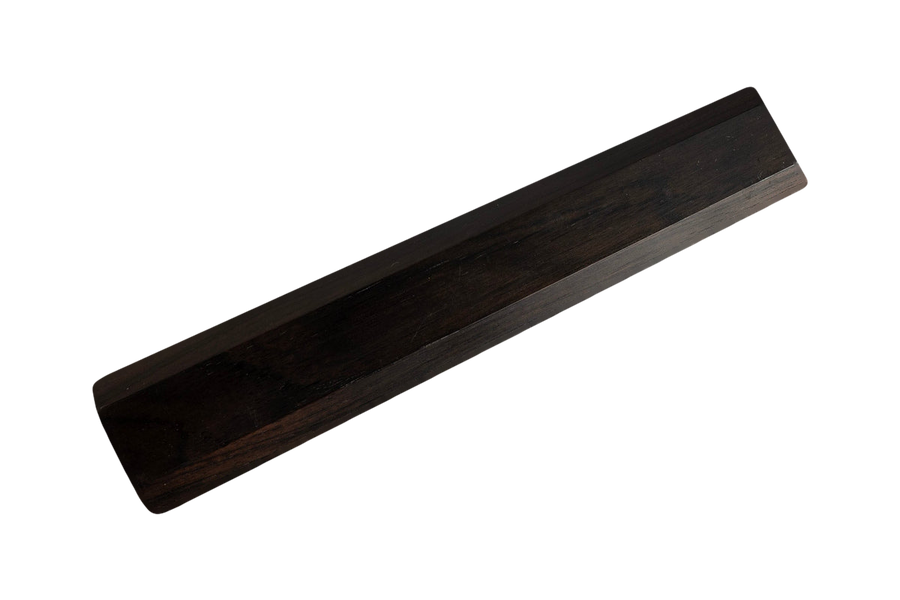
Octagonal Ebony

Octagonal WA

Dense, dark ebony in the eight-sided wa shape. The flats give a sure grip for either hand.

Frequently asked questions

What is a petty knife and when do I need one?

A petty is a small utility knife, from the French petit. It is commonly shaped like a small gyuto and runs from 120 to 150 mm, up to 180 mm. Its clearest role is detailed work where a larger knife feels cumbersome: fruit peeling, garnish work, condiments, and small board work beside a gyuto or santoku.

A knife maker, Tojiro, frames the petty as a useful second knife, not an automatic necessity, and recommends santoku plus petty or gyuto plus petty combinations. It is not a replacement for a full size chef's knife; it lacks the blade length and belly for efficient chopping, rocking, or breaking down larger proteins. Treat it as a precision tool, not an all-rounder.

How long is a petty knife?

Petty knife lengths vary by maker: KAI's guide defines a petty (ペティナイフ) as a small knife with a narrow blade measuring 150 mm or under. Its table gives 90 to 150 mm, and it describes the shape as a smaller gyuto with a pointed tip.

We list petty knives from 70 mm to 165 mm, including lengths above the limit used in KAI's guide.

What is a good second Japanese knife after a gyuto?

For most cooks the second knife after a gyuto is a small utility knife (petty) of about 150mm. If most of your cooking is vegetables, make it a vegetable knife (nakiri) instead; if you carve or slice a lot of meat or fish, a slicing knife (sujihiki).

A gyuto covers the main board work, so the gap it leaves is small work. A petty does the jobs where a full-size blade is clumsy: peeling, trimming and coring in the hand, and small board jobs such as shallots, fruit and herbs. Our petty knife FAQ covers the shape in detail.

A nakiri earns the second slot if you prep vegetables every day. Its flat edge meets the board along its whole length, so slices separate cleanly. It has no pointed tip, so the gyuto still does the tip work.

A sujihiki is the choice for carving roasts and portioning large pieces of meat or fish. The long, narrow blade has less surface touching the food than a gyuto, so slices come away cleaner. 240mm and 270mm are the popular lengths.

A santoku or a bunka is a weak second knife: both are all-purpose shapes that repeat what the gyuto does. If your gyuto already handles the small jobs comfortably, the second knife can wait, and a whetstone to keep the first one sharp is the better spend.

Will a carbon steel knife rust, and how do I look after it?

Yes, carbon steels such as Aogami (Blue) and Shirogami (White) are not stainless steels, so left wet they can spot or rust.

Care is simple once it becomes habit. Wipe the blade as you go, especially after acidic food like citrus, tomato or onion. When you finish, wash it in warm water with a little soap and dry it straight away with a towel. Do not let it air dry, leave it in the sink or the dish rack, or put it in the dishwasher. Store it dry: on a magnetic strip or in a ventilated block in a dry spot.

If the knife will sit unused for a while, wipe on a thin layer of oil before storing. In our video James shows that mineral oil can stand in for camellia (tsubaki) oil, and he picks one labelled medical grade; we list the Kitchen Knife / Cutting Board Mineral Oil Medical Grade for this. If you find light rust, lift it with a rust eraser and a little water, then dry and oil the blade; we list the CKK and Naniwa rust erasers.

What is the difference between Blue 2 and White 2 steel?

Blue 2 is White 2 with tungsten and a little chromium added. Blue 2 holds its edge longer. White 2 sharpens faster and takes a very keen edge. Both are carbon steels that will rust if left wet.

The figures come from Proterial, which makes both. Each has 1.05 to 1.15% carbon. Blue 2 (Aogami 2) adds 1.00 to 1.50% tungsten and 0.20 to 0.50% chromium. White 2 (Shirogami 2) lists neither, and Proterial describes it as a carbon steel with minimum impurities. Proterial says the tungsten and chromium improve heat treatment and wear resistance, and gives a hardening hardness over 60 HRC for both.

In use, the tungsten forms hard carbides that resist wear, so a Blue 2 edge lasts longer between sharpenings. White 2 has none, so it comes back on a whetstone very quickly. The chromium in Blue 2 is far below the 10.5% a steel needs to be stainless, so it gives no real rust protection. Wipe either steel dry after use and expect a patina.

Choose Blue 2 if you want to sharpen less often. Choose White 2 if you enjoy sharpening and want the keenest edge. We list both widely: Blue 2 from Nigara, Myojin Riki and Anryu, and White 2 from Masamoto Sohonten, Sakai Takayuki and Yoshikane.

What is the hamaguri-ba edge on the knives we list as Myojin Riki?

A hamaguri-ba edge, written 蛤刃, is a convex edge shape, and it is the shape the workshop 明神利器製作所 sharpens its knives to. Kochi City's craft page records that the workshop's second generation, whose name the page gives as 直人, learned it over several years of training in Fukui.

The same page says the workshop also takes sharpening-only orders from outside Kochi.

Does Myojin Riki forge its own knives?

Yes. Kochi City's craft page for his workshop 明神利器製作所 says the work runs from forging through finishing in one continuous process, 鍛造から仕上げまで一貫して行う.

That page lists the workshop in Susaki, Kochi.

Are Myojin Riki knives worth it?

We think so, and mostly for the edge. The workshop 明神利器製作所, whose knives we list as Myojin Riki, is in Susaki, Kochi. Kochi City's craft page says it takes its knives from forging to finishing in one process, and that its second generation, 明神 直人, does the sharpening. He learned the hamaguri-ba (蛤刃) edge during several years of training in Fukui.

That page says the edge is ground with a slight roundness toward the cutting edge, neither too thin nor too thick. It says a knife finished this way bites into food well, cuts cleanly and releases food well.

We list Hatsukokoro x Myojin Shirasagi knives in White #2 and Blue #2 steel, including yanagiba, deba and usuba, and Myojin Cobalt Special knives. Stock changes, so check each listing. The Myojin Riki maker page has more on the workshop.