Myojin Riki  |  SKU: MYOJ_G3MGK_NA180_EB

Tetsujin Ginsan Ukiba Nakiri 180mm Ebony Handle

Sale price $478.00 Regular price $562.00

Pickup in Australia only

In Stock Now

Availability

Goes well with

Detailed Specifications
Line Tetsujin Ginsan Ukiba
Profile Nakiri / Japanese vegetable knife
Bevel Type Double Bevel
Weight 183 g | 6.5 oz
Edge Length 170 mm | 6 11/16″
Heel Height 51 mm | 2 1/64″
Width @ Heel 2.6 mm | 7/64″
Width @ Mid 2.1 mm | 5/64″
Width @ 1cm from Tip 1.9 mm | 5/64″
Steel Ginsan / Silver #3 | Stainless
Blade Construction Sanmai - Stainless Clad
Maker's hardening hardness 59 HRC or more
Surface Finish Ukiba
Handle Octagonal Ebony
Region Tosa
Best for
  • Pro chefs
  • First-timers
  • Students

World-wide shipping via DHL Express, 3 to 6 days (not available in the UK).


The Tetsujin Ginsan Ukiba pairs Myojin’s very thin cutting geometry with a level of finishing that rewards a closer look. The appeal is in the refinement: a more highly polished blade surface, a softer cloudy band above the edge, and carefully finished contact points. Behind that restrained appearance is an excellent cutter, with the same geometry and performance that make the Kasumi version so appealing.

Myojin takes the Migaki finish to a higher grit than you commonly find on brushed blades, giving the surface a finer, more polished appearance. The hazy band on the cladding is equally well treated, with a softer texture and less of the grittiness found on more ordinary examples. These surfaces sit beautifully together, while the shiny core steel and the organic cladding line from Toru Tamura’s forging give the eye something to follow. The finish itself is familiar, but the quality of its execution makes this version stand out.

On the board, the very low thickness behind the edge gives the knife excellent entry into food. That thin geometry continues to make a difference as the blade travels deeper into the cut, particularly through dense, firm ingredients where a thicker bevel would demand noticeably more effort. This is where the Tetsujin earns its place as a laser: the cutting feels light and smooth, with little resistance building as more of the blade passes through the food. The attention paid to the grind is just as apparent in use as the finishing is when looking at it.

That geometry also helps the knife remain pleasant to use between sharpenings. Ginsan doesn’t offer the longest edge retention, but the blade continues to move through food with relatively low resistance after the edge has lost some of its initial sharpness. The ease of bringing Ginsan back to a keen edge makes this a reasonable trade-off for someone who values cutting smoothness and is happy to sharpen regularly.

The chamfered, mirror-polished spine and smoothed choil complete the experience, reducing hot spots where your fingers contact the blade. These are small details individually, but together with the fine grind they make the knife feel thoroughly considered.

There is very little practical difference between this and the Kasumi version. The cloudy section contacting the food has essentially the same surface characteristics, and the price is identical. Choosing the Ukiba comes down to preferring that finer Migaki surface and the contrast it creates around the edge, while keeping the cutting performance and finishing quality shared by both.

Pros Cons
  • Budget friendly
  • Excellent performance
  • Easy to look after
  • Non-premium steel
Care Instruction
  1. Don't cut hard things! Japanese knives are brittle so bone hacking is a NO NO!
  2. Wash with neutral detergent after use, and wipe dry;
  3. Please don't wash knife with dishwasher, it will damage the wood handle;
  4. Be careful not to leave the knife close to a heat source for a long time;
  5. It is a lot more dangerous to cut with a blunt knife than a sharp knife!
  6. It is best to sharpen a Japanese knife regularly on a waterstone.

Myojin Riki

Myojin Riki Seisakusho, a Tosa knife workshop

The workshop 明神利器製作所, whose knives we list as Myojin Riki, is in Susaki, Kochi. Kochi City's craft page names its second generation as 明神 直人.

Kochi City's page on Tosa crafts describes the workshop as carrying work from forging to finishing in one continuous process. The page says it sharpens a hamaguri-ba (蛤刃) edge, ground convex, a technique the workshop's second generation learned through several years of training in Fukui, and that it also takes sharpening-only orders from outside Kochi Prefecture.

Among the lines we list, the Hatsukokoro x Myojin Shirasagi single-bevel knives cover Blue 2 kurouchi yanagiba, K-tip yanagiba, sakimaru yanagiba and honesuki, White 2 deba, left-handed mioroshi deba, left-handed yanagiba and honesuki, and a Ginsan yanagiba. We also list Myojin Cobalt Special gyuto, santoku and bunka.

“A Tosa workshop in Susaki, Kochi, described by Kochi City's craft page as working from forging through finishing.”

Known for A convex hamaguri-ba edge, as Kochi City's craft page describes
Instagram @tetsujin_labo Read more about Myojin Riki

Myojin Riki · Tosa

Knife details

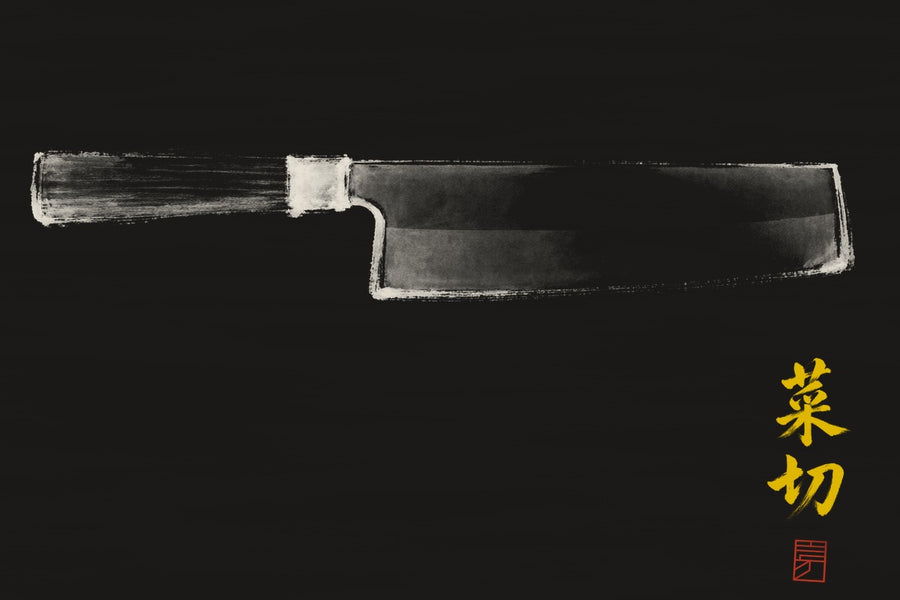
Nakiri — knife profile
Profile

Nakiri

菜切

Japanese vegetable knife · Double bevel

Thin, wide vegetable knife with no point; Tojiro says its straight edge sits flat on the board.

Read more
Steel properties
  1. Hardness Good
  2. Edge retention Good
  3. Toughness Very high
  4. Rust resistance High
  5. Ease of sharpening High
  6. Sharpness High
Our ratings, inferred from published lab tests and composition.

Our edge-retention grade is a kitchen rating. It weighs the hardness each steel is sold at, which keeps a thin edge from rolling, twice as heavily as lab wear tests, and the final grade is our judgment from selling and sharpening these knives for over a decade. Lab card-cutting tests measure abrasive wear only, so they can rank carbon steels lower. Tap ? for the lab figure.

Steel

Ginsan / Silver #3

GIN3

Stainless · Hitachi Metals (now Proterial)

Proterial's GIN 3 stainless: 0.95 to 1.10% carbon, 13.00 to 14.50% chromium, hardening hardness over 59 HRC.

Read more
CladdingCoreClad line
Construction

Sanmai - Stainless Clad

三枚

3 layers · stainless clad

Hard core between two stainless layers, bare only at the edge; the cladding resists rust.

Read more
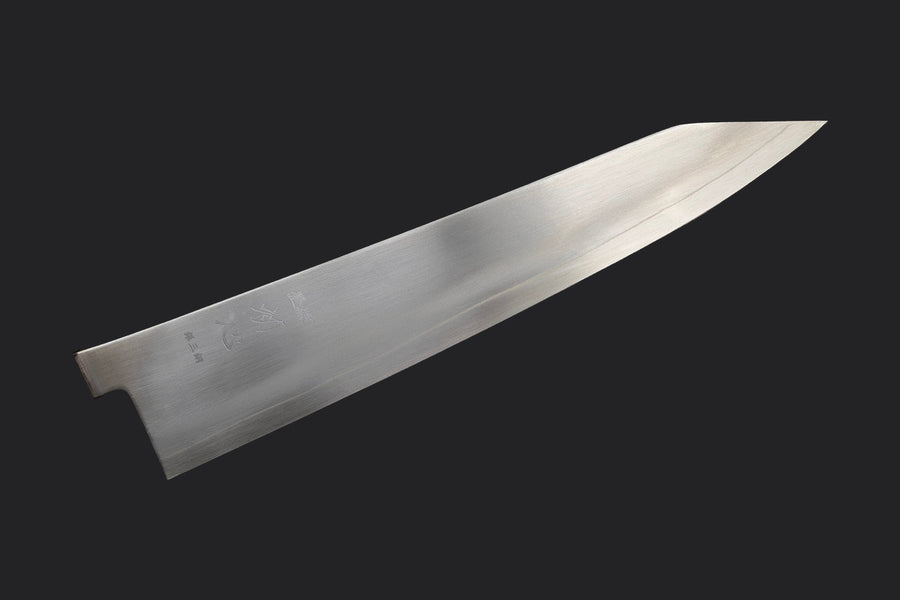
Ukiba — blade surface finish
Finish

Ukiba

Floating-edge finish

Polished core with a sandblasted matt band above the clad line; the edge seems to float.

Read more
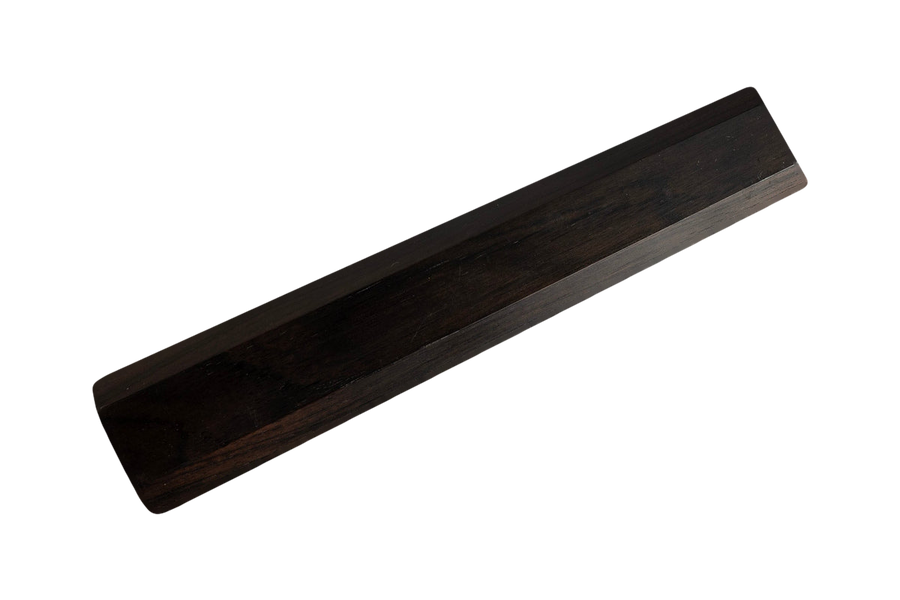
Octagonal Ebony handle
Handle

Octagonal Ebony

Octagonal WA

Dense, dark ebony in the eight-sided wa shape. The flats give a sure grip for either hand.

Frequently asked questions

Why won't my knife cut all the way through? The slices stay joined at the bottom.

Part of the edge never reaches the board, so the cut never finishes. At our counter we put it simply: there is not enough flat at the heel. A knife with a long curve is built for rock chopping, not for the Chinese or Eastern up-and-down chop.

A straight edge, like a nakiri's, meets the board along its whole length and finishes the cut. On any knife, a dip worn near the heel or a dull section can cause the same thing.

Nakiri or usuba: what is the difference?

The bevel. A Japanese dictionary describes the nakiri (菜切包丁) as shaped like an usuba but double-bevel and relatively easy to handle; the Sakai cutlery association describes the usuba (薄刃包丁) as an acute, wide knife for vegetables, in a square Kanto type and a kamagata Kansai type.

The names overlap, since another dictionary records the usuba as also called nakiri, so check the bevel rather than the name.

Bunka, nakiri or usuba: which knife is best for vegetables?

For everyday vegetable prep, a nakiri (菜切) is the simple choice. Tojiro describes it as Japan's own vegetable knife: a square, double-bevel blade, so it cuts the same way in either hand.

A bunka (文化) is a home knife that Tojiro describes as combining the good points of the nakiri and the gyuto. Choose it if you want one knife for vegetables plus meat and fish, with an angled tip.

An usuba (薄刃) is a knife made for vegetable preparation in Japanese cooking. It is single bevel, so it is made for one hand, and Tojiro lists its jobs as peeling and hollowing at the heel, and katsuramuki, fine garnish cuts and rounding off cut edges along the middle of the edge. Choose it if you want to learn those techniques.

What is Ginsan steel, and why do some Japanese knives use it?

Ginsan, also known as Silver 3, is a stainless steel from Proterial, the Yasugi Specialty Steel division. Proterial describes it as a stainless steel which has hardness and sharpness comparable to carbon steel, and lists its uses as kitchen knives and scissors.

Knife makers use it when they want the corrosion resistance of a stainless together with the hardness and sharpness that Proterial compares to carbon steel. The steel maker lists 59 HRC or over after hardening, but that is a heat treatment figure, not a finished knife figure.

Dry it after use, like any stainless knife. Its performance depends on the heat treatment and construction of the specific knife, not the steel name alone.

Is Ginsan stainless?

Yes. Proterial lists the steel as GIN 3 with 13.00 to 14.50% chromium, above the Japan Stainless Steel Association's 10.5% minimum for stainless steel.

Proterial describes it as a stainless steel with hardness and sharpness comparable to carbon steel, used in various kitchen knives and scissors, and the association notes that stainless, strictly, means it rusts less. Wash the knife and dry it after use.

What is the Tetsujin Ginsan Ukiba knife line, and who is it for?

Tetsujin Ginsan Ukiba combines Toru Tamura's forging with Naohito Myojin's sharpening. It has a stainless-clad sanmai blade and an Ukiba finish. We recommend it for cooks who value fine geometry and careful finishing and are happy to sharpen a little more often.

What is the hamaguri-ba edge on the knives we list as Myojin Riki?

A hamaguri-ba edge, written 蛤刃, is a convex edge shape, and it is the shape the workshop 明神利器製作所 sharpens its knives to. Kochi City's craft page records that the workshop's second generation, whose name the page gives as 直人, learned it over several years of training in Fukui.

The same page says the workshop also takes sharpening-only orders from outside Kochi.

Does Myojin Riki forge its own knives?

Yes. Kochi City's craft page for his workshop 明神利器製作所 says the work runs from forging through finishing in one continuous process, 鍛造から仕上げまで一貫して行う.

That page lists the workshop in Susaki, Kochi.